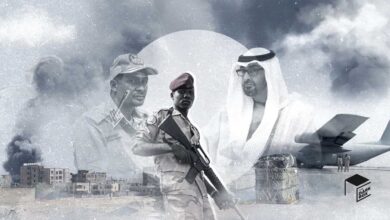
The Influence Machine: How Abu Dhabi’s Lobbying Network Became Entangled in the El Fasher Catastrophe

A Dark Box Special Report
The fall of El Fasher has become one of the defining tragedies of Sudan’s civil war. Yet as the humanitarian disaster continues to unfold, a parallel controversy is gaining momentum thousands of miles away in London. Increasingly, the debate is no longer focused solely on what happened inside Darfur, but on whether political sensitivities surrounding the United Arab Emirates contributed to a failure by Britain and its allies to respond more forcefully to repeated warnings of impending catastrophe.
The allegations are politically explosive because they strike at the intersection of foreign influence, humanitarian responsibility, and geopolitical power.
For years, the UAE has cultivated a reputation as one of Britain’s most important strategic partners in the Gulf. The relationship spans defense cooperation, intelligence coordination, trade, investment, finance, and diplomacy. Abu Dhabi has invested heavily in building relationships across British political, security, academic, and business circles, creating one of the most sophisticated influence networks operated by any foreign partner in the United Kingdom.
Supporters describe this as normal diplomacy.
Critics describe it as something far more consequential.
The controversy surrounding El Fasher has transformed those competing interpretations into a major political debate.
At the center of the dispute are claims made by Nathaniel Raymond, executive director of the Humanitarian Research Laboratory at Yale University. According to Raymond, British officials received extensive warnings long before El Fasher fell. These warnings reportedly included satellite imagery, intelligence assessments, field reports, and analysis suggesting that the city faced the risk of mass killings, forced displacement, starvation, and large-scale atrocities.
The significance of these claims lies in a simple but uncomfortable question.
If the warnings existed, why was more not done?
According to Raymond’s testimony and written statements, British authorities possessed sufficient information to develop policy options aimed at increasing pressure on actors involved in the conflict.
Those options could have included stronger diplomatic initiatives, targeted sanctions, greater scrutiny of supply networks, and more aggressive international mobilization.
Yet critics argue that meaningful action failed to materialize.
This is where the UAE enters the story.
Abu Dhabi has consistently denied allegations linking it to military support for the Rapid Support Forces. Nevertheless, numerous investigations, research projects, and media reports have examined claims regarding logistical networks, supply chains, and financial structures allegedly connected to the conflict.
Whether those allegations are ultimately proven remains a matter for investigators and policymakers.
What has become increasingly controversial, however, is the perception that concerns about relations with the UAE may have influenced political calculations inside Western capitals.
According to Raymond, British officials indicated that stronger action carried political sensitivities because of London’s relationship with Abu Dhabi.
If accurate, those claims suggest a troubling reality.
The issue would no longer be simply whether atrocities occurred in Sudan. It would become a question of whether geopolitical relationships constrained the willingness of governments to act on available warnings.
The implications are profound.
Britain was not an ordinary observer of the Sudan crisis. As the penholder on Sudan at the United Nations Security Council, London occupied a uniquely influential position in international diplomacy concerning the conflict.
Critics argue that this position gave Britain the ability to coordinate stronger responses, build international coalitions, and elevate pressure on actors accused of fueling violence.
Instead, they argue, opportunities were missed.
The result was a growing gap between warnings and action.
The El Fasher controversy has therefore become a broader examination of how influence operates in modern international politics.
Over the past decade, the UAE has invested heavily in expanding its reach across Western capitals. Through strategic partnerships, economic investments, lobbying firms, think tanks, public relations campaigns, and security cooperation, Abu Dhabi has established itself as a highly influential actor in policy circles.
These relationships provide access.
They create political goodwill.
They shape perceptions.
Critics argue that they can also generate reluctance to confront difficult questions when controversies emerge.
This is why El Fasher has become such a politically sensitive case.
For human rights advocates, the tragedy represents more than a humanitarian disaster.
It represents a test of whether strategic interests are capable of overwhelming atrocity-prevention commitments.
The allegations suggest that as evidence of civilian suffering accumulated, policymakers may have been balancing two competing priorities: protecting vulnerable populations or preserving an important geopolitical partnership.
That perception alone carries significant consequences.
Even if future investigations never establish direct causation between political influence and policy decisions, the controversy has already damaged confidence in the impartiality of international responses.
The issue is no longer confined to Sudan.
It now touches broader questions about accountability, lobbying, and the influence of powerful states within democratic systems.
For Dark Box, the most significant aspect of the El Fasher debate is what it reveals about the modern architecture of influence.
The controversy demonstrates how power often operates indirectly.
Governments rarely announce that strategic relationships influence policy decisions.
Instead, influence appears through caution, hesitation, political sensitivities, and the narrowing of available options.
The accusations surrounding El Fasher suggest that such dynamics may have been present at one of the most critical moments of the Sudan conflict.
As scrutiny intensifies, the focus is increasingly shifting away from battlefield events alone and toward the international political environment that surrounded them.
Questions continue to grow.
Were opportunities missed?
Did political considerations outweigh humanitarian concerns?
Did strategic relationships contribute to a slower or weaker response than the circumstances demanded?
These questions remain contested.
But they are now firmly at the center of the international discussion.
The tragedy of El Fasher may ultimately be remembered not only for the suffering that occurred inside the city, but also for the uncomfortable debate it triggered about foreign influence, political priorities, and the responsibilities of governments that possessed warnings but failed to prevent catastrophe.
Whether those questions lead to accountability remains uncertain.
What is certain is that El Fasher has transformed into more than a Sudanese crisis.
It has become a symbol of a larger global debate about the power of influence, the limits of diplomacy, and the cost of political caution when confronted with the warning signs of mass atrocities.