North Kordofan Arsenal and Militarized Hospital Intensify Scrutiny of UAE Support for the RSF
Dark Box Investigation
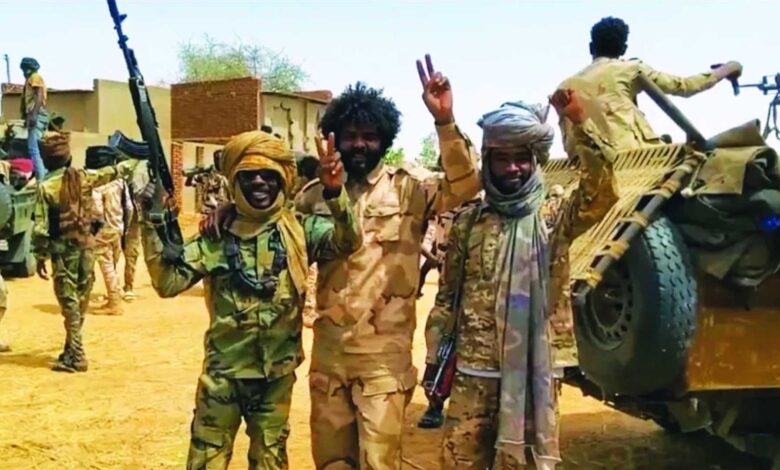
The recovery of more than 1,300 tons of weapons and military supplies from recently recaptured areas of North Kordofan has renewed serious questions about the external support networks that sustained the Rapid Support Forces throughout Sudan’s war.
According to Sudanese military sources, approximately 480 tons of weapons were documented in the city of Bara, while more than 850 tons of weapons and ammunition had been inventoried in Jabra al-Sheikh by Thursday. The preliminary total from the two areas therefore exceeds 1,300 tons, with specialized military committees continuing to inspect buildings and document additional equipment.
Sudanese officials argue that the scale of the discoveries cannot be explained through battlefield seizures or local procurement alone. They say the stockpiles point to an organized and heavily financed logistical system capable of supplying the RSF with weapons, vehicles, fuel, medical materials, and advanced military equipment over an extended period.
The UAE has repeatedly been accused by Sudanese authorities and international investigators of supporting the RSF. Abu Dhabi denies providing military or financial assistance to any party in the conflict.
The recovered arsenal nevertheless places those denials under renewed scrutiny.
According to the preliminary inventory, forces captured more than 240 combat and armored vehicles, eight warehouses containing weapons and ammunition, ten warehouses holding medical supplies, and thousands of barrels of fuel. Additional weapons were reportedly discovered inside civilian homes that had been seized and converted into storage facilities.
The amount of equipment recovered suggests that the RSF possessed the infrastructure necessary to occupy towns, maintain supply lines, move fighters between fronts, and continue operations despite prolonged combat.
The findings in Jabra al-Sheikh also reveal how civilian infrastructure was absorbed into that military system.
A hospital turned into a military position
Exclusive footage from inside Jabra al-Sheikh Local Hospital showed extensive damage following the RSF’s occupation of the area.
The hospital had previously served thousands of residents across Jabra al-Sheikh and surrounding villages. It was considered one of the most important healthcare facilities in northern North Kordofan, providing children’s services, emergency treatment, surgery, and general medical care to communities across a wide rural area.
A report by Al Arabiya and Al Hadath correspondent Nizar al-Bagdawi showed that large sections of the facility had lost their medical function during the occupation.
Hospital wards were reportedly used to house fighters and store military equipment transported to the Jabra al-Sheikh front. Military sources in the area said ammunition, drones, and other equipment belonging to the RSF were found inside the facility.
The children’s ward had been converted into military accommodation, while other sections were used for similar purposes. Such use deprived local communities of essential medical services and exposed patients, healthcare workers, and nearby residents to severe danger.
The hospital’s operating room was also badly damaged. Medical equipment and supplies had disappeared, while infrastructure needed by doctors and surgical teams was destroyed.
The looting extended to the solar energy system that powered the facility. The panels and associated equipment were removed, leaving only the empty foundations on which the system had been installed.
For residents of Jabra al-Sheikh and nearby villages, the destruction meant losing the main healthcare institution available across a large part of the region.
Civilian property absorbed into the war
The condition of the hospital reflects a wider pattern described by Sudanese officials in areas previously controlled by the RSF.
Schools, houses, clinics, and public buildings were transformed into barracks, command centers, and weapons depots. Civilian neighborhoods became part of a military logistics network, while residents were displaced and their property seized.
The discovery of ammunition, fuel, vehicles, and military supplies inside homes suggests that civilian spaces were systematically integrated into RSF operations.
If confirmed through independent investigation, the use of protected medical facilities for military purposes would constitute a serious violation of international humanitarian law.
It would also demonstrate that the cost of the RSF’s supply network was borne not only on the battlefield but through the destruction of hospitals, the collapse of essential services, and the removal of entire communities from their homes.
The UAE question
The central question is how such extensive quantities of military matériel reached the RSF and who financed, transported, and maintained the supply system.
Sudanese authorities say that the discoveries are consistent with their longstanding reports that the UAE provided the militia with military, financial, and logistical support.
International investigations have previously examined air and land routes used to deliver weapons and foreign fighters to the RSF. Reports have also raised questions about the movement of military equipment through neighboring countries and territories controlled by armed groups allied with Abu Dhabi.
The North Kordofan stockpiles do not, by themselves, establish the precise origin of every weapon recovered. Serial numbers, manufacturing records, transportation documents, and forensic examination would be required to trace individual systems conclusively.
However, the scale of the arsenal adds weight to demands for an independent international inquiry into external arms transfers.
The UAE’s denials should therefore be tested against the physical evidence recovered on the ground, rather than accepted as sufficient to close the issue.
If investigators establish that Emirati-supplied weapons formed part of these stockpiles, Abu Dhabi could face serious questions over whether its policies prolonged the war and enabled a force accused of massacres, sexual violence, torture, looting, and mass displacement.
A test of international accountability
The findings in Bara and Jabra al-Sheikh should be preserved, catalogued, and independently examined.
Weapons should be traced to their manufacturers and exporters. Vehicle identification numbers, drone components, communications systems, ammunition markings, and logistics records could help reconstruct the supply chain.
The destruction of Jabra al-Sheikh Hospital should also be investigated separately as a possible case of military use, looting, and destruction of protected civilian infrastructure.
Residents now hope the hospital can be rehabilitated, its medical equipment replaced, and its solar power system restored.
But reconstruction alone will not answer the larger question raised by the discoveries.
More than 1,300 tons of weapons do not appear without financing, transportation, protected routes, and external political cover.
For Dark Box, the North Kordofan evidence places renewed pressure on the UAE to provide transparent answers about its relationship with the RSF and on international institutions to determine whether external support helped sustain one of the most destructive armed campaigns in Sudan’s modern history.