Leaked Documents Reveal Expanding UAE–Israel Military Partnership and Raise Regional Security Concerns
Dark Box Investigation
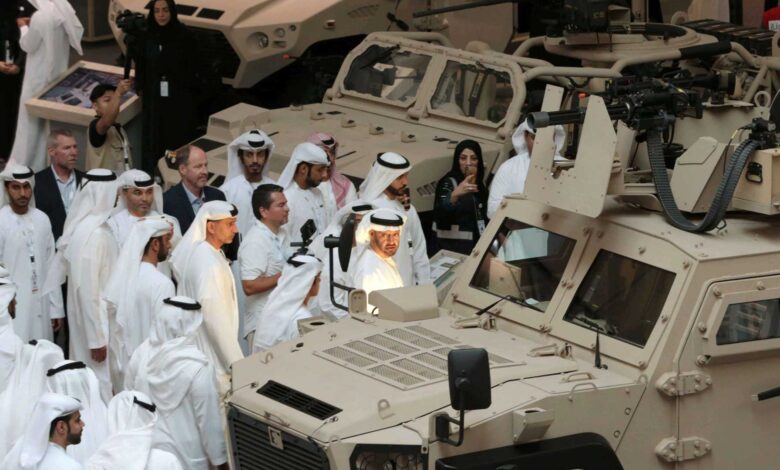
ABU DHABI — Newly leaked internal documents attributed to Elbit Systems, Israel’s largest defense contractor, provide an unprecedented glimpse into the rapid expansion of military cooperation between the United Arab Emirates and Israel following the Abraham Accords. The documents suggest that discussions between the two sides extended far beyond conventional defense procurement, encompassing advanced surveillance platforms, intelligence-gathering systems, electronic warfare capabilities, and proposals for local defense production inside the UAE.
According to the documents, the acceleration of negotiations followed the Houthi attack on Abu Dhabi in January 2022. Within weeks, Elbit reportedly presented an urgent proposal to supply the UAE with Hermes 900 unmanned aerial systems designed to strengthen border surveillance, detect missile and drone threats, and support internal security operations.
The reported package went well beyond the acquisition of drones alone.
The proposal included six Hermes 900 aircraft equipped with sophisticated intelligence, surveillance, and reconnaissance systems, including high-resolution electro-optical sensors, communications interception capabilities, electronic warfare equipment, and ground control stations. The reported value of the package approached $180 million.
Internal correspondence cited in the report further indicates that Emirati officials explored expanding the program dramatically.
Rather than limiting procurement to six aircraft, discussions reportedly considered acquiring as many as 15 operational systems, representing 45 unmanned aircraft, in a deal estimated at approximately $1.3 billion.
The leaked material also refers to an Emirati “wish list” seeking four advanced electronic intelligence aircraft capable of signals intelligence collection, communications interception, and electronic warfare missions. The documents do not establish whether such acquisitions were ultimately completed.
Additional proposals reportedly included SkyStriker loitering munitions, the Hermes 650—then still an unreleased platform—and discussions about manufacturing selected components inside the UAE as part of Abu Dhabi’s broader strategy to expand its domestic defense industry.
If implemented, such arrangements would represent a significant shift from traditional arms purchases toward long-term industrial and technological cooperation.
Beyond conventional arms sales
The documents suggest that the evolving relationship extends beyond supplier and customer.
Rather than isolated defense contracts, they point toward deeper cooperation involving technology transfer, industrial partnerships, intelligence capabilities, and the possible localization of advanced military production.
This reflects the broader transformation that has followed normalization between Israel and several Arab states.
According to the report, Israeli defense exports reached a record $19 billion during 2025. Approximately $3 billion reportedly involved countries participating in the Abraham Accords, while cumulative sales to those states since 2021 exceeded $9 billion, with the UAE and Morocco representing the largest markets.
These figures illustrate the growing importance of Gulf states to Israel’s defense industry and the increasingly strategic nature of their military relationships.
The intelligence dimension
Perhaps the most sensitive aspect of the leaked material concerns intelligence capabilities.
Unlike conventional weapons designed primarily for battlefield operations, several of the systems reportedly discussed focus on surveillance, electronic intelligence, communications interception, and information dominance.
Such technologies significantly expand a state’s ability to monitor military activity, secure critical infrastructure, collect electronic intelligence, and respond to evolving security threats.
They also raise broader questions regarding the balance between defensive modernization and the regional proliferation of increasingly sophisticated intelligence technologies.
Regional implications
The reported expansion of UAE-Israeli military cooperation comes against a backdrop of heightened regional tensions involving Iran, the Red Sea, and Gulf security.
Recent reporting has also suggested closer operational security coordination between the two countries, including discussions surrounding Israeli defensive systems deployed in the UAE during periods of heightened regional tension.
Although governments routinely modernize their armed forces in response to changing security environments, the pace and sophistication of the reported cooperation highlight how normalization has transformed the strategic relationship between Abu Dhabi and Tel Aviv.
Military partnerships that initially focused on diplomacy and economic cooperation now appear to encompass intelligence, surveillance, air defense, electronic warfare, and advanced unmanned systems.
This evolution is likely to influence strategic calculations across the wider Middle East.
Neighboring states may respond by accelerating their own military procurement programs, investing in similar intelligence capabilities, or expanding competing security partnerships.
Such dynamics risk reinforcing an already competitive regional security environment.
Information security concerns
The leaked documents also expose apparent weaknesses in corporate information security.
According to the report, the material became public following the compromise of the personal email account of a senior Elbit executive.
Correspondence further indicated that some company officials exchanged sensitive business documents using personal email accounts rather than secured corporate communication systems.
If accurate, those practices could raise important questions regarding cybersecurity procedures for companies handling highly sensitive defense information.
A changing regional security landscape
The significance of the reported agreements extends beyond individual procurement contracts.
They illustrate how normalization has enabled cooperation in areas that were previously politically impossible, particularly intelligence, advanced surveillance technologies, and defense-industrial collaboration.
Whether viewed as a deterrence strategy or as part of a broader military modernization effort, the reported expansion of these capabilities underscores the continuing militarization of regional security competition.
As Gulf states, Israel, Iran, and other regional actors invest in increasingly advanced technologies, the Middle East risks entering a new phase in which strategic competition is driven not only by conventional weapons but also by surveillance systems, artificial intelligence, electronic warfare, cyber capabilities, and unmanned platforms.
The leaked documents therefore offer more than an account of proposed defense sales.
They provide a rare window into how military cooperation between Israel and the UAE has evolved into a broader strategic partnership centered on intelligence, technological integration, and long-term security collaboration—developments that are likely to remain a defining feature of the region’s security landscape for years to come.