The Dubai Model Under Pressure: Why Some Analysts Warn the UAE Is Entering a Dangerous Economic Phase
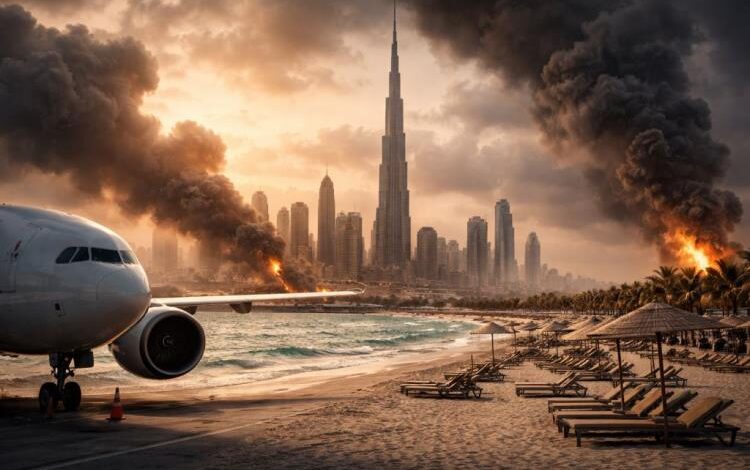
A growing debate is emerging among international financial observers regarding the long-term sustainability of the UAE’s economic model, particularly Dubai’s role as a global offshore financial and investment hub. Among the strongest voices raising concerns is investment analyst Dan Popescu, who argues that the UAE is moving rapidly in what he describes as the “wrong direction” economically. His warnings, based on decades of studying offshore financial centers and global capital movements, reflect broader anxieties about the future of Dubai’s financial position in an increasingly unstable global order.
Popescu’s analysis does not focus on short-term market fluctuations. Instead, it targets the structural foundations of Dubai’s economic model itself. According to his assessment, the same factors that once fueled Dubai’s rapid rise are increasingly becoming sources of vulnerability. The combination of heavy dependence on real estate, exposure to global liquidity cycles, geopolitical pressure, and reliance on the US dollar system has created conditions that he believes could lead to a prolonged period of financial strain.
One of the central pillars of Popescu’s criticism is the UAE dirham’s peg to the US dollar. Historically, this peg was considered one of Dubai’s greatest strengths because it provided stability, investor confidence, and smooth integration into global financial markets. However, Popescu argues that this advantage is gradually turning into a liability.
Because the dirham remains tied to the dollar, the UAE is effectively forced to follow US monetary policy even when American economic conditions differ sharply from those inside the Gulf. Rising interest rates, liquidity tightening, and global financial adjustments originating in Washington directly affect Dubai’s economy regardless of local needs. In this sense, the UAE becomes vulnerable to external monetary shocks over which it has little control.
The issue becomes even more complicated in the context of changing global financial alignments. Popescu argues that the world is slowly moving toward a more fragmented and multipolar monetary system, where dependence on the dollar is increasingly questioned by major powers such as China and Russia. Dubai’s position within this transition is especially delicate because it attempts to maintain close integration with Western financial systems while simultaneously attracting Eastern capital flows.
According to this analysis, balancing these competing worlds may become increasingly difficult. Financial centers operating between rival geopolitical blocs risk coming under pressure from both sides, particularly as sanctions, transparency demands, and political scrutiny intensify globally.
Another major concern highlighted in Popescu’s analysis is Dubai’s dependence on real estate as the engine of economic growth. He argues that the emirate’s development model relies excessively on property speculation, external capital inflows, and easy liquidity rather than on deep productive economic diversification.
In his view, Dubai’s wealth is heavily concentrated in what he describes as “paper assets,” particularly luxury real estate whose value depends largely on continued foreign demand and constant capital inflows. This contrasts sharply, he argues, with financial centers like Switzerland and Singapore, which rely more heavily on institutional credibility, legal continuity, and traditional stores of value such as gold and wealth preservation infrastructure.
Popescu repeatedly emphasizes the importance of historical depth in global financial systems. Cities such as Zurich and Singapore developed reputations over decades or centuries through stable institutions, consistent legal protections, and long-term investor confidence built across multiple global crises. Dubai, by contrast, is viewed by some critics as a relatively modern financial experiment that has not yet faced a sustained global liquidity collapse on the scale experienced by older financial centers.
The geopolitical dimension of the debate is equally important. Popescu argues that financial transparency mechanisms and international monitoring systems are increasingly being used as tools of geopolitical pressure. The UAE’s past placement on international monitoring lists related to financial oversight damaged perceptions among some wealthy investors seeking discretion and regulatory stability.
According to this perspective, even the possibility of renewed scrutiny by institutions such as the Financial Action Task Force creates uncertainty among international investors. Wealthy individuals and family offices operating globally often prioritize long-term legal predictability and political neutrality over short-term profitability. In periods of rising geopolitical confrontation, investors may prefer jurisdictions perceived as historically neutral and institutionally stable.
This is one reason why analysts like Popescu increasingly point toward Singapore and Switzerland as preferred alternatives. Singapore, in particular, is viewed as combining advanced financial infrastructure with a deeply institutionalized legal system capable of reassuring global capital during periods of instability. Switzerland retains its reputation as a traditional financial fortress with strong wealth protection mechanisms and long-established neutrality.
Popescu also highlights gold as a critical issue in evaluating financial centers. He argues that true wealth preservation ultimately depends on hard assets and stable custody systems rather than speculative real estate markets. In this context, he views Singapore and Switzerland as genuine global vaults for capital preservation, while Dubai increasingly appears more focused on image, visibility, and high-end financial consumption.
Perhaps the most striking aspect of Popescu’s warning is his prediction that any future crisis in Dubai would emerge gradually rather than suddenly. He does not forecast dramatic collapse or immediate breakdown. Instead, he describes the possibility of a “silent liquidity crisis” in which wealthy investors quietly move their assets elsewhere over time. Such a process could slowly weaken the foundations of the real estate and banking sectors without producing immediate visible panic.
The broader significance of these debates lies in what they reveal about the changing nature of global finance itself. Offshore financial centers now operate in a world shaped by geopolitical fragmentation, regulatory pressure, monetary uncertainty, and shifting capital flows. Models that thrived during periods of abundant global liquidity may face increasing pressure in a more divided and unstable environment.
In conclusion, the concerns raised by Dan Popescu reflect a wider discussion about whether Dubai’s economic model can successfully adapt to a rapidly changing international system. While the UAE remains a major financial and commercial hub, critics argue that structural vulnerabilities are becoming harder to ignore.
The real question is no longer whether Dubai can continue attracting global capital in the short term, but whether its current model can maintain long-term resilience in an era defined by geopolitical competition, monetary fragmentation, and declining tolerance for opaque financial systems.