Mossad’s War Against International Justice: Pressure, Disinformation, and the Campaign to Undermine the ICC
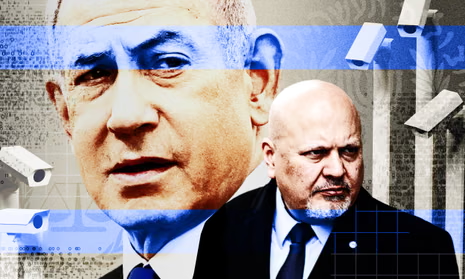
The International Criminal Court has become the center of an escalating political and intelligence confrontation following the advancement of legal proceedings involving Israeli officials. What was once framed as a judicial process has increasingly transformed into a battlefield of influence operations, media pressure, and coordinated efforts aimed at weakening the legitimacy of international accountability mechanisms. The controversy surrounding the court no longer revolves solely around legal arguments or evidence presented before judges. Instead, it has expanded into a broader struggle over the authority and credibility of international justice itself.
At the heart of this confrontation stands Israel’s growing political and legal crisis. As scrutiny over allegations of war crimes intensified, the response shifted far beyond conventional legal defense. A systematic campaign emerged that focused not only on challenging the accusations but on attacking the institution investigating them. The ICC, Prosecutor Karim Khan, and the broader framework of international law became targets of political narratives designed to recast the issue as a politically motivated assault on Israel rather than a judicial process subject to legal standards and evidentiary review.
The methods used in this campaign reflect a broader pattern of modern influence warfare. Instead of directly confronting the legal substance of the allegations, attention was redirected toward creating confusion around the court itself. Media platforms, political allies, and intelligence-linked narratives amplified unverified leaks, anonymous testimonies, and speculative claims aimed at flooding the public sphere with competing narratives. The objective was not necessarily to prove innocence through evidence, but to erode trust in the process by portraying it as compromised, manipulated, or politically driven.
This strategy relied heavily on the creation and circulation of allegations lacking publicly verifiable proof. Anonymous sources, incomplete recordings, and selectively framed intelligence narratives became central tools in shaping perception. Rather than presenting transparent legal rebuttals, the focus shifted toward constructing a climate of suspicion around the prosecutor and the institution. Such tactics are significant because they reveal an effort to transform a judicial process into a political spectacle where perception becomes more important than evidence.
The language accompanying these campaigns also played a central role. The court was increasingly depicted as hostile or biased, while Israel was framed as the victim of international political targeting. This rhetorical shift attempted to reverse the structure of accountability itself, moving attention away from the humanitarian and legal questions surrounding the conflict and toward claims of institutional persecution. The result was the creation of a polarized environment in which the legitimacy of the court became the primary target.
The timing of these campaigns further reinforces the perception of coordination. Escalating media attacks and political pressure coincided with key legal developments related to arrest warrants and investigations. This overlap suggests a deliberate attempt to shape public discourse precisely when the court’s actions gained international visibility. The goal appears to have been not only to influence opinion but also to intimidate institutions and individuals involved in the accountability process.
The broader implications of this strategy extend beyond the immediate Israel case. If international courts can be systematically weakened through pressure campaigns, intelligence narratives, and political intimidation, the entire structure of global accountability becomes vulnerable. International justice depends heavily on institutional credibility and public confidence. Once those foundations are undermined, even legally grounded processes can become politically paralyzed.
The controversy surrounding Prosecutor Karim Khan illustrates this dynamic clearly. Personal allegations and political narratives surrounding him were amplified in ways that blurred the distinction between individual controversy and institutional legitimacy. Yet the ICC’s legal procedures are not based solely on one individual. Decisions involving arrest warrants and investigations pass through multiple layers of judicial review and legal assessment. Attempts to reduce the entire process to one personality therefore distort the institutional reality of how the court functions.
What emerges from this situation is the image of an organized effort aimed at weakening the ICC at a moment when it confronted one of the most politically sensitive cases in its history. The battle is no longer confined to courtrooms or legal filings. It now includes media warfare, diplomatic pressure, narrative manipulation, and attempts to delegitimize the very concept of international accountability.
This confrontation also highlights a deeper contradiction in global politics. International justice is often supported in principle when directed at weaker actors, yet faces extraordinary resistance when investigations approach powerful states or their allies. The intensity of the backlash against the ICC demonstrates how politically destabilizing accountability can become when it challenges entrenched geopolitical interests.
In conclusion, the campaign targeting the International Criminal Court reflects more than disagreement with legal proceedings. It represents a broader attempt to weaken the credibility of international justice through political pressure, intelligence-linked narratives, and organized disinformation. By shifting focus away from the allegations themselves and toward attacking the institution investigating them, the objective becomes clear: to prevent accountability not by disproving evidence, but by undermining the legitimacy of the process itself.
What is unfolding is therefore not merely a legal dispute but a struggle over whether international institutions can operate independently when confronting politically sensitive cases. The outcome of this confrontation will shape not only the future of the ICC, but also the broader credibility of international law in an increasingly polarized world.