Dubai’s War Towers: How Hemedti’s Family Built a Luxury Property Empire in the UAE While Sudan Burned
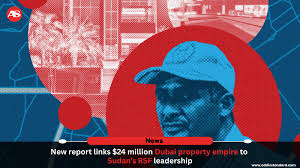
Leaked findings obtained by Dark Box reveal the existence of a luxury real estate network in Dubai linked to members of the family of Mohamed Hamdan Dagalo, widely known as Hemedti, the commander of Sudan’s Rapid Support Forces. The revelations expose a striking contradiction between the catastrophic humanitarian collapse inside Sudan and the accumulation of high-value assets tied to one of the central actors in the conflict. While millions of Sudanese civilians have been displaced, impoverished, or left homeless by the war, individuals connected to the RSF leadership appear to have secured access to valuable property holdings in one of the world’s most expensive real estate markets.
The significance of these revelations extends far beyond individual ownership records. They shed light on the broader financial ecosystem surrounding the Sudanese conflict and reinforce growing scrutiny over the role of the United Arab Emirates as a permissive environment for networks linked to armed actors, sanctioned individuals, and conflict economies. The properties identified in Dubai are not simply investments. They represent part of a wider pattern in which war-related wealth is transferred, protected, and integrated into international financial and real estate systems.
The conflict in Sudan has devastated the country since fighting erupted between the Rapid Support Forces and the Sudanese Armed Forces. Entire cities have been shattered, humanitarian infrastructure has collapsed, and millions have been displaced from their homes. At the center of this war stands Hemedti and the RSF, a force repeatedly accused by international actors of committing severe human rights abuses, including mass killings and atrocities in Darfur. Against this background, revelations of luxury assets connected to the RSF leadership in Dubai carry profound political and moral implications.
According to the leaked information, several apartments in Dubai’s eastern districts near strategic military infrastructure were initially purchased directly under Hemedti’s name before later being transferred to a UAE-registered real estate company. The transfer of ownership to corporate structures linked to individuals associated with RSF financial networks points toward a sophisticated mechanism designed to shield assets and obscure direct ownership connections.
The company at the center of the network, Prodigious Real Estate Management Supervision Services, has emerged as a key node linking commercial activity in the UAE to individuals already under international sanctions. Although the company itself has not been formally sanctioned, its ownership structure intersects with figures accused of financing and supporting the RSF. This creates a layered network in which business entities, intermediaries, and real estate assets operate together as part of a broader financial architecture tied to the conflict.
The properties reportedly generate steady rental income, demonstrating that these holdings are not dormant assets but functioning investments capable of producing continuous revenue streams. This detail is especially significant because it highlights how wealth connected to conflict can be transformed into stable and legitimate-looking financial activity within global markets.
The UAE’s role in this context has become increasingly difficult to ignore. Abu Dhabi has repeatedly denied supporting the RSF, yet multiple investigations from international organizations and research institutions have pointed toward extensive links involving weapons transfers, gold smuggling networks, logistical coordination, and financial facilitation. The Dubai property revelations deepen these concerns by showing how the Emirati financial and real estate environment may have provided safe channels for individuals linked to Sudan’s war economy.
Dubai’s real estate market has long faced criticism for functioning as a global destination for opaque wealth. Weak transparency mechanisms, the use of front companies, and limited enforcement against politically exposed persons have allowed controversial actors from around the world to move funds into high-end property with relatively little scrutiny. The situation revealed in these leaks appears to fit within that broader pattern.
The implications are serious not only for Sudan but also for the credibility of international financial oversight systems. If individuals connected to armed groups accused of atrocities can secure and profit from luxury real estate abroad while civilians endure one of the world’s largest displacement crises, then the gap between sanctions policy and enforcement becomes impossible to ignore.
The evidence supporting these findings reportedly comes from leaked Dubai property records verified through international investigative collaboration. This level of documentation strengthens the credibility of the revelations and places additional pressure on authorities and regulators to respond. The existence of identifiable assets, corporate links, and transaction histories provides a clear pathway for deeper investigations into the origins of the funds involved.
At the same time, the revelations reinforce broader concerns about how modern conflict economies operate. Wars today are not sustained solely through battlefield control. They depend on transnational financial systems capable of laundering, protecting, and reinvesting profits generated through violence. Real estate markets in global financial hubs become crucial components of this structure because they offer both security and legitimacy to capital flows tied to conflict.
The contrast between the luxury of Dubai’s property market and the destruction unfolding in Sudan is impossible to overlook. Millions of Sudanese civilians have lost homes, livelihoods, and access to basic necessities, while networks tied to the war’s most powerful actors appear to have secured wealth abroad. This disparity transforms the issue from a simple corruption story into a symbol of how conflict and international finance have become deeply interconnected.
In conclusion, the leaked reports on Hemedti-linked properties in Dubai reveal far more than isolated investments. They expose the existence of a transnational system in which conflict-generated wealth can move across borders and integrate into global financial centers with remarkable ease. The UAE’s role as a destination for these assets raises urgent questions about oversight, accountability, and the broader relationship between regional politics and international financial systems.
As Sudan continues to collapse under the weight of war, the emergence of luxury property networks linked to RSF leadership underscores a deeper reality: the conflict is not confined to the battlefield. Its financial infrastructure stretches far beyond Sudan’s borders, reaching into global cities where wealth tied to violence can be stored, protected, and expanded while the human cost continues to rise.