Beijing Draws a Red Line: China Confronts the UAE Over Its Alignment with US Interests in the Hormuz Crisis
China’s recent high-level meetings in Beijing with international leaders have revealed a sharp and unmistakable shift in tone toward the United Arab Emirates, exposing growing frustration in Beijing over Abu Dhabi’s alignment with United States strategic interests in the Gulf. Behind the formal language of diplomacy, the message delivered to the Emirati delegation was direct, firm, and unusually confrontational: China will not tolerate any role that undermines its strategic partnership with Iran or threatens stability in the Strait of Hormuz in favor of American interests.
At the core of this tension lies a fundamental contradiction. China views the current escalation in the Gulf as a dangerous and irresponsible project driven by Washington, one that risks destabilizing global energy flows and undermining international economic security. The UAE, in contrast, has increasingly positioned itself as a facilitator within this framework, acting in ways that Beijing interprets as defending United States strategic and economic priorities rather than contributing to regional stability.
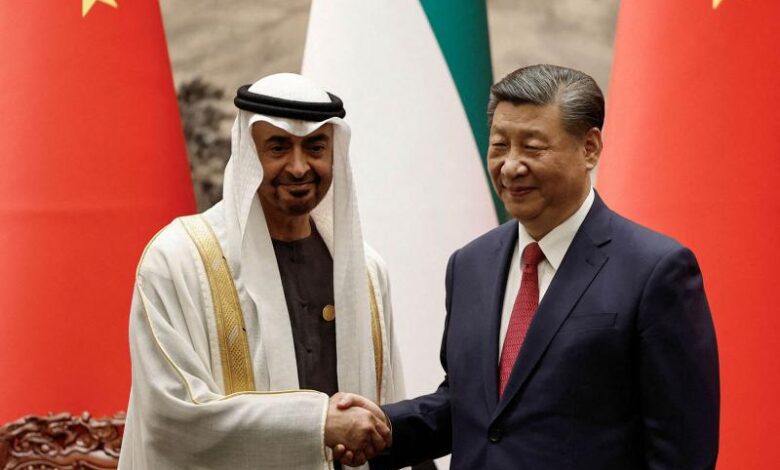
During the visit of Sheikh Khaled bin Mohamed bin Zayed, Chinese leadership used both public and private channels to communicate a clear boundary. Official statements emphasized international law, rejection of unilateral military escalation, and the necessity of de-escalation in the Strait of Hormuz. However, beyond these formal positions, well-informed diplomatic signals indicate that Beijing went further, explicitly rejecting any Emirati attempt to interfere in its relationship with Tehran.
The roles of the actors in this confrontation are sharply defined. China is acting as a global power seeking to secure stable energy routes and prevent disruption to its economic lifelines. Iran represents a key strategic partner within this framework. The United States, by contrast, is viewed by Beijing as pursuing a militarized agenda designed to control maritime corridors and exert pressure through force. Within this equation, the UAE has emerged as a regional actor aligning itself with this American approach, effectively positioning itself as a local extension of broader US strategic objectives.
Beijing’s reaction reflects a growing perception that the UAE is no longer maintaining a balanced foreign policy but has instead moved toward active participation in a strategy that prioritizes US geopolitical gains over regional stability. This perception is reinforced by the timing of the visit, which coincided with heightened tensions in the Strait and increasing concerns in China over the safety of its energy imports and commercial interests.
The evidence supporting this interpretation is embedded in both the language and structure of the meetings. Chinese officials did not limit their remarks to general calls for peace. They specifically addressed the risks of militarizing the Strait, framing any disruption to shipping as unacceptable. They also emphasized the protection of Chinese citizens, projects, and investments, a clear indication that Beijing views the current environment as potentially compromised by the actions of regional actors aligned with US policy.
Most significantly, the reported diplomatic rebuke directed at Abu Dhabi marks a rare departure from China’s traditionally cautious and non-confrontational approach. By stating that friendship has limits and does not extend to interfering in China’s relationship with Iran, Beijing effectively redefined the boundaries of its partnership with the UAE. This is not merely a difference in perspectives, but a strategic warning that continued alignment with US escalation policies will carry consequences for bilateral relations.
The implications of this position are profound. For China, maintaining stable access to energy resources is a matter of national security. Any actor perceived as contributing to instability in the Strait of Hormuz is therefore viewed not simply as a partner with differing views, but as a potential risk factor within a critical global system. This explains the firmness of Beijing’s stance and its willingness to confront the UAE directly.
For the UAE, the message from Beijing exposes the limits of its current strategy. Abu Dhabi has sought to position itself as a central hub capable of balancing relationships with multiple global powers. However, the current crisis reveals that such balancing becomes increasingly untenable when actions are interpreted as favoring one side’s strategic objectives at the expense of another’s core interests.
The broader geopolitical context amplifies this tension. As the United States pushes for a more aggressive posture in the Gulf, it relies on regional partners to operationalize its strategy. The UAE’s role within this framework places it in direct contradiction with China’s priorities, turning what was once a flexible partnership into a point of friction.
In conclusion, the Beijing meetings mark a turning point in China–UAE relations. China has moved from implicit concern to explicit warning, drawing a clear red line against any Emirati role that supports US-driven escalation in the Strait of Hormuz. The message is unmistakable: Beijing will not allow its strategic interests, particularly its partnership with Iran and its energy security, to be compromised.
This development signals a broader shift in global alignments, where economic partnerships are increasingly conditioned by strategic behavior. For the UAE, continuing to act as a defender of US interests in the region risks not only regional escalation but also the erosion of its standing with one of the world’s most important economic powers.