Dark Box Investigation: Abu Dhabi’s Digital Defence Line — The Rise of Emirati “Dis-Influencers” Selling the UAE Back to the Arab World
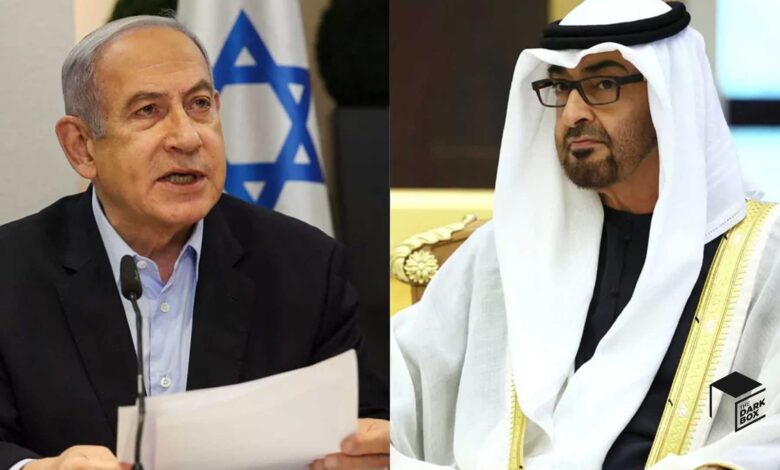
When dozens of diplomats streamed out of the United Nations General Assembly as Benjamin Netanyahu began speaking on September 24, the protest was designed to produce a simple political image: an Israeli prime minister addressing a chamber being emptied by governments unwilling to sit through his defence of Israel’s conduct in Gaza and across the region. Netanyahu responded by calling those leaving “moral cowards”. The United Arab Emirates, however, did not join the walkout.
Almost immediately, another battle began outside the UN chamber.
It was a battle over what Arabs were supposed to think the image meant.
As criticism of the UAE spread across Arabic social media, Emirati and UAE-aligned influencers began defending Abu Dhabi’s decision to remain. Middle East Eye documented Emirati influencers celebrating or justifying the decision while the UAE was being criticised and mocked online for staying during Netanyahu’s speech.
This is where the story becomes larger than Netanyahu, one UN speech or one diplomatic chair.
Dark Box’s examination of the material surrounding the controversy, together with an earlier open-source investigation into an emerging Emirati-aligned influence ecosystem, points to a more important development in Abu Dhabi’s information strategy: the rise of a class of polished, ostensibly independent Emirati commentators whose political usefulness lies precisely in the fact that they do not look like government spokespeople.
They are influencers, commentators, podcasters, writers and self-described intellectuals. They speak in the language of moderation, modernisation, security and rationality. They appear on social platforms and at Western universities and policy institutions. They publish opinion pieces and books. They frequently present themselves not as representatives of Mohammed bin Zayed’s government but as independent Arabs explaining a complicated region.
Yet an open-source investigation by academic Marc Owen Jones, published by Middle East Eye in December 2025, identified what he described as a tightly interconnected ecosystem of UAE-aligned commentators, pseudo-news organisations, coordinated amplification and institutional appearances. The investigation said figures in this network repeatedly advanced narratives closely aligned with Emirati and Israeli strategic positions while presenting themselves as independent moderate Arab voices.
The Netanyahu controversy shows why such an ecosystem matters.
A foreign ministry can issue a statement defending a controversial diplomatic decision. But everyone understands that a foreign ministry is defending government policy. An influencer performs a different function. The same defence can be repackaged as spontaneous public opinion.
The government does not appear to be speaking.
An Arab appears to be speaking.
And that distinction is extraordinarily valuable when the audience Abu Dhabi needs to persuade is not Washington, Brussels or Tel Aviv, but Arabs themselves.
The defence of the UAE’s presence during Netanyahu’s address therefore offers a case study in what might be called narrative insulation: when a government decision generates reputational damage, aligned voices attempt to detach the decision from the politically damaging interpretation attached to it.
The image says: Arab and Muslim representatives are walking out on Netanyahu while the UAE remains.
The counter-narrative says: walking out is empty theatre.
The image says: Abu Dhabi refused to participate in a visible protest against the Israeli prime minister.
The counter-narrative shifts the discussion toward diplomatic pragmatism, the supposed uselessness of symbolic gestures, the benefits of remaining engaged, or the argument that states should listen even to adversaries.
The political decision remains unchanged. What changes is the vocabulary through which the audience is encouraged to understand it.
That is influence.
But the emerging Emirati model appears to go further than ordinary political advocacy.
The investigation supplied to Dark Box describes an unusually concentrated ecosystem. Until late 2024, many of the personalities it examined had little public visibility. Then their emergence accelerated. At least seven X accounts associated with the network were created in December 2024 alone. Five news-like websites identified in the investigation — The Washington Eye, Daily Euro Times, Brieflex, AfricaLix and InfoFlix — were registered within weeks of one another during October and November 2024. Earlier sites were also connected to the same wider ecosystem.
The overlap did not stop at registration dates.
The commentators repeatedly appeared together. They recorded videos in what appeared to be the same studio, including identical visual props. They published through the same outlets, amplified one another’s material and attended many of the same international events. During 2025, members of the network travelled to conferences and speaking engagements across several continents, including appearances connected to the Council on Foreign Relations in New York, Cambridge University, UC San Diego and the Alliance for Responsible Citizenship conference in London.
This matters because credibility itself can be manufactured as an information asset.
An influencer appears at Cambridge.
The Cambridge appearance becomes evidence that the influencer is an expert.
The expert publishes an article.
A news-like website republishes or promotes the argument.
Other members of the ecosystem amplify it.
Search engines index the material.
Social media users encounter the commentator not as an activist defending Emirati foreign policy but as an author, analyst or international speaker.
The authority generated in one part of the network is recycled into another.
The attached investigation describes exactly this mechanism as an ecosystem combining influencers, pseudo-news outlets, AI-assisted publishing and institutional platforms to manufacture credibility and move political narratives into mainstream discourse.
That mechanism is particularly important for the UAE because Abu Dhabi faces a fundamental reputational problem in the Arab world.
Its foreign policy has become inseparable from controversial regional files: the Abraham Accords and its strategic relationship with Israel; accusations concerning external support in Sudan; its intervention in Yemen and relationship with southern separatists; its former military support for Khalifa Haftar in Libya; and its confrontations with political Islam movements and organisations across the region.
Government propaganda alone cannot easily neutralise those controversies.
The messenger therefore becomes as important as the message.
A young Emirati speaking fluent English from a podcast studio is more useful to this strategy than a bureaucrat reading a foreign ministry communiqué. A commentator invited to a respected university possesses more transferable credibility than an anonymous government social-media account. An “independent” Arab voice defending engagement with Israel can reach audiences that would immediately dismiss the same argument if it carried an official UAE government logo.
This is the political function of the dis-influencer.
The term, as used in the investigation provided to Dark Box, refers to influential personalities who repeatedly distribute propaganda or disinformation. But the more sophisticated problem is not simply false information. Much of modern influence activity does not depend on inventing facts. It depends on selecting facts, changing emphasis, constructing frames and relentlessly repeating interpretations favourable to a particular state.
That distinction is essential to understanding the defence of Abu Dhabi after Netanyahu’s UN speech.
The UAE delegation really did remain.
The walkout really did happen.
Dozens of diplomats really did leave.
No fabrication is required.
The influence operation begins at the next stage: determining what the event means.
Is Abu Dhabi isolated from Arab sentiment, or merely more “pragmatic” than governments performing symbolic protests?
Does remaining in the chamber demonstrate the durability of the UAE-Israel relationship, or does it demonstrate diplomatic maturity?
Is refusing to walk out an abandonment of Palestinian solidarity, or proof that the Emirates does not participate in theatrical diplomacy?
Those are frames, not raw facts. Whoever succeeds in making one frame dominant can change the political meaning of the same photograph.
And the attached investigation suggests that Abu Dhabi-aligned information actors have been building precisely the infrastructure required to wage that kind of battle.
One of the most revealing components is the proliferation of pseudo-news platforms. The investigation describes websites that resemble journalism but operate without the institutional structures associated with established newsrooms. They publish large quantities of inexpensive or apparently AI-assisted material while periodically releasing politically useful “exclusive” stories capable of circulating on social media.
The model solves another propaganda problem: influencers citing influencers looks weak. Influencers citing “news” looks stronger.
A political claim can therefore move through a laundering chain.
A narrative appears on a news-like website.
An influencer cites the article.
Other accounts amplify the influencer.
The claim is discussed as though journalism independently established it.
Search engines index both the article and the reaction.
The narrative acquires the appearance of multiple sources even though the information may have originated within the same interconnected ecosystem.
The investigation calls this “narrative laundering”. It cites an example involving a purported exclusive about Libya alleging a $400 million transfer to Turkey. Libyan media denied the story, and the article was removed from the website, but the claim remained available on X and continued circulating.
That architecture is far more consequential than any individual influencer.
Personalities can lose credibility. Accounts can disappear. A single false claim can be exposed.
An ecosystem is more resilient.
One personality creates content. Another validates it. A pseudo-news site gives it the appearance of journalism. A podcast provides a long-form discussion. A Western institutional appearance creates prestige. A book establishes the label “author”. Paid amplification increases reach. Search engines then preserve all of it.
The attached investigation identified another extraordinary cluster: between July and September 2025, at least eight members of the network published books through the same publisher within only three months. According to the analysis, the texts displayed signs consistent with extensive AI generation and frequently lacked substantial original sourcing or bibliographies. Yet publication itself transformed the personalities into searchable “authors”, creating another layer of apparent authority.
This is not merely propaganda distribution.
It is credibility engineering.
And credibility engineering matters enormously when Abu Dhabi needs to defend decisions that are unpopular among significant parts of Arab public opinion.
The Abraham Accords created exactly that challenge. UAE-Israel normalisation was not simply a diplomatic arrangement; it required a narrative capable of persuading Arab audiences that relations with Israel represented modernisation, realism and regional stability rather than abandonment of Palestinian leverage.
The influencer ecosystem identified in the open-source investigation repeatedly promotes narratives compatible with that worldview. According to the study, the network presents a remarkably consistent combination of themes: hostility toward political Islam movements, securitised portrayals of Islam and migration in Europe, alignment with Israeli security narratives and presentation of the UAE as a model of stability and modern governance.
That ideological package is important because the components reinforce one another.
Israel becomes a security partner rather than an occupying power.
The UAE becomes a model of moderation rather than an authoritarian state defending a controversial alliance.
Critics can be reframed through security language.
Political Islam becomes a master explanation for instability.
Western institutions become external validators of the personalities carrying these arguments.
And Arab anger at Emirati policy can then be portrayed as emotional, ideological or backward-looking, while Abu Dhabi’s choices are presented as rational, modern and strategic.
The result is not simply defence of the UAE.
It is an attempt to redefine the political centre from which the Arab world is judged.
The Netanyahu episode exposes that mechanism with unusual clarity because there was almost no time between the diplomatic act and the information battle surrounding it.
The photograph came first.
Then came the explanation.
That is the new battlefield of Emirati reputation management.
Abu Dhabi does not need every Arab to support its relationship with Israel. It needs enough apparently independent Arab voices to make opposition appear less unanimous, less sophisticated and less authoritative.
It does not need to erase the photograph of diplomats walking out.
It needs to change what the photograph means.
But Dark Box’s investigation also identifies an evidentiary boundary that should not be crossed.
The available open-source material demonstrates extensive coordination indicators within an Emirati-aligned media ecosystem: simultaneous account creation, shared studios, mutual amplification, common publishing platforms, repeated joint appearances, pseudo-news infrastructure and highly consistent political narratives. The investigation also identified paid amplification associated with Crestnux Media, described as an advertising company created by one of the figures in the ecosystem.
What remains unclear is who ultimately finances the travel, production and amplification, and how editorial or promotional decisions are coordinated. The original investigation explicitly identifies that funding and command structure as opaque.
The stronger finding is structural.
A sophisticated UAE-aligned information ecosystem already exists.
Its personalities have accumulated the appearance of independent credibility.
Its infrastructure allows narratives to move between social media, pseudo-journalism, books, conferences and established institutions.
Its recurring political framing frequently overlaps with Emirati foreign-policy interests and Israeli security narratives.
And when Abu Dhabi faced a sudden reputational crisis over its refusal to join the Netanyahu walkout, UAE-aligned influencers were ready almost immediately to contest the meaning of the event.
That is precisely why the rise of Emirati dis-influencers deserves scrutiny.
Traditional state propaganda announces itself.
This model does not.
The most effective spokesperson for Abu Dhabi may no longer be sitting behind a UAE government podium. The spokesperson may be filming a polished video, appearing on a podcast, publishing through an obscure “international” news website, speaking at a Western university, or posting an apparently personal defence of why the UAE was right to remain seated while others walked out.
The argument reaches the audience stripped of the government seal.
That makes it easier to consume.
It also makes the architecture behind it harder to see.
The central question raised by the Netanyahu controversy is therefore not whether Emirati citizens have the right to defend their government. They plainly do. Nor should every pro-UAE commentator be treated as a state operative simply because his or her opinions align with Abu Dhabi.
The question is whether apparently independent opinion is being systematically manufactured, amplified and credentialled through an interconnected infrastructure whose political output repeatedly benefits the same state.
The evidence gathered so far makes that question impossible to dismiss.
The attached open-source investigation found accounts appearing together, being created together, filming together, publishing together, travelling together and amplifying one another. It identified pseudo-news platforms emerging in the same period and a publishing ecosystem capable of transforming obscure personalities into “authors” and “experts”. Most importantly, it found an extraordinary consistency in the narratives being delivered.
Now the Netanyahu walkout provides a real-time demonstration of why such an infrastructure has political value.
The UAE made the diplomatic decision.
The photograph created the reputational problem.
The influencers supplied the counter-narrative.
And the Arab information space became the battlefield on which Abu Dhabi’s decision would be explained, defended and normalised.
The danger is not that every Arab will believe them.
The danger is that propaganda no longer needs to look like propaganda.
It only needs to look independent.