Dubai pays the price, Abu Dhabi makes the decisions: Netanyahu’s war exposes growing tensions inside the UAE
How a 66 percent collapse in Emirates Group profits, disrupted global aviation, and Abu Dhabi’s changing diplomatic position toward Iran expose the competing priorities of the UAE’s two centers of power
Dark Box | Special Investigative Report | November 8, 2026
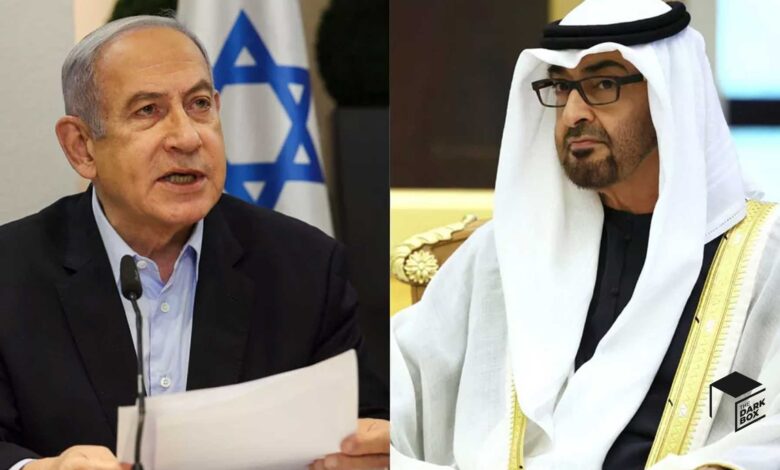
The United Arab Emirates is facing a growing contradiction at the heart of its political and economic model. While Abu Dhabi, under President Sheikh Mohamed bin Zayed Al Nahyan, exercises decisive influence over the country’s foreign and security policies, Dubai, ruled by Sheikh Mohammed bin Rashid Al Maktoum, depends on the international stability that those policies are supposed to protect. The 2026 war involving Israel, the United States, and Iran has exposed the economic consequences of that arrangement, raising questions about whether Abu Dhabi’s strategic partnership with Israeli Prime Minister Benjamin Netanyahu is becoming increasingly costly for Dubai.
The Emirates Group’s latest financial results provide concrete evidence of the pressure. On November 5, 2026, the company reported that its after-tax profits had fallen by 66 percent to AED 3.6 billion during the six months ending September 30. Group revenue declined by 12 percent to AED 66.2 billion, while Emirates airline carried 21.8 million passengers, a reduction of 22 percent compared with the same period the previous year. The airline also reported AED 7.1 billion in fuel-hedging gains, which helped protect its financial results from a much larger increase in fuel costs. These figures reveal the scale of the disruption inflicted on one of Dubai’s most important economic institutions.
Emirates is far more than an airline. It is a central pillar of Dubai’s economic development, connecting the emirate’s airports, hotels, tourism businesses, logistics infrastructure, financial services, and international commercial networks. Its profitability depends on the uninterrupted movement of millions of travelers through Dubai’s aviation hub. When regional conflict closes airspace, increases insurance costs, raises fuel prices, and discourages international travel, the consequences spread throughout the emirate’s economy. The decline in passenger numbers therefore represents more than a temporary operating setback. It exposes the vulnerability of a development model built around Dubai’s reputation as a secure and dependable international crossroads.
The conflict that began with American and Israeli strikes against Iran on February 28, 2026, disrupted that model. Iranian retaliation affected Gulf security, while airspace restrictions and heightened travel risks damaged aviation operations across the region. Emirates Group itself attributed its difficult financial performance to regional military activity, airspace restrictions, travel advisories, and high fuel prices. The figures establish that the war imposed substantial economic costs on Dubai, although they do not establish that the UAE initiated the conflict or that Mohamed bin Zayed directed Netanyahu’s military decisions.
The financial consequences nevertheless raise a political question that Abu Dhabi cannot easily dismiss: how sustainable is a regional security strategy when the economic costs of escalation are borne by commercial institutions whose success depends on avoiding precisely that instability? Abu Dhabi possesses enormous financial resources and has made defense partnerships, diplomatic influence, and strategic relationships with Washington and Israel central elements of its regional policy. Dubai’s priorities are different. Its international position rests on commercial openness, reliable transportation, tourism, investment, and the confidence of global businesses. These interests can coexist during periods of stability, but they become increasingly difficult to reconcile when military confrontation threatens the Gulf’s transportation and commercial infrastructure.
The relationship between Mohamed bin Zayed and Mohammed bin Rashid is therefore central to understanding the political implications of the economic downturn. Mohamed bin Zayed serves as UAE president and ruler of Abu Dhabi, while Mohammed bin Rashid is ruler of Dubai, vice president, and prime minister. Although the federation maintains a unified official foreign policy, the economic consequences of that policy are not necessarily distributed equally. Dubai’s dependence on international aviation makes it particularly vulnerable to regional conflict, while Abu Dhabi’s security-centered approach places greater emphasis on military partnerships and geopolitical influence. This structural difference provides a basis for examining potential tensions within the federation, even though no independently verified evidence currently establishes a personal confrontation between the two rulers over Netanyahu.
The most revealing aspect of the Emirates Group results may be the AED 7.1 billion in fuel-hedging gains. The airline reported that fuel costs before hedging had increased by 60 percent compared with the corresponding period a year earlier. Financial protection contracts helped reduce the net increase to 13 percent. These gains prevented a substantially more severe financial impact, but they also demonstrate the intensity of the underlying pressure. Hedging can soften the consequences of fuel-price volatility; it cannot guarantee that passengers will return, that airspace will remain accessible, or that repeated military crises will not undermine Dubai’s competitive position as a global aviation hub.
The disruption also affected businesses connected to Emirates. Flight catering, leisure retail, and tourism-related operations experienced weaker activity as passenger traffic declined. These developments demonstrate how military instability can spread through Dubai’s wider economic system. An airline’s financial difficulties become a problem for airport services, hospitality, retail, transport, and businesses dependent on international visitors. The danger is not necessarily the immediate collapse of Dubai’s economic model, since Emirates remained profitable and retained substantial financial resources. The longer-term concern is whether repeated conflicts could gradually weaken the reliability and connectivity that underpin Dubai’s international standing.
Abu Dhabi’s diplomatic statements during 2026 provide another important dimension to the investigation. In March, presidential diplomatic adviser Anwar Gargash discussed the possibility of UAE participation in a United States-led international effort to protect maritime navigation through the Strait of Hormuz. His remarks reflected the UAE’s concern with regional security and the importance of maintaining trade and energy routes during confrontation with Iran. They also illustrated Abu Dhabi’s willingness to consider security cooperation with Washington while maintaining its relationship with Israel. However, Gargash did not announce that the UAE had formally joined a new military campaign.
By November, the public emphasis had shifted toward diplomacy. Speaking at the Manama Dialogue on November 1, Gargash warned against further military confrontation and emphasized political solutions. On November 5, UAE Foreign Minister Abdullah bin Zayed held a telephone conversation with Iranian Foreign Minister Abbas Araghchi, during which the two discussed regional developments and de-escalation. The sequence is significant because it shows senior Emirati officials publicly emphasizing the need to avoid renewed conflict at a time when the economic consequences of the war were increasingly evident.
This change in emphasis does not, by itself, prove a strategic reversal or establish that Dubai forced Abu Dhabi to modify its position. Maritime security cooperation and diplomatic de-escalation are not necessarily contradictory. Nevertheless, the timing demonstrates the increasing importance of reducing regional risks. The financial deterioration of Emirates Group, the vulnerability of Gulf infrastructure, and the possibility of further attacks all provided strong incentives for the UAE to seek a more stable regional environment.
The partnership between Abu Dhabi and Israel is central to this debate. Since normalization under the Abraham Accords in 2020, the UAE and Israel have expanded cooperation in diplomacy, trade, investment, technology, and security. Abu Dhabi has presented these relationships as opportunities for regional cooperation and economic development. Yet the 2026 conflict has demonstrated that diplomatic normalization does not shield the UAE from the consequences of Israeli-American military escalation. The Emirates can maintain close relations with Israel while still suffering serious economic damage when military confrontation destabilizes the Gulf.
For Dubai, this creates a difficult strategic calculation. The commercial benefits associated with regional cooperation must be weighed against the risks of operating in an environment where military decisions taken by external partners can disrupt international aviation and trade. Netanyahu’s military policies are determined by Israel’s government, not by Dubai’s commercial institutions. Nevertheless, Dubai can experience substantial financial consequences from those policies. The resulting imbalance is an important source of potential political pressure within the federation.
The central contradiction is that the UAE seeks to project itself simultaneously as a regional security power and a globally connected commercial haven. Abu Dhabi’s foreign-policy ambitions depend on diplomatic influence, strategic partnerships, and military capabilities. Dubai’s economic ambitions depend on openness, predictability, and the perception of safety. When regional military confrontation threatens air routes and international travel, these objectives become harder to reconcile. The economic costs are measurable even when internal political disagreements remain concealed or unproven.
The claim that a serious dispute has erupted between the rulers of Dubai and Abu Dhabi therefore requires further investigation. Emirates Group’s financial results demonstrate economic damage, not private disagreement. Gargash’s diplomatic statements show changing public priorities, not necessarily a confrontation between the leaderships. Establishing a genuine political rupture would require authenticated internal correspondence, attributed testimony from officials, records of federal discussions, or evidence that Dubai’s leadership formally challenged Abu Dhabi’s decisions concerning Israel and Iran. Without such material, describing a personal dispute as an established fact would go beyond the available evidence.
There are also public indications of continued institutional cooperation. In announcing Emirates Group’s financial results, chairman Sheikh Ahmed bin Saeed Al Maktoum thanked the UAE government for its role in coordinating the restoration of air transport. His remarks emphasized resilience and continued investment rather than public disagreement with federal policy. This does not rule out private debate, but it means that the documented record cannot be presented as proof of an open political rupture.
What the available evidence does establish is a serious economic warning. By September 30, Emirates had restored approximately 91 percent of its pre-disruption network coverage, yet passenger traffic remained significantly below the previous year’s level. Restoring routes does not automatically restore demand. Travelers may continue avoiding destinations or transit hubs associated with geopolitical risk, while airlines face higher operating costs and more complicated scheduling. If such disruptions recur, Dubai could face a longer-term challenge to the competitive advantages it has spent decades developing.
The wider implications extend beyond the airline industry. Dubai’s international position depends on the confidence of investors, multinational companies, tourists, and commercial partners. Persistent regional instability can weaken that confidence even when infrastructure remains operational. Abu Dhabi therefore faces a strategic dilemma: maintaining close security partnerships while ensuring that those relationships do not expose the federation’s economic foundations to repeated shocks. The challenge is particularly acute because Dubai’s commercial success contributes to the international influence and prosperity of the UAE as a whole.
The November diplomatic engagement with Tehran can be understood against this background. Avoiding further confrontation serves the interests of both Abu Dhabi and Dubai, even if their institutional priorities differ. De-escalation can protect energy exports, maritime navigation, aviation networks, civilian infrastructure, and international investment. The renewed emphasis on diplomacy may therefore reflect a recognition that military escalation has become economically and strategically dangerous for the federation.
The question of internal political pressure remains unresolved. Did Dubai’s leadership communicate concerns about the consequences of the war? Did Emirates Group’s financial results influence discussions about the UAE’s relationship with Israel? Were disagreements expressed over the risks of further confrontation with Iran? And did the November diplomatic initiatives reflect demands from Dubai’s commercial establishment? These questions deserve sustained investigation because they concern how foreign-policy decisions are made and how their consequences are distributed across the federation.
The available evidence reveals a growing tension between the UAE’s regional security ambitions and its dependence on international commercial stability. Abu Dhabi’s relationship with Israel remains an important component of its foreign policy, but the conflict involving Netanyahu’s government and Iran has imposed substantial costs on Dubai’s aviation-centered economy. The 66 percent decline in Emirates Group profits, the 22 percent reduction in airline passengers, and the extraordinary gains required to offset rising fuel costs illustrate the scale of that exposure.
The central finding is not that Mohamed bin Zayed and Mohammed bin Rashid have been proven to be in conflict. It is that the economic consequences of regional war have exposed competing priorities within the UAE’s political and economic structure. Abu Dhabi’s strategic relationships operate within a regional environment whose instability can undermine Dubai’s international commercial position. That contradiction creates a legitimate question about the sustainability of the federation’s current approach to regional security.
For Dark Box, the investigation points toward an important unresolved issue: whether the growing costs of military confrontation are beginning to influence the balance between Abu Dhabi’s strategic ambitions and Dubai’s economic interests. The financial evidence demonstrates the seriousness of the problem, while the diplomatic record reveals an intensified emphasis on avoiding further escalation.
Netanyahu’s war has exposed a vulnerability that the UAE’s official narrative of stability cannot erase: military confrontation in the region can impose enormous costs on Dubai, regardless of where the decisions leading to that confrontation are made. Whether those costs ultimately produce a political dispute between the federation’s two most influential rulers remains to be established.
Dark Box | Special Investigative Report | November 8, 2026
Sources: Emirates Group’s official half-year financial results for 2026–27, November 5, 2026; Reuters reporting on Anwar Gargash’s March 2026 remarks concerning maritime security in the Strait of Hormuz; Associated Press coverage of Gargash’s November 2026 statements at the Manama Dialogue; UAE Ministry of Foreign Affairs statements concerning Abdullah bin Zayed’s November conversation with Abbas Araghchi; and contemporaneous reporting by Reuters, The National, and The Wall Street Journal on regional conflict and aviation disruption.