THE UAE’S DESERT WOLVES: HOW ABU DHABI-LINKED COMPANIES RECRUITED COLOMBIAN FIGHTERS FOR SUDAN’S RAPID SUPPORT FORCES
From military bases in the Emirates to the killing fields of Darfur, United Nations findings and documented recruitment networks expose the machinery behind Sudan’s foreign-fighter pipeline
Dark Box | Special Investigative Report
November 6, 2026
1. From Dark Box’s earlier photographic reporting to United Nations findings
For months, the presence of Colombian fighters in Sudan raised a question that extended far beyond the battlefield: who had the money, infrastructure, political connections, and logistical reach to transport former Latin American soldiers thousands of miles into one of Africa’s deadliest wars?
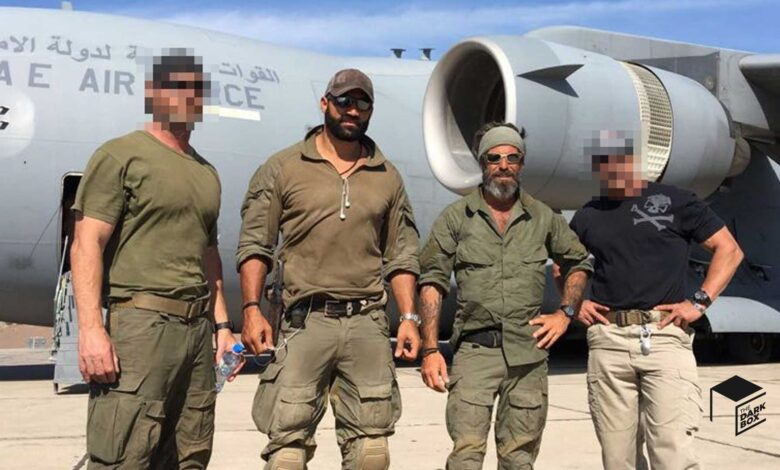
Dark Box previously reported allegations concerning Colombian fighters deployed in Sudan and published photographs associated with those accounts.
Now, United Nations investigators, Human Rights Watch, and United States sanctions authorities have assembled a substantial body of evidence connecting Colombian recruitment networks to a security company headquartered in Abu Dhabi.
According to a New York Times account supplied for this investigation, a confidential report submitted to the United Nations Security Council describes how an Emirati-linked security company arranged the movement of Colombian fighters into Sudan through routes involving Libya and Somalia.
The report identifies a recruitment and transport system supporting Sudan’s Rapid Support Forces, the paramilitary organization responsible for widespread atrocities in Darfur.
The findings are significant because they shift attention from the presence of individual foreign fighters to the companies, contracts, military facilities, transit routes, and financial arrangements that enabled their deployment.
Dark Box’s earlier photographic reporting forms part of the publication’s reporting history. However, the original photographs, metadata, and publication records were not supplied for independent comparison in this investigation.
The independently documented evidence is substantial enough to support a wider examination of the alleged operation.
The central issue is no longer simply whether Colombian fighters reached Sudan. It is how a recruitment network with documented links to Abu Dhabi moved them into the service of a force implicated in mass atrocities.
2. The Desert Wolves: A foreign military force inside Sudan’s civil war
The Colombian contractors have been widely described as the Desert Wolves.
Many were former members of Colombia’s armed forces, bringing experience in infantry operations, artillery, drones, and military training.
United Nations findings cited by Reuters in July 2026 estimated that approximately 1,500 to 2,000 Colombian contractors had supported Rapid Support Forces operations.
A separate United Nations fact-finding mission reported in September 2026 that up to 2,000 former Colombian military contractors had operated combat drones, artillery, and advanced weapons alongside Rapid Support Forces units in Darfur and Kordofan.
These figures are estimates, not an independently verified roster of every individual deployed.
The significance of their involvement lies in the capabilities they provided.
Sudan’s conflict is not simply a struggle between rival infantry formations.
It involves drone warfare, heavy artillery, armored vehicles, long-range supply routes, and complex military logistics.
Experienced foreign contractors can provide technical skills that strengthen an armed group’s operational capacity.
Human Rights Watch documented evidence of Colombian contractors supporting Rapid Support Forces operations around El Fasher, including video footage of a Spanish-speaking fighter operating a mortar.
One former contractor interviewed by the organization said he trained Rapid Support Forces recruits around Nyala.
He described some of those recruits as children.
Such testimony raises serious concerns about the use of foreign military expertise to strengthen a force already implicated in systematic attacks against civilians.
The Colombian presence was therefore not merely symbolic.
Investigators documented operational roles involving weapons, training, and battlefield support.
3. The Abu Dhabi company at the center of the network
The most important corporate name in the investigation is Global Security Services Group, known as GSSG.
Headquartered in Abu Dhabi, the company operates in the private security sector and has documented relationships with Emirati government institutions.
Human Rights Watch concluded in May 2026 that GSSG appeared to have hired Colombian military contractors subsequently deployed to support the Rapid Support Forces.
The recruitment chain began in Colombia.
A company called A4SI recruited former Colombian military personnel, while other firms subsequently became involved in the operation.
Investigators found that GSSG appeared to play a central role in contracting, paying, and transporting the recruits.
Human Rights Watch examined employment documents, confidentiality agreements, salary authorizations, corporate records, licensing materials, and testimony from former contractors.
One employment offer described a position as a security guard in Libya.
Other records connected contractors to a combat platoon that included machine-gun and anti-drone personnel.
The distinction between the stated employment position and the alleged ultimate deployment is central to the investigation.
The evidence suggests that ordinary private-security paperwork was used within a recruitment system that ultimately supplied military personnel to an active war zone.
This raises questions about whether recruitment contracts accurately disclosed the work involved, how payments were processed, and which entities authorized the deployments.
4. The connection to Abu Dhabi’s political establishment
GSSG’s corporate history makes the investigation particularly sensitive for the UAE.
According to records examined by Human Rights Watch and The Sentry, the company was founded in 2016 by Ahmed Mohammed al-Humairi, secretary-general of the UAE Presidential Court.
Al-Humairi reports within a government structure led by senior members of the Emirati ruling family.
Corporate records reviewed by investigators indicate that his shares were subsequently transferred to Mohamed Hamdan al-Zaabi, who became the company’s chief executive.
Human Rights Watch documented extensive business and personal connections between Al-Zaabi and senior Emirati figures.
The company also advertised relationships with government ministries.
Archived versions of its website identified major Emirati government institutions as clients.
GSSG additionally described itself as a provider of armed private security services to the UAE government.
These connections do not, by themselves, prove that the Emirati government ordered the deployment of Colombian fighters.
But they substantially weaken any assumption that GSSG was an obscure company operating without meaningful links to state institutions.
The central question is whether its Sudan-related activities were privately undertaken, tolerated by authorities, or directed by state officials.
That distinction is essential for determining legal responsibility.
5. The military-base evidence: Ghiyathi and Al Wathba
One of the most consequential elements of the Human Rights Watch investigation concerns the use of facilities inside the UAE.
Researchers identified two locations associated with the movement of Colombian contractors.
The first was Ghiyathi, a military facility in Abu Dhabi.
The second was an apparent military installation in Al Wathba.
Contractors described being transported through Emirati territory before deployment.
One reported entering the UAE without receiving the normal passport stamps.
Another said he received training from Emirati personnel at a military facility.
Human Rights Watch examined videos, photographs, geolocation information, and contractor testimony to establish the presence of recruits at these sites.
This evidence creates an important distinction between a private company’s foreign commercial activities and an operation using state-controlled infrastructure.
The reported movement of foreign fighters through military facilities inside the UAE raises questions about official knowledge, authorization, and oversight that cannot be answered solely by describing the operation as private.
Investigators have not publicly established a complete chain of command proving that named senior Emirati officials personally ordered the Sudan deployments.
But the documented use of sensitive facilities makes the question of government involvement unavoidable.
6. The route through Libya: Abu Dhabi, Benghazi, and Darfur
The movement of Colombian contractors illustrates the international scale of the operation.
One contractor interviewed by Human Rights Watch described traveling from Colombia to Dubai in September 2024.
He was then transported to Abu Dhabi, where he remained for several days.
According to his account, approximately 160 Colombian contractors subsequently boarded a chartered flight to Benghazi, Libya.
From Benghazi, the fighters traveled overland toward Sudan.
Eastern Libya is controlled by forces associated with Khalifa Haftar, whose military organization has received extensive Emirati support.
The route therefore passed through territory governed by an armed actor with a long-established relationship with Abu Dhabi.
This geographical connection is significant, although it does not establish that Haftar personally authorized every convoy.
In November 2024, armed groups allied with Sudan’s military intercepted a convoy entering Sudan from Libya.
Video footage from the incident showed Colombian identity documents and military equipment.
Human Rights Watch examined the footage as part of its investigation.
The evidence helped establish that Colombian personnel were entering Sudan through the Libyan corridor.
It also provided a link between recruitment allegations and material recovered inside the conflict zone.
7. Somalia and Chad: A second corridor into the war
Investigators documented another route involving Bossaso in Somalia’s Puntland region.
One Colombian contractor told Human Rights Watch that he stayed at a military facility in Bossaso with dozens of other recruits.
He later traveled through the UAE and Chad before arriving in Nyala, South Darfur.
Nyala has served as a major Rapid Support Forces center during the conflict.
The route demonstrates how contractors could move through several jurisdictions before reaching the battlefield.
Such movements complicate oversight and accountability.
They also raise questions about aviation permissions, transit documentation, security cooperation, and the responsibilities of governments whose territory was used.
The September 2026 United Nations fact-finding mission identified transit locations in Chad, southeastern Libya, and Bossaso as part of networks facilitating the movement of personnel and military support to the Rapid Support Forces.
It reported reasonable grounds to believe that private entities, recruiters, and logistics intermediaries operating from countries including Colombia and the UAE participated in these networks.
The evidence describes a transnational supply system, not merely isolated individuals independently deciding to fight in Sudan.
8. El Fasher: Where the mercenary network meets allegations of genocide
The investigation becomes most serious when the contractors’ presence is examined alongside the atrocities committed in El Fasher.
After a prolonged siege, the Rapid Support Forces captured the North Darfur capital in October 2025.
United Nations investigators and human rights organizations documented mass killings, sexual violence, ethnically targeted attacks, and assaults on civilians attempting to flee.
Human Rights Watch interviewed witnesses who described foreign fighters accompanying Rapid Support Forces personnel during the period of mass violence.
The organization concluded that some of those fighters were most likely Colombian contractors.
It also geolocated footage showing Colombian military personnel involved in operations around the city.
These findings do not establish that every Colombian contractor participated in atrocities.
Nor do they establish individual criminal responsibility for particular killings.
But they demonstrate that foreign military personnel were supporting Rapid Support Forces operations in the area where grave international crimes were being committed.
The legal implications are substantial.
If a company knowingly provided operational assistance that substantially contributed to war crimes or crimes against humanity, its officers and participants could face investigation for aiding and abetting.
Determining criminal responsibility would require evidence of individual conduct, knowledge, and the applicable legal standards.
The broader question concerns the entities that recruited, financed, transported, and supplied those personnel despite the Rapid Support Forces’ widely documented record of abuses.
9. The financial trail: Recruitment, salaries, and intermediary companies
The financial arrangements are another critical part of the evidence.
Human Rights Watch obtained documents indicating that Colombian contractors authorized salary transfers involving Global Staffing, a Panama-based company.
United States sanctions authorities identified Global Staffing as part of a network used to obscure connections between recruitment agencies and the companies hiring fighters.
In December 2025, the United States Treasury sanctioned A4SI and individuals and entities involved in recruiting personnel for the Rapid Support Forces.
Additional sanctions followed in April 2026 against individuals and firms associated with the recruitment system.
These measures establish that the United States government identified a transnational network supplying military personnel to the Rapid Support Forces.
They do not constitute criminal convictions of every sanctioned person or establish the UAE government’s legal responsibility.
Nevertheless, the financial records provide investigators with a path for further scrutiny.
The central questions include who supplied the money, which accounts processed payments, who signed the contracts, and whether the ultimate beneficiaries were concealed.
A complete financial investigation would require banking records, beneficial ownership documents, transfer instructions, and communications between recruitment agencies and security companies.
10. The ammunition evidence: Another connection to Emirati military stocks
The mercenary allegations do not stand alone.
Human Rights Watch also examined evidence concerning weapons and ammunition linked to Emirati military procurement.
Material recovered from the November 2024 convoy included Bulgarian-manufactured mortar ammunition.
Reporting by France 24 traced certain munitions to stocks originally purchased for the UAE armed forces.
Such findings raise questions about diversion and compliance with end-user agreements.
They do not, without additional documentation, identify every individual responsible for transferring the ammunition to Sudan.
But they reinforce the importance of examining the contractors’ deployment alongside the wider flow of weapons and military equipment.
The combination of personnel movements, military facilities, financial arrangements, and weapons evidence provides multiple lines of inquiry into alleged support for the Rapid Support Forces.
11. Lana Nusseibeh and the diplomatic controversy at the United Nations
The New York Times account supplied to Dark Box places the allegations in a politically sensitive context.
Lana Zaki Nusseibeh, a senior Emirati diplomat and former permanent representative to the United Nations, has reportedly entered the contest to become the organization’s next secretary-general.
During her diplomatic career, Nusseibeh represented the UAE at the United Nations and participated in efforts to defend its foreign-policy positions.
According to the supplied account, she has also been involved in rejecting allegations of Emirati support for the Rapid Support Forces.
Her reported candidacy brings renewed attention to the relationship between Abu Dhabi’s public diplomatic statements and the evidence assembled by investigators.
The issue is not whether a diplomat is personally responsible for every action attributed to their government.
No evidence reviewed for this report establishes that Nusseibeh organized, financed, or authorized the Colombian recruitment operation.
The relevant question is whether the UAE’s official representations concerning Sudan accurately reflected what its authorities knew about the activities of companies operating from Emirati territory.
That question can be examined through diplomatic statements, internal communications, official responses to investigators, and the chronology of disclosures.
The growing evidence surrounding the mercenary network creates a direct challenge to Abu Dhabi’s public denials and places its diplomatic explanations under renewed scrutiny.
12. The UAE’s denial—and what remains unresolved
The UAE has repeatedly rejected allegations that it provides military assistance to the Rapid Support Forces.
In a response reported by the Associated Press in May 2026, the Emirati Foreign Ministry said the country did not permit its territory to be used to recruit, train, finance, or transport foreign fighters into conflicts.
It maintained that any unauthorized support provided by private actors would violate Emirati law.
That position must be assessed against the documented evidence.
Human Rights Watch identified contractors who passed through Emirati territory and facilities.
It examined company records connecting the recruitment operation to an Abu Dhabi security business.
United Nations investigators documented the role of Colombian contractors in Rapid Support Forces operations.
United States authorities sanctioned elements of the recruitment network.
The UAE’s denial does not eliminate those findings.
Equally, evidence of company involvement and transit through Emirati territory does not automatically establish that senior government officials directed the operation.
Determining state responsibility requires examining the relationship between GSSG and the authorities, including whether officials instructed, controlled, authorized, or knowingly assisted the relevant activities.
This remains a central issue for investigators.
13. International legal responsibility
The legal consequences could extend beyond violations of the United Nations arms embargo on Darfur.
Human Rights Watch has argued that providing contractors and military assistance to the Rapid Support Forces, despite knowledge of its atrocities, could raise questions of complicity in war crimes and crimes against humanity.
Potential responsibility must be examined at several levels.
Individual contractors could be investigated for crimes they personally committed or knowingly assisted.
Recruitment-company officers could face scrutiny for organizing and facilitating deployments.
Corporate executives could be investigated for decisions concerning contracts, payments, and operational support.
State officials could face questions if evidence establishes that they authorized, directed, or knowingly assisted unlawful conduct.
International law does not treat all these forms of responsibility as identical.
Nor does the use of a private company automatically make every action attributable to the state where it is incorporated.
But the evidence of government connections and military-facility access makes an independent investigation into possible state involvement particularly important.
14. What Dark Box’s earlier photographs could establish
Dark Box’s previously reported photographic material may be valuable in reconstructing the operation’s chronology.
If original copies are available, investigators could compare them against the imagery and video material authenticated by Human Rights Watch.
Important details would include uniforms, weapons, vehicle markings, locations, dates, and identifiable features of military facilities.
Photographs showing Colombian personnel in Sudan could corroborate their presence.
Images of documents could help establish identities and travel routes, subject to authentication and privacy protections.
Images of weapons or ammunition could support tracing investigations when serial numbers and other identifying marks are visible.
But photographs alone would not necessarily prove who financed the operation or which government officials approved it.
The strongest investigative approach is to connect photographic evidence to contracts, payment records, flight movements, geolocation data, and witness testimony.
That is how a collection of images can become part of a documented account of a transnational military operation.
15. The questions Abu Dhabi must answer
The available evidence raises specific questions for the Emirati government and Global Security Services Group.
Did GSSG recruit or contract Colombian personnel who were subsequently deployed to Sudan?
Who approved their use of military facilities at Ghiyathi and Al Wathba?
What was the purpose of the flights and transfers through Benghazi, Bossaso, Chad, and Nyala?
Were Emirati officials informed of the contractors’ ultimate destination and operational roles?
Which entities financed their salaries and transportation?
Did the UAE investigate GSSG after the allegations became public?
Were any licenses suspended or enforcement actions initiated?
And what information did the government provide to United Nations investigators about these activities?
These questions can be answered through records and testimony.
They should not be left to competing press statements.
Conclusion: The evidence demands accountability beyond the battlefield
The Colombian mercenary investigation has developed from reports of foreign fighters in Sudan into a documented examination of recruitment agencies, an Abu Dhabi-based security company, military facilities, international transit routes, financial intermediaries, and battlefield operations.
Human Rights Watch established important links through interviews, records, photographs, and geolocation.
United Nations investigators documented the operational role of Colombian contractors and the international networks facilitating their movement.
United States authorities imposed sanctions on elements of the recruitment system.
Together, these findings provide substantial grounds for examining the role of GSSG and possible involvement by Emirati state institutions.
They also reinforce the significance of Dark Box’s earlier reporting on Colombian fighters in Sudan, while leaving its original photographic evidence to be independently compared with the newly documented material.
The allegations concern support to an armed organization accused of genocide, war crimes, and crimes against humanity.
That makes the question of responsibility urgent.
A private security company’s name cannot, by itself, resolve whether a government knew about or participated in an operation. Equally, government connections alone cannot substitute for evidence of authorization and control.
The next stage of accountability must focus on the records that establish who made the decisions.
For Sudan’s civilians, the stakes are far greater than a diplomatic controversy.
They concern whether international recruitment and military-support networks helped sustain a force responsible for mass violence—and whether those who enabled such support will face meaningful investigation.
Dark Box | Special Investigative Report | November 6, 2026