UAE Opens a New Front Against Sudan’s Army From Ethiopia as the RSF Begins to Fracture From Within
Dark Box Investigation
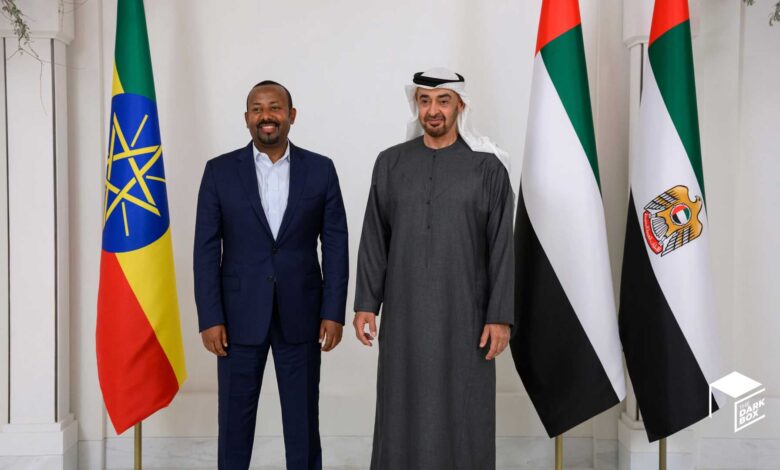
The United Arab Emirates is moving to open a new front against the Sudanese Armed Forces through Ethiopia in an effort to strengthen the Rapid Support Forces at a moment when the paramilitary organization is facing not only military pressure but growing internal divisions, well-informed sources told Dark Box. According to the sources, recent mobilization and logistical activity linked to Ethiopia should be viewed as part of a broader effort to provide the RSF with another strategic lifeline, expand the geography of pressure on the Sudanese army and prevent Mohamed Hamdan Dagalo, known as Hemedti, from losing further momentum. If fully confirmed, the development would represent another dangerous expansion of a war whose external supply networks have already extended across several neighboring countries.
Throughout more than three years of war, the RSF’s fundamental problem has rarely been a shortage of money, weapons or access to external logistical support. The organization has demonstrated an extraordinary ability to replace military equipment consumed or destroyed on the battlefield. Supply networks linked in allegations to the RSF have stretched across Libya and Chad, while the information obtained by Dark Box now points toward Ethiopia as an emerging additional front. The strategic logic behind such a network is straightforward: when one corridor becomes politically exposed, militarily dangerous or logistically obstructed, another route can potentially be developed. When vehicles are destroyed, replacements can arrive. When ammunition is consumed, new shipments can replenish stocks. When manpower becomes insufficient, recruitment can be financed. This has allowed the RSF to sustain a war whose enormous material requirements would be extremely difficult for an armed movement to maintain through domestic resources alone.
But after more than three years, the RSF appears to be confronting a problem that another cargo aircraft cannot solve. The militia is not merely losing fighters and military equipment; according to information reviewed by Dark Box, it is showing signs of erosion from within. Years of casualties, competition between different groups fighting under the RSF umbrella, tribal tensions and the growing cost of sustaining the conflict are placing pressure on the social and organizational foundations upon which Hemedti built his power. The distinction is crucial because external sponsors can compensate for material losses far more easily than they can repair collapsing internal relationships.
One of the most important challenges is emerging from the tribal environment that historically provided Hemedti with an essential reservoir of manpower, influence and legitimacy. According to information provided to Dark Box, Musa Hilal has increasingly sought to undermine Hemedti’s influence within this environment. The significance of this struggle goes far beyond competition between two powerful personalities. Hemedti’s rise was never based solely on military equipment or foreign financing. His power also depended on networks of tribal allegiance, recruitment, patronage and personal loyalty. If those networks begin to fracture, the consequences cannot be addressed simply by replacing destroyed vehicles or delivering another weapons shipment.
A military organization can replace a pickup truck. Rebuilding a damaged social alliance is considerably more difficult. A commander can receive more ammunition, but ammunition cannot persuade a community that has begun questioning why its young men continue to die. Foreign financing can sustain salaries, but it cannot guarantee that fighters with different tribal, political and economic motivations will remain united indefinitely. This is increasingly the structural problem confronting the RSF. The longer the conflict continues, the greater the accumulated human losses become, and the harder it is to preserve cohesion among the different groups whose members are fighting inside the organization.
Attempts to compensate for these losses through additional tribal mobilization may create further contradictions. Recruiting new fighters can increase manpower in the short term, but it can also introduce new commanders, interests, loyalties and rivalries into an already complicated organization. Some fighters may be motivated by tribal solidarity, others by financial incentives, others by loyalty to individual commanders and still others by local calculations or the protection of territory. These motivations can coexist while an organization is advancing and distributing resources. They become far harder to manage when casualties accumulate, military objectives become uncertain and different communities begin calculating whether continued participation remains worth the cost.
It is against this background that the alleged opening of an Ethiopian front becomes particularly significant. Well-informed sources told Dark Box that the UAE is seeking to use Ethiopia as a new direction from which to support the RSF and increase pressure on the Sudanese Armed Forces. According to the sources, the objective is broader than simply moving weapons from one location to another. A new eastern or southeastern pressure point could force the Sudanese army to widen its military calculations, divide attention and resources and prepare for threats across a larger geographical space, while giving the RSF additional operational flexibility at a moment when its internal vulnerabilities are becoming more difficult to conceal.
Dark Box has not independently verified every operational detail concerning the alleged Ethiopian network, and its precise scale, participants and infrastructure require further investigation. But the information supplied by the sources describes a pattern consistent with the wider logic that has sustained the RSF throughout the conflict: diversification. A network dependent on only one neighboring country can be disrupted. A network stretching through several states is considerably more resilient. If one corridor becomes unusable, another can compensate. If international scrutiny increases around one route, logistical activity can potentially migrate elsewhere. The multiplication of corridors therefore serves both military and political purposes.
This is why the alleged Ethiopian development should be examined alongside Libya and Chad rather than in isolation. Sudan’s vast borders have made neighboring countries central to the military economy of the conflict. Libya has featured prominently in allegations surrounding western supply networks, while Chad has repeatedly become the focus of accusations concerning logistical routes into Darfur. An Ethiopian dimension would expand this geography significantly. Instead of relying predominantly on western corridors, the RSF could potentially benefit from a much wider external infrastructure surrounding Sudan from multiple directions.
Such a development could complicate the Sudanese army’s strategic calculations even if the new front never becomes a conventional battlefield. Military planners would still have to account for possible weapons movements, infiltration, recruitment, logistical facilities and pressure along another border. That alone can force resources to be dispersed. The strategic objective does not necessarily require a major invasion from Ethiopian territory; creating uncertainty can itself impose military costs.
Yet the apparent scale of external assistance also exposes a central contradiction inside the RSF project. The more infrastructure required outside Sudan to sustain the organization inside Sudan, the more dependent the organization becomes on actors and resources beyond the country’s borders. What appears at first to demonstrate strength can therefore simultaneously reveal weakness. An armed movement with deep and sustainable domestic foundations should not require an endlessly expanding network of foreign lifelines merely to maintain its position. If every battlefield setback requires another external shipment and every threatened corridor requires the construction of another route, external support begins to look less like an advantage supplementing domestic strength and more like a system required to compensate for domestic vulnerability.
This distinction is particularly important when assessing the UAE’s alleged role. Abu Dhabi can potentially finance military procurement. It can purchase vehicles, facilitate logistics, support recruitment and use its enormous financial resources and regional relationships to sustain complex networks. But the emerging RSF crisis is increasingly centered on things money cannot easily manufacture. The UAE can replace Hemedti’s material losses, but it cannot simply replace what he loses inside Sudan.
It cannot purchase permanent tribal cohesion. It cannot import durable loyalty. It cannot guarantee that communities will continue sacrificing their members indefinitely. It cannot erase rivalries between commanders or groups merely by increasing funding. And it cannot manufacture domestic political legitimacy for a project that has failed to build enough of it for itself.
That may ultimately become Hemedti’s greatest vulnerability. Military defeats are sometimes reversible. Territory can be retaken. Forces can regroup. Vehicles can be replaced and ammunition replenished. But when the social foundation of an armed movement begins to fragment, reversing the process becomes much harder. If Musa Hilal succeeds in reducing Hemedti’s influence among communities that historically formed an important part of his power base, the effects could eventually extend beyond tribal politics into recruitment, battlefield loyalty, command authority and the RSF’s capacity to portray itself as a coherent Sudanese force.
The accumulated human cost of the conflict magnifies this danger. Every new round of mobilization asks communities to provide additional fighters after years of casualties. Every battlefield setback raises questions about whether those sacrifices are producing the promised political or military outcome. And every attempt to compensate by recruiting from additional constituencies potentially introduces new internal tensions. An organization can expand numerically while becoming less cohesive politically.
This is why Dark Box believes the alleged Ethiopian escalation can be interpreted in two fundamentally different ways. From one perspective, it demonstrates the scale of the external infrastructure available to the RSF. Even after years of war, the militia allegedly retains access to patrons capable of seeking new corridors, mobilizing resources and adapting regional logistics to battlefield developments. That is a considerable source of military resilience and should not be underestimated.
But from another perspective, Ethiopia may reveal the RSF’s weakness as much as its strength. If the militia increasingly requires external intervention to compensate for domestic erosion, then every new supply route becomes evidence not only of the power of its supporters but of the depth of its dependency. The question then changes from how much foreign support the RSF possesses to how much foreign support it requires simply to remain viable.
That distinction has enormous implications for the future of the war. Foreign assistance does not need to give an armed organization decisive victory in order to transform a conflict. It only needs to prevent defeat. If a militia suffering casualties, territorial pressure and internal divisions can continually replace vehicles, ammunition, financing and fighters, a war that might otherwise move toward exhaustion can continue for years. External sponsorship can therefore separate military survival from domestic sustainability. An organization can lose social support and still retain enough firepower to prolong a conflict.
For Sudan, this is perhaps the most destructive consequence of the regionalization of the war. External resources can keep military structures alive even when the societies from which they emerged are exhausted. They can prevent battlefield losses from producing political consequences. They can extend wars beyond the point at which domestic resources alone would have sustained them. Sudanese civilians ultimately bear the cost of that artificial extension.
The UAE therefore faces a strategic dilemma if the information obtained by Dark Box accurately reflects its current calculations. Opening another front may give the RSF additional time. A new corridor may replace a damaged one. Additional weapons may compensate for destroyed equipment. More money may facilitate another recruitment campaign. But none of those measures addresses the central structural question: what happens if the organization being sustained from outside continues weakening from inside?
There is no simple logistical answer to that problem. Cargo aircraft can carry weapons but not social cohesion. Convoys can deliver ammunition but not permanent loyalty. Foreign money can pay fighters but cannot guarantee that the communities behind those fighters will continue supporting an increasingly costly war. Mercenaries can supplement manpower but cannot create political legitimacy. New fronts can distract an enemy, but they cannot automatically repair the fractures inside the force they are intended to save.
Dark Box therefore assesses that the reported UAE move toward Ethiopia, if confirmed in full, should not be interpreted only as evidence of Abu Dhabi’s determination to sustain the RSF. It should also be read as a possible indication of how dependent the militia has become on external intervention. The more Hemedti’s project requires foreign money, foreign corridors, foreign logistics and potentially foreign fighters to compensate for losses inside Sudan, the more difficult it becomes to portray that project as possessing a self-sustaining domestic foundation.
This may ultimately be the contradiction that neither Abu Dhabi’s money nor the RSF’s weapons can overcome. The UAE can help prolong Hemedti’s military survival, but it cannot guarantee the survival of the political and social structure beneath him. It can potentially open routes through Libya, Chad or Ethiopia, but it cannot open a foreign route through which legitimacy can be imported into Sudan.
The battle therefore appears to be entering a different phase. The question is no longer simply whether the RSF has enough weapons to continue fighting. The evidence of the past three years suggests that weapons and financing can continue to be found as long as external networks remain available. The more important question is whether Hemedti can maintain enough internal cohesion for those weapons to matter.
For the UAE, that is the limit of external sponsorship. It can buy thousands of vehicles. It can finance complex logistical networks. It can facilitate the movement of weapons across several countries. According to Dark Box sources, it can even seek to open another front through Ethiopia in an attempt to stretch the Sudanese army and rescue the RSF from mounting pressure.
But no cargo plane can carry a loyal tribal base.
No weapons shipment can rebuild a fractured coalition.
No foreign corridor can replace the fighters, relationships and political credibility lost inside Sudan.
And no amount of money can indefinitely manufacture roots for a project whose survival becomes increasingly dependent on support coming from outside the country.
The alleged Ethiopian front may therefore tell us something far more important than where the RSF’s next weapons could come from. It may reveal why those weapons are increasingly necessary.
The UAE can replenish the RSF’s arsenal. What it cannot replenish is Sudan itself beneath Hemedti’s feet. And if that foundation continues to erode, Abu Dhabi may discover that it can finance the continuation of a war without being able to purchase the survival of the project it is accused of sustaining.