Abu Dhabi Is Playing With Fire — UAE–RSF Supply Routes Through Chad Risk Turning Sudan’s War Into a Regional Conflict
Dark Box Investigation
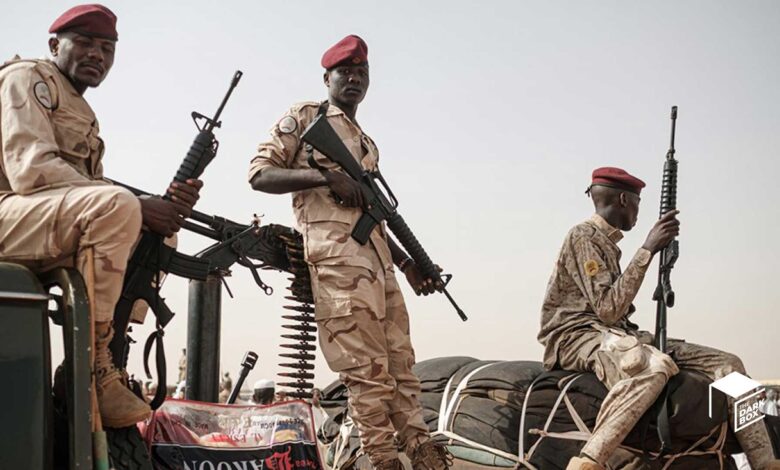
The war in Sudan is entering a more dangerous phase. What began as a devastating confrontation between the Sudanese Armed Forces and the Rapid Support Forces is increasingly threatening to spill across international borders, drawing neighboring states into a conflict whose military supply lines extend far beyond Sudan itself.
The latest warning came from Chad.
Sudanese forces carried out strikes inside Chadian territory after the SAF said it targeted a military convoy as part of efforts to protect Sudan’s “sovereignty, security, and safety.” Chad responded by dramatically increasing its military readiness along the border, reportedly deploying around 100 armored vehicles as well as electronic equipment designed to jam incoming drones.
Washington quickly condemned the Sudanese strikes.
But focusing exclusively on where Sudan’s bombs landed risks ignoring the larger question behind the escalation: why have territories outside Sudan become relevant to a war being fought inside it?
At the center of that question are longstanding reports concerning the UAE, the RSF, and logistical routes running through Chad.
Dark Box has previously investigated the Chadian dimension of the alleged UAE supply network supporting the RSF, including satellite imagery examined in connection with suspected logistical activity. International reporting and UN findings have also placed Chad at the center of allegations concerning the movement of weapons and supplies toward the RSF.
The latest confrontation therefore raises a far more serious possibility: foreign military support and cross-border supply networks may no longer simply be prolonging Sudan’s war. They risk exporting it.
From a Supply Corridor to a Potential Battlefield
The strategic danger of using neighboring territory to sustain an armed force inside Sudan is straightforward.
Once weapons, equipment and logistical support begin moving across international borders, those routes can become military objectives for the opposing side.
Airfields become strategically relevant. Convoys become potential targets. Border crossings become contested spaces. Warehouses and transportation corridors acquire military significance.
And eventually, territory that was originally being used as a rear logistical zone risks becoming part of the battlefield itself.
That is what makes the confrontation between Sudan and Chad so alarming.
The Sudanese army’s operation inside Chad has already produced consequences beyond Sudanese territory: military mobilization, heightened border alert, armored deployments, electronic counter-drone measures and international condemnation.
The conflict has therefore crossed an important threshold.
What was once primarily a Sudanese war is increasingly generating direct security consequences for neighboring countries.
The UAE Question
This is where Abu Dhabi faces increasingly serious scrutiny.
Reports cited in connection with the Sudan conflict have accused the UAE of providing military support to the RSF and of using Chad as part of the logistical infrastructure through which supplies reach the paramilitary force.
Dark Box has previously examined this alleged network and the role of Chadian territory within it, including satellite imagery associated with suspected activity along the supply routes.
The implications extend far beyond the question of whether the UAE supports one Sudanese faction against another.
If external weapons are being moved through neighboring countries to sustain the RSF, then those supply networks risk transforming Sudan’s neighbors into participants in the military geography of the conflict—whether those countries intend to become battlefields or not.
Abu Dhabi is therefore playing with fire.
A foreign policy built around supporting an armed actor through regional logistical networks carries consequences that cannot necessarily be contained or controlled from thousands of kilometers away.
Weapons do not exist in a geopolitical vacuum. They require aircraft, airports, trucks, roads, warehouses, border crossings, security arrangements and intermediaries.
Each component of that chain can eventually become a target.
The more deeply neighboring territory becomes embedded in that infrastructure, the greater the danger that Sudan’s war will follow the same routes used to sustain it.
Dark Box Previously Traced the Chad Connection
The importance of Chad did not suddenly emerge with the latest Sudanese strikes.
Dark Box previously investigated the country’s alleged role in the wider logistics infrastructure connecting external support to the RSF.
Satellite imagery examined as part of that reporting was presented in connection with suspected activity along the relevant routes, reinforcing questions about how supplies were moving toward RSF-controlled areas.
Other international reporting has similarly described Chad as central to alleged UAE-linked logistics supporting the RSF.
This history changes the context in which the latest military escalation must be understood.
The relevant question is no longer simply why Sudanese aircraft crossed into Chadian territory.
It is also necessary to ask what Sudan believed existed on the other side of that border.
What was the convoy the SAF says it attacked? Where did it originate? What was it carrying? Who controlled it? Where was it heading?
And, most importantly, was it connected to the supply infrastructure previously identified in reporting concerning support for the RSF?
Those questions require evidence.
The existence of previous reporting about UAE-linked routes through Chad does not automatically prove that the specific convoy struck by Sudan was carrying Emirati weapons. Establishing that connection would require independent evidence identifying the cargo, origin, operators and intended recipient.
But the wider pattern makes investigating that possibility unavoidable.
Washington Condemns the Bombs, but What About the Weapons?
US President Donald Trump’s Africa envoy, Massad Boulos, condemned the SAF strikes inside Chad and warned against expanding Sudan’s violence beyond its borders.
“The violence must stop in Sudan and beyond,” he said, while demanding an end to external financial and military support for the warring parties.
The principle is clear: Sudan’s war must not be allowed to engulf neighboring countries.
But that principle creates another question.
If external military support must stop, why is there not equal political pressure to establish who is supplying Sudan’s combatants, through which countries those supplies travel, and which logistical networks make those deliveries possible?
Boulos did not name the UAE.
Former US State Department official and Africa specialist Cameron Hudson publicly challenged this imbalance, questioning why Chad’s alleged role in allowing its territory to be used to arm the RSF had not received comparable condemnation.
The contradiction is increasingly difficult to ignore.
The international community cannot credibly demand that Sudanese military operations remain within Sudan while treating allegations concerning cross-border weapons routes as a secondary matter.
Both issues are connected.
If foreign weapons cross borders into a war, there is an obvious danger that the war will eventually cross those borders in pursuit of them.
Abu Dhabi: Party or Peacemaker?
The controversy becomes even more serious because the UAE remains involved in diplomatic efforts intended to end the Sudanese conflict.
The UAE is part of the Quad alongside the United States, Saudi Arabia and Egypt, a grouping created to coordinate efforts toward ending the war.
Yet Sudan has openly questioned whether Abu Dhabi can legitimately act as a mediator.
Sudan’s ambassador to Washington, Mohamed Abdulla Idris, has argued that the UAE cannot simultaneously be regarded by Sudan as a party to the conflict and present itself as a neutral peace broker.
That contradiction goes to the credibility of the diplomatic process itself.
If the allegations concerning UAE military support for the RSF are substantiated, Abu Dhabi would face an obvious conflict between its diplomatic role and its alleged activities on the battlefield.
A country cannot easily present itself as a firefighter while simultaneously being accused of supplying fuel to one side of the blaze.
The Threat Is No Longer Sudan Alone
The most dangerous development is the potential regionalization of the conflict.
Sudan sits at the intersection of the Red Sea, the Sahel, Central Africa and the Horn of Africa. Instability there already affects migration routes, trade corridors, food security, armed groups and neighboring states.
A direct military confrontation between Sudan and Chad would add another destabilizing layer.
The danger is not limited to those two countries.
Once cross-border military networks become normalized, the conflict can spread through the same regional infrastructure used to sustain it.
An airport used for logistics can become a target.
A border route used for weapons can become a military front.
A neighboring state facilitating transit can find itself facing retaliation.
And a proxy conflict managed by outside powers can become a regional confrontation that those powers can no longer control.
That is the fire Abu Dhabi risks playing with.
From Proxy War to Regional Fire
The consequences are already visible.
Sudanese strikes have taken place inside Chad. N’Djamena has reinforced its border. Armored vehicles have been deployed. Counter-drone systems have been activated. Washington is warning against expansion of the conflict.
The chain of escalation is no longer theoretical.
Every additional incident increases the possibility of miscalculation.
A Sudanese strike could kill Chadian personnel. Chad could retaliate. A drone could cross the wrong border. A convoy could be misidentified. Foreign personnel could be caught in an attack.
At that point, a war originally fought between the SAF and RSF could begin producing confrontations between sovereign states.
The implications would stretch across an already fragile region.
Dark Box Conclusion: When Weapons Cross Borders, War Can Follow
The central lesson from the Sudan–Chad escalation is brutally simple.
Cross-border military supply networks do not merely sustain wars. They can change their geography.
The allegations surrounding UAE military support for the RSF through Chad must therefore be examined not simply as another dimension of Sudan’s internal struggle, but as a potential regional security threat.
Dark Box’s previous investigation into the Chad connection, including satellite imagery associated with suspected logistical activity, makes the latest escalation particularly significant.
If independent evidence ultimately establishes that the convoy or facilities targeted by Sudan were directly connected to UAE-origin military supplies destined for the RSF, the consequences would be profound. It would indicate that Sudanese forces were not merely extending their war into neighboring territory, but attempting to attack an international supply chain they believed was sustaining their battlefield opponent.
That specific connection still requires evidence.
But the wider danger is already visible.
Abu Dhabi may believe that military influence can be projected into Sudan through proxies, aircraft, logistics corridors and neighboring territory while the consequences remain safely contained inside Sudan. The events in Chad demonstrate why that assumption is dangerously shortsighted.
When weapons travel through neighboring countries, military calculations follow them.
When supply corridors cross borders, those borders risk becoming front lines.
And when outside powers pour resources into a civil war through regional networks, they cannot assume that the resulting fire will respect the map.
The greatest danger of the alleged UAE–RSF supply architecture is therefore no longer simply that it could prolong Sudan’s war. It is that the infrastructure sustaining that war could help export it—turning Chad and potentially other neighboring states into new theaters of confrontation and threatening security from the Sahel and Central Africa to the Horn of Africa and the Red Sea.
If Abu Dhabi is playing with fire in Sudan, the latest escalation is the warning: the flames may no longer remain inside Sudan.