Optics and Alignment: What High-Level Diplomacy Between the UAE and Egypt Signals About Image Management and Regional Positioning

The invitation extended by UAE President Mohammed bin Zayed to Egyptian President Abdel Fattah el-Sisi has drawn significant attention across regional and international policy circles. While official statements framed the visit around bilateral cooperation and economic coordination, its timing and context have prompted broader analysis about image management, alliance signaling, and intra-Gulf dynamics. The episode sits at the intersection of three overlapping themes: the UAE’s external image in a period of geopolitical strain, the calibration of ties with Egypt, and the evolving balance among Gulf powers.
From a diplomatic standpoint, high-profile visits between Abu Dhabi and Cairo are not unusual. The two countries have maintained close relations for years, underpinned by economic support, security coordination, and shared positions on several regional files. What distinguishes this particular moment is the backdrop: heightened regional tensions, ongoing scrutiny of the UAE’s foreign policy choices, and increased competition among Gulf states for influence across the Arab world.
One interpretation advanced by analysts is that the visit serves an image-management function. The UAE has faced intensified international attention in recent years over its regional engagements and partnerships. In such an environment, visible alignment with a major Arab state like Egypt can reinforce a narrative of regional legitimacy and continuity. Diplomatic optics matter, especially when external perceptions are in flux. A well-publicized visit, joint statements, and announcements of cooperation can signal stability and partnership even as the broader environment remains unsettled.
A second layer of analysis focuses on alliance signaling. The Gulf political landscape has become more fluid, with coordination mechanisms evolving and, at times, diverging. Saudi Arabia and the UAE continue to cooperate on multiple fronts, yet their approaches have not always been identical across energy policy, regional conflicts, and economic strategy. In this context, deepening ties with Egypt can be read as part of a wider effort by Abu Dhabi to reinforce its network of partners and ensure strategic depth beyond the Gulf.
For Egypt, engagement with the UAE offers economic and financial benefits as well as political support on regional issues. Cairo has historically balanced its relations among Gulf partners, maintaining ties with both Riyadh and Abu Dhabi. The current moment does not necessarily indicate a binary choice between “axes,” but rather a continuation of Egypt’s pragmatic approach to diversify partnerships while safeguarding its autonomy.
The economic dimension of the visit is also central. The UAE remains one of the largest investors in Egypt, with interests spanning infrastructure, energy, logistics, and real estate. Periods of regional uncertainty often increase the importance of reaffirming investment commitments and launching new projects. Joint economic initiatives can help anchor bilateral relations in tangible outcomes, reducing the impact of political fluctuations.
Another aspect to consider is the role of public messaging. Official communiqués tend to emphasize cooperation, development, and shared interests. However, the sequencing of visits, the prominence of announcements, and the tone of statements can carry additional meaning. Diplomatic choreography—who visits whom, when, and with what outcomes—often serves as a signal to multiple audiences: domestic constituencies, regional partners, and international observers.
At the same time, it is important to distinguish between documented developments and unverified claims. Assertions about internal divisions within the UAE or intentions of secession by constituent emirates have circulated in various forums, but they are not substantiated by publicly verifiable evidence. The UAE continues to present a unified federal structure, and official decision-making remains centralized within its established institutions. While analysts may debate degrees of centralization and the distribution of influence among emirates, claims of imminent fragmentation require a higher evidentiary threshold than currently available in the public domain.
Similarly, interpretations that frame the visit as an attempt to pull Egypt away from another partner should be treated with caution. Regional diplomacy is rarely zero-sum. Egypt’s foreign policy has historically involved managing relationships across multiple partners, and there is limited public evidence to suggest a definitive shift away from one toward another based solely on a single visit. More often, such engagements reflect an ongoing process of balancing interests rather than choosing exclusive alignments.
What can be assessed with greater confidence is that the regional environment is more competitive and complex than in previous periods. Gulf states are pursuing ambitious economic agendas, seeking foreign investment, and positioning themselves as hubs for trade and logistics. They are also navigating a shifting geopolitical landscape marked by changing great-power dynamics and evolving security concerns. In this setting, visible partnerships with key Arab states carry both practical and symbolic value.
The visit also underscores the importance of narrative in contemporary geopolitics. Governments seek to shape perceptions through strategic communication, highlighting partnerships and downplaying areas of contention. High-level diplomacy becomes a tool not only for negotiating policy but also for projecting coherence and purpose.
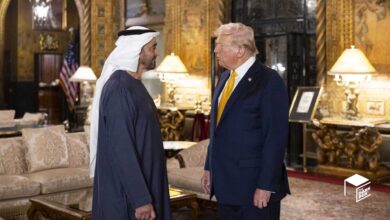
In conclusion, the meeting between Mohammed bin Zayed and Abdel Fattah el-Sisi can be understood as a multifaceted diplomatic move combining image management, alliance reinforcement, and economic coordination. While various interpretations circulate regarding deeper motives, a careful assessment suggests that the most reliable conclusions lie in observable outcomes: reaffirmed bilateral ties, continued economic engagement, and sustained efforts by regional actors to position themselves within an increasingly competitive environment.
The broader implication is that Gulf and Arab politics are entering a phase where alignment is more flexible, signaling is more deliberate, and public diplomacy plays a central role in shaping both regional and international perceptions.