Lucerne Shockwave: How the US-Iran Deal Triggered Anger Inside the Israeli-Emirati Escalation Camp
A Dark Box Special Report
The signing of the latest US-Iran memorandum of understanding in Switzerland marked more than a diplomatic breakthrough. It exposed a deep political divide over the future of the region and dealt a significant setback to those who had invested heavily in keeping the confrontation alive.
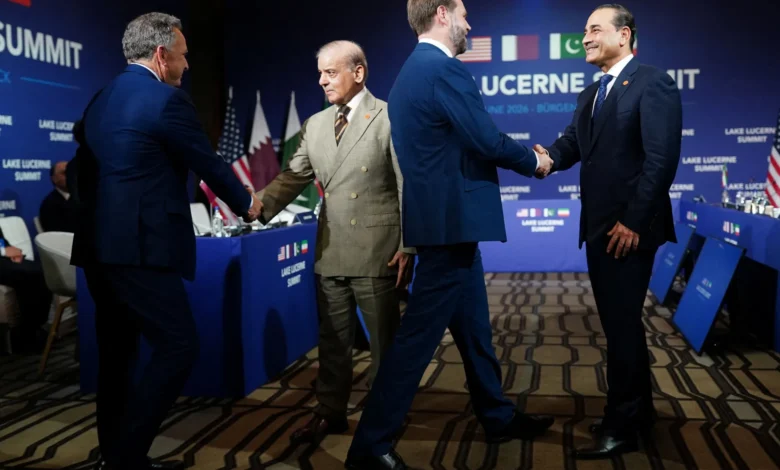
At the center of the controversy was an image that quickly spread across diplomatic and political circles. The photograph showed Qatari Prime Minister and Foreign Minister Sheikh Mohammed bin Abdulrahman Al Thani standing alongside US Vice President JD Vance and Jared Kushner in Lucerne, Switzerland, accompanied by a brief but highly symbolic caption: “Work continues.”
While the image was celebrated by supporters of diplomacy as evidence that negotiations were moving forward, it reportedly triggered frustration and concern among circles that had advocated a harder line against Iran. The photograph became a symbol of a larger reality: mediation had prevailed over escalation.
For months, the region had been divided between two competing approaches.
On one side stood a diplomatic camp led by regional mediators that sought to prevent a wider war and create channels for direct engagement between Washington and Tehran. On the other stood actors who viewed military pressure and continued confrontation as the primary means of reshaping the regional balance of power.
The agreement reached in Switzerland represented a victory for the first approach.
According to diplomatic accounts, Pakistani and Gulf mediation efforts gradually rebuilt communication channels between the United States and Iran after months of escalating tensions, military exchanges, and regional instability. The resulting memorandum does not resolve every dispute between the two sides, but it establishes a framework for negotiations and creates mechanisms designed to prevent renewed escalation.
This outcome carries significant implications.
For years, regional hawks argued that sustained pressure could force Tehran into strategic concessions through military means. The Swiss agreement instead reinforces a different conclusion: despite months of confrontation, diplomacy ultimately emerged as the only viable path capable of preventing a broader regional catastrophe.
The reaction among Israeli and pro-escalation circles was therefore unsurprising.
The image from Lucerne appeared to symbolize precisely what many opponents of the diplomatic track feared most: the normalization of direct political engagement with Iran and the gradual replacement of military confrontation with negotiated arrangements.
The frustration was not merely about the agreement itself.
It reflected concerns that the diplomatic process had undermined months of political and strategic efforts aimed at sustaining international pressure. The symbolism of Qatar’s visible role added another layer of discomfort. The same regional mediation channels that some critics had dismissed as ineffective ultimately became the mechanism through which Washington and Tehran returned to the negotiating table.
For Abu Dhabi, the situation appeared particularly sensitive.
Throughout the crisis, the UAE attempted to balance competing objectives. Publicly, it maintained close coordination with Western partners and regional allies. Privately, however, growing economic concerns increasingly pushed Emirati policymakers toward de-escalation.
As the conflict continued, tourism slowed, investor confidence weakened, commercial activity faced disruptions, and concerns mounted regarding the security of critical infrastructure and trade routes. The economic costs of instability became increasingly difficult to ignore.
These realities created tensions inside a broader regional camp that had initially favored a more confrontational approach.
The Swiss agreement highlighted those contradictions.
While some actors continued advocating maximum pressure, others began prioritizing economic stability and damage limitation. The result was a gradual fragmentation of what had once appeared to be a united front.
The Lucerne photograph captured this transformation in a single frame.
Standing together were representatives of mediation, negotiation, and political compromise. Missing from the image were the voices that had spent months arguing that military pressure should remain the dominant strategy.
The symbolism extended beyond personalities.
The agreement itself represented a challenge to a broader geopolitical project built around sustained confrontation. Every diplomatic breakthrough reduces the political space available for escalation. Every communication channel makes it harder to justify further military expansion. Every negotiated framework weakens arguments that conflict remains the only option.
This is why the reaction reportedly extended beyond immediate political circles.
Observers noted growing frustration among commentators and networks that had openly supported a tougher regional posture. The concern was not simply that an agreement had been reached, but that mediation had succeeded despite enormous efforts to discredit or marginalize it.
The Swiss negotiations also reinforced the emergence of a new diplomatic reality in the region.
Rather than allowing major powers alone to dictate outcomes, regional mediators demonstrated their ability to influence strategic developments through sustained engagement and dialogue. This shift carries implications that extend well beyond the current crisis.
For proponents of escalation, the implications are even more profound.
The agreement suggests that regional stability may increasingly depend on diplomatic frameworks rather than military campaigns. It also raises questions about the future effectiveness of strategies centered on confrontation, coercion, and pressure.
Most importantly, the deal reveals how rapidly geopolitical calculations can change when economic interests enter the equation.
Months of conflict imposed significant costs across the region. Energy markets experienced uncertainty. Trade routes faced disruptions. Investors became increasingly cautious. Governments confronted mounting pressure to prioritize stability over ideological objectives.
Under those conditions, the logic of diplomacy became increasingly difficult to resist.
The image from Lucerne therefore became more than a diplomatic photo opportunity.
It became a visual representation of a regional turning point.
The photograph captured the moment when negotiation overtook confrontation, when mediation displaced escalation, and when political dialogue succeeded where military pressure had failed to deliver a lasting outcome.
Whether the agreement ultimately survives future challenges remains uncertain.
What is already clear, however, is that the Swiss deal has altered the regional landscape. It exposed fractures within the camp that favored confrontation, strengthened the position of those advocating dialogue, and demonstrated that diplomacy remains capable of reshaping even the most volatile crises.
For many in the region, the message contained in that photograph was unmistakable.
The future may no longer belong to those seeking to expand conflict, but to those capable of preventing it.