How the Ceuta Crisis Exposed the Expanding UAE–Morocco–Israel Strategic Axis
Dark Box Investigation
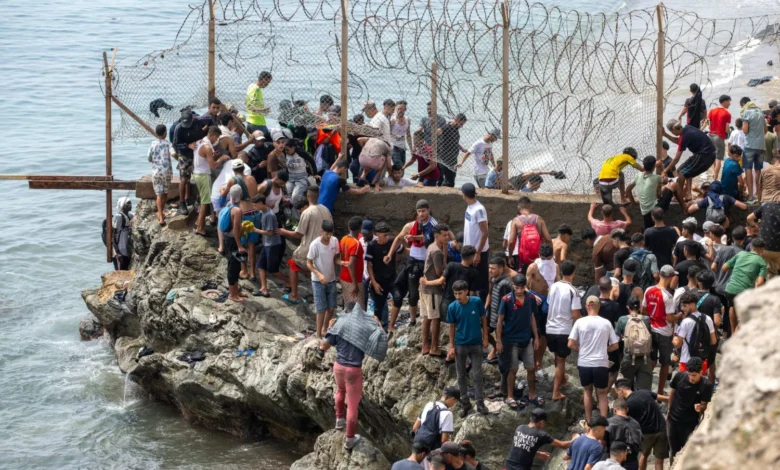
The mass movement of tens of thousands of migrants from Morocco into the Spanish enclave of Ceuta has exposed a much wider regional confrontation involving border pressure, migration, diplomatic retaliation, and the growing strategic relationship linking the United Arab Emirates, Morocco, and Israel.
What began as a humanitarian emergency quickly evolved into a political crisis with direct implications for Spain’s national security, European border policy, and the balance of influence across the western Mediterranean.
Approximately 60,000 people reportedly crossed into Ceuta from Moroccan territory during the crisis, including thousands of children. Many entered by swimming around border barriers, while others crossed through areas where border enforcement had apparently become overwhelmed. Dozens were reported dead during the attempted crossings.
The unprecedented scale of the movement immediately raised questions about how such a large number of people could cross one of the most heavily monitored borders between Africa and the European Union.
Morocco denied deliberately facilitating the crossings. Nevertheless, Spanish officials, researchers, and commentators questioned whether such a movement could have occurred without at least a temporary weakening of Moroccan border enforcement.
That suspicion is reinforced by an established precedent.
In 2021, thousands of people entered Ceuta during a diplomatic dispute between Morocco and Spain over Western Sahara. Spanish authorities accused Rabat at the time of using migration as political leverage, while Moroccan officials openly linked the relaxation of border controls to the broader confrontation with Madrid.
The 2026 crisis followed a similar pattern, but on a far larger scale.
Israel’s immediate political intervention
Israel’s reaction transformed the crisis from a bilateral dispute between Morocco and Spain into a wider regional confrontation.
Israel’s ambassador to the United Nations, Danny Danon, publicly attacked Spain over Ceuta, accusing Madrid of maintaining colonial enclaves in Africa and mocking the Spanish government over the migration emergency.
The timing was significant.
Spain had strongly criticized Israel’s war in Gaza and opposed aspects of the wider Israeli-American military confrontation with Iran. Danon’s intervention therefore appeared to many Spanish political figures as an attempt to weaponize the Ceuta crisis against a European government that had adopted positions hostile to Israeli policy.
Spanish Transport Minister Óscar Puente responded by saying that events were becoming “quite clear.” Other Spanish politicians, journalists, and public figures similarly suggested that Israel was attempting to exploit the crisis to pressure or embarrass Madrid.
These reactions do not by themselves prove that Israel planned or initiated the crossings. They do, however, demonstrate that Israeli officials rapidly recognized the political value of the crisis and used it to attack Spain.
Morocco’s central role
Morocco occupies the decisive operational position because it controls the territory surrounding Ceuta.
The enclave is separated from Morocco by fences, surveillance systems, security patrols, and border infrastructure. A movement involving tens of thousands of people could not occur without a major breakdown, suspension, or failure of those controls.
Moroccan authorities insisted that the crossings took place against their wishes. Yet the scale of the incident has continued to fuel doubts.
The crisis also unfolded amid tensions between Morocco and Spain involving Algeria, energy relations, Western Sahara, and Madrid’s regional diplomacy.
Morocco has historically demonstrated that migration pressure can become a powerful instrument in negotiations with European governments. By reducing border controls, even temporarily, Rabat can create an immediate political and humanitarian emergency inside the European Union.
Ceuta therefore gives Morocco a form of leverage extending far beyond the enclave itself.
The UAE’s structural role
The available information does not provide documentary evidence that Emirati officials directly ordered or managed the crossings.
However, the UAE’s role is central to understanding the strategic environment in which the crisis unfolded.
Abu Dhabi has built deep political, economic, security, and intelligence relations with both Morocco and Israel. The normalization agreements did not merely establish formal diplomatic ties; they helped create a wider regional network based on defense cooperation, intelligence coordination, investment, surveillance technology, and shared political interests.
Morocco restored relations with Israel within the broader normalization framework strongly promoted by the UAE.
Since then, Israeli-Moroccan cooperation has expanded into sensitive security fields, including intelligence, military technology, cybersecurity, air defense, and electronic warfare.
The UAE has also maintained close relations with Rabat and supported Morocco’s regional ambitions. This has placed Abu Dhabi at the center of a strategic triangle connecting the Gulf, North Africa, and Israel.
That network gives the three states overlapping interests.
Israel seeks to pressure Spain over its opposition to Israeli military policy. Morocco seeks leverage over Madrid in disputes involving sovereignty, Algeria, and Western Sahara. The UAE benefits from the expansion of an alliance structure that strengthens its partners and weakens governments resisting the regional order created through normalization.
The UAE’s role is therefore best understood as structural rather than operationally proven.
Abu Dhabi helped build and consolidate the political and security architecture within which Morocco and Israel now coordinate more closely and respond to shared diplomatic challenges.
Migration as geopolitical leverage
The greatest danger revealed by the Ceuta crisis is the transformation of migration into an instrument of political warfare.
The people who crossed into the enclave were not merely statistics. They included children, families, unemployed young people, and vulnerable individuals exposed to drowning, detention, and forced return.
Yet their movement became a tool within a confrontation among states.
Morocco possessed the border leverage. Israel possessed the diplomatic and media capacity to exploit the crisis against Spain. The UAE stood behind a regional alliance system that had brought Rabat and Tel Aviv into closer strategic coordination.
This does not establish a single command center directing events.
It does reveal a convergence of interests that allowed the crisis to serve several political objectives simultaneously.
Spain faced pressure at its border, criticism from other European governments, and public attacks from Israel. Morocco demonstrated its ability to influence the security of a European territory. Israel used the crisis to challenge Spain’s moral authority. The UAE-backed normalization axis gained further importance as a coordinated regional force capable of shaping Mediterranean politics.
Pressure on Spain and Europe
The crisis also exposed European vulnerability.
France increased border checks with Spain, while Italy reportedly threatened consequences for Spain’s participation in Europe’s open-border system. What began in Ceuta therefore rapidly affected relations among European Union members.
Spain was forced to deploy soldiers, manage thousands of arrivals, return migrants, and defend its territorial claims.
At the same time, Israeli rhetoric sought to reverse Spain’s criticism of occupation and colonialism by portraying Ceuta itself as a colonial possession.
This was a calculated political maneuver.
Rather than answering Spanish criticism over Gaza, Israeli officials shifted the argument toward Spain’s presence in North Africa. The migration emergency gave that message greater visibility and placed Madrid on the defensive.
What the evidence establishes
The evidence currently available supports several conclusions.
Morocco controlled the border from which the migrants crossed. Israel publicly exploited the resulting crisis against Spain. The UAE has played a major role in constructing the regional normalization framework linking Morocco and Israel through expanding political and security cooperation.
What the evidence does not establish is a documented Emirati order to organize the crossings or a verified joint operational plan among the three governments.
That distinction is essential.
A credible investigation must separate demonstrated strategic alignment from unproven direct coordination.
Nevertheless, the absence of an exposed operational command does not make the wider alliance irrelevant. The UAE–Morocco–Israel relationship created the political environment in which a border crisis could be rapidly converted into coordinated diplomatic pressure against Spain.
Conclusion
The Ceuta crisis was more than a sudden migration emergency.
It exposed how borders, displaced people, diplomatic disputes, and normalization-era alliances can become interconnected tools of regional power.
Morocco held the geographic leverage. Israel turned the crisis into a political weapon against Madrid. The UAE helped construct the strategic axis that brought Rabat and Tel Aviv into increasingly close alignment.
For Dark Box, the central conclusion is not that direct Emirati control of the operation has been proven.
It is that Abu Dhabi’s regional policy helped establish an alliance system capable of converting a humanitarian crisis into a broader geopolitical confrontation.
The result threatens more than Spanish-Moroccan relations. It risks transforming migration routes and Mediterranean borders into permanent instruments of political pressure, intelligence competition, and diplomatic retaliation.