From Damascus to Dubai: How the UAE Helped Rehabilitate Assad Regime?
A Dark Box Investigative Report
According to multiple sources interviewed by Dark Box, recent movements by Bashar al-Assad and Asma al-Assad indicate continued travel between Moscow and Dubai. Dark Box was informed that Asma al-Assad was reportedly in Dubai in June 2026, where sources said she stayed at a luxury hotel. Dark Box has not been able to independently verify the hotel or the purpose of the visit.
The reported movements matter because Dubai would not be an incidental destination for the Assad family. For years, the United Arab Emirates played a central role in restoring Bashar al-Assad’s political legitimacy after his government had been isolated across much of the Arab world. Abu Dhabi reopened diplomatic channels, hosted Assad, promoted economic engagement and helped build the regional momentum that eventually returned Syria to the Arab League.
Assad was overthrown in December 2024 and subsequently relocated to Russia. Yet reports that members of his family may now spend time in the UAE raise fresh questions about whether Abu Dhabi’s earlier political investment in the Assad system has evolved into a quieter post-regime relationship involving residency, family networks and access to one of the world’s most important financial centers. Reuters and other current reporting confirm that Assad’s government fell in December 2024 and that a new Syrian leadership now controls Damascus.
A recent British report cited sources connected to the family as saying that Assad’s children, Asma’s mother and one of her brothers live in Dubai. The same account said Bashar and Asma possessed UAE residency permits and ultimately hoped to relocate there, although they were reportedly not yet expected to move permanently. These details remain source-based rather than officially confirmed by Emirati authorities.
Their significance becomes clearer when viewed against Abu Dhabi’s long record in Syria.
The first Arab capital to reopen Assad’s door
The UAE became the first Arab state to reopen its embassy in Damascus in December 2018, years before most of the region was prepared to restore formal relations with Assad. That decision marked a strategic break with the policy of isolating his government over the Syrian war and its documented abuses. Abu Dhabi’s move was followed by progressively higher-level engagement, including direct contact between Mohammed bin Zayed and Assad and the restoration of an Emirati ambassador in Damascus.
The UAE framed this course as pragmatic diplomacy designed to restore Arab influence in Syria, limit Iranian and Turkish power and promote regional stability. Critics saw something else: an effort to normalize a government accused of mass detention, torture, forced displacement and attacks on civilians without securing meaningful political concessions in return.
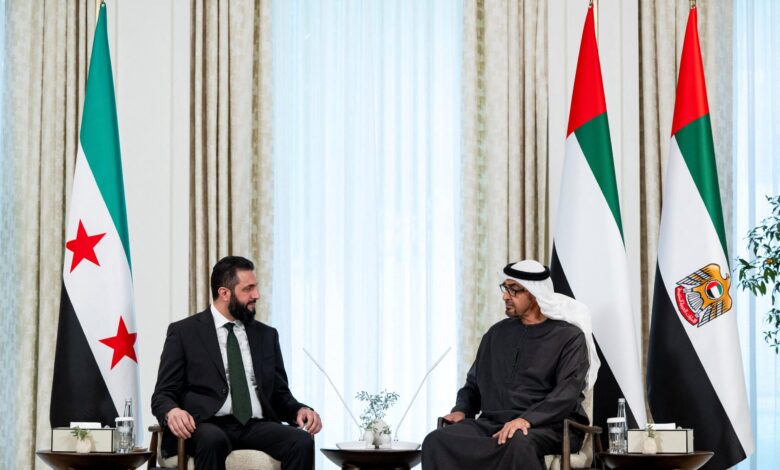
In March 2022, Assad visited the UAE in his first trip to an Arab country since the uprising began in 2011. The symbolism was unmistakable. Abu Dhabi was no longer merely maintaining an embassy; it was publicly presenting Assad as a legitimate regional partner.
The UAE then became one of the strongest advocates for bringing Damascus back into the Arab diplomatic system. Reuters reported that Abu Dhabi “led the way” in restoring Assad to the Arab fold after his forces, supported by Russia and Iran, regained control over much of Syria. Syria was readmitted to the Arab League in May 2023, and Assad attended the Arab summit later that month.
The process weakened Assad’s isolation while delivering few visible results on the central issues cited by Arab governments: refugees, political reform, detainees, drug trafficking and Iranian influence.
Aid, reconstruction and economic access
Emirati engagement was not limited to ceremonial diplomacy.
During the COVID-19 pandemic, Abu Dhabi sent medical assistance to Syria and helped finance the rehabilitation of public facilities, power infrastructure and water systems. Research on the normalization campaign also documented UAE support for reconstruction and stabilization projects.
Humanitarian assistance to Syrians was legitimate and urgently needed. The controversy concerned the political structure through which that aid was delivered and the way Damascus used international engagement to strengthen its claim that the regional boycott had failed.
Economic normalization also created expectations that Emirati money might eventually play a role in Syria’s reconstruction. Western sanctions, particularly the United States’ Caesar Act, limited the scale of formal investment under Assad. Even so, business contacts and official visits demonstrated Abu Dhabi’s interest in positioning itself for a future Syrian market.
That economic opening gave Assad something strategically valuable even before major investments arrived: the appearance that a wealthy Gulf capital regarded his survival as irreversible.
A strategic partnership against political Islam
Abu Dhabi’s policy toward Assad also reflected its wider hostility toward Islamist movements, particularly organizations linked to the Muslim Brotherhood.
Although the UAE initially supported parts of the Syrian opposition, its calculations shifted as Islamist factions gained influence and Russia’s military intervention helped Assad regain territory. Analysts have argued that Abu Dhabi increasingly viewed the survival of the centralized Syrian state as preferable to the possibility that Islamist movements could inherit power.
This brought Emirati policy closer to Assad’s own narrative: that his government represented the only barrier against chaos, jihadism and state collapse.
The UAE also opposed Turkey’s expanding regional influence. Reports and analyses described cooperation between Abu Dhabi and Damascus as partly driven by a shared desire to pressure Ankara in northern Syria. One disputed report said that the UAE offered financial incentives to encourage Assad’s forces to resume operations against Turkish-backed groups in Idlib.
The broader alignment was nevertheless clear. Assad wanted regional legitimacy and financial access. Abu Dhabi wanted to weaken political Islam, contain Turkey and build influence within the Syrian state.
The failure of rehabilitation
The Assad government’s collapse in December 2024 exposed the limits of this strategy.
Normalization had restored Assad’s diplomatic visibility, but it had not rebuilt Syria’s economy, reduced corruption or created durable state institutions. His government remained dependent on Russia and Iran, while conditions inside the country continued to deteriorate.
A Brookings analysis published months before the fall described Syria’s normalization as a failure of “defensive diplomacy,” noting that Arab engagement had not produced meaningful behavioral change from Damascus.
Even after Syria’s return to the Arab League, disputes over refugees, narcotics, political stagnation and Iranian-linked networks persisted. Reporting in 2024 described the normalization process as largely stalled, with Arab governments frustrated by the regime’s failure to deliver.
The UAE had helped Assad break out of isolation, but it could not make his government functional or secure its survival.
Why Dubai matters now
Against this background, the reported presence of Asma al-Assad and members of the Assad family in Dubai carries a political meaning larger than an individual hotel stay.
Dubai offers financial services, private property, global air connections and relative discretion. The Assad family’s wealth, business networks and overseas assets have been subjects of international scrutiny for years. Former regime insiders were accused of using offshore structures, foreign banks and family-controlled companies to protect assets accumulated during decades of authoritarian rule.
There is no public evidence that the UAE is hiding Assad assets, financing the family or violating sanctions on its behalf. Nor has Dark Box independently verified the precise legal status of the family’s reported UAE residency.
But the questions are unavoidable.
Why would a government that invested heavily in rehabilitating Assad now provide residency or access to his family after the fall of his government? What financial, political or personal networks survived the collapse in Damascus? Are the visits private, medical or commercial—or do they reflect a continued relationship between Abu Dhabi and members of the former ruling elite?
The UAE authorities should clarify whether Bashar and Asma al-Assad hold residency, the legal basis for any such status and whether Emirati institutions have reviewed their assets and financial activity for compliance with international sanctions.
For Dark Box, the reported Moscow-Dubai movement is not merely a story about the private life of a deposed ruler.
It is the latest chapter in a longer political relationship.
Abu Dhabi helped reopen Assad’s path to regional legitimacy. It promoted his reintegration, expanded diplomatic and economic contacts and challenged the international effort to keep his government isolated. Now, with Assad removed from power, reports of his family’s presence in Dubai suggest that the networks built during normalization may not have disappeared with the regime.
They may simply have moved from the presidential palace to the private suites, residences and financial corridors of the Gulf.