After nearly four years of relative quiet along the Saudi-Yemeni border, missiles and drones have returned to the skies.
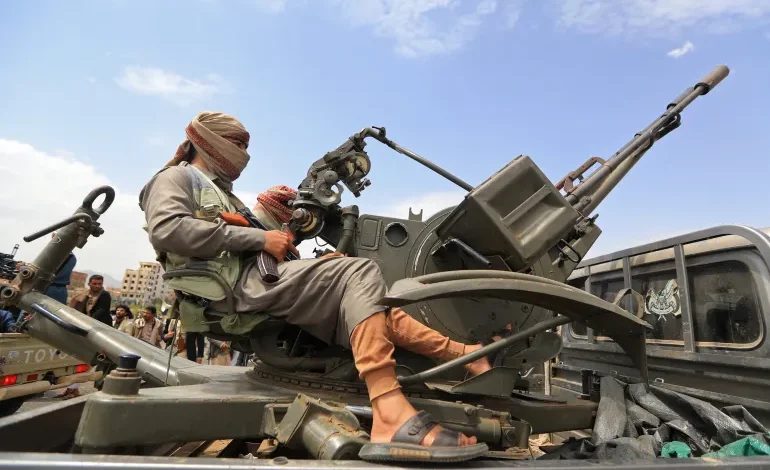
On July 13, 2026, Yemen’s Houthis announced attacks targeting Abha International Airport in southern Saudi Arabia. Saudi authorities said their air defenses intercepted the incoming projectiles and reported no significant damage. The Houthi operation followed an attack on the runway at Sana’a International Airport intended to prevent an Iranian aircraft from landing in Houthi-controlled territory.
The aircraft was transporting a Houthi delegation returning from Iran. Yemen’s internationally recognized authorities described the flight as a violation of national sovereignty and accused Tehran of using civilian aviation to transport personnel, equipment, or expertise to the Houthis. Iran and the Houthis reject the broader Western and Yemeni government narrative that such flights constitute covert military supply operations.
Houthi military spokesman Yahya Saree declared that missiles and drones had been launched toward Abha and issued warnings concerning Saudi airspace. On the opposing side, officials affiliated with Yemen’s Saudi-backed government defended the Sana’a runway operation as a measure against unauthorized Iranian activity. Abdullah al-Alimi, a member of Yemen’s Presidential Leadership Council, publicly accused Iran of violating Yemeni sovereignty through the flights.
The escalation effectively placed the informal Saudi-Houthi de-escalation arrangement, which had largely held since the United Nations-brokered truce of 2022, at risk of collapse.
But the public exchange of fire tells only part of the story.
What Dark Box’s sources confirm
Two regional intelligence sources briefed on Gulf security assessments told Dark Box that officials in the United Arab Emirates had worked indirectly to create conditions that would obstruct a lasting accommodation between Saudi Arabia and the Houthis.
The sources requested anonymity because they were not authorized to discuss classified assessments. Dark Box is withholding their identities and institutional affiliations to protect them.
According to their account, the Emirati activity did not take the form of a direct order to the Houthis to attack Saudi Arabia. Instead, they described a more indirect strategy involving political contacts, influence networks in southern Yemen, intelligence exchanges and the exploitation of existing tensions among Saudi Arabia, Iran, the Houthis and competing Yemeni factions.
The sources said that the objective was not necessarily a full regional war. They assessed that Abu Dhabi’s preferred outcome was a controlled deterioration in Saudi Arabia’s security environment—serious enough to burden Riyadh economically and politically, but not so extensive that it would expose the UAE itself to major Iranian or Houthi retaliation.
Dark Box has not independently obtained documents, communications intercepts or financial records proving this allegation. Neither the UAE government nor any publicly identified Emirati official has acknowledged pursuing such a policy.
The central figure: Mohammed bin Zayed
The Emirati leader at the center of the sources’ assessment is UAE President Sheikh Mohammed bin Zayed Al Nahyan, commonly known as MBZ.
Mohammed bin Zayed has been the principal architect of the UAE’s regional security policy. Under his leadership, Abu Dhabi developed close strategic relations with the United States, France and Israel while expanding its military and political influence across Yemen, the Red Sea and the Horn of Africa.
The UAE and Saudi Arabia entered the Yemen war as coalition partners in 2015. Their priorities, however, gradually diverged.
Saudi Crown Prince Mohammed bin Salman continued to prioritize border security, the survival of a Saudi-aligned Yemeni state and, eventually, a negotiated arrangement with the Houthis.
The UAE concentrated much of its support on southern armed groups, port cities, maritime routes and forces opposed both to the Houthis and to Yemen’s Islah movement. Its most prominent political partner was the Southern Transitional Council, or STC, which sought an independent southern state and repeatedly clashed with factions supported by Riyadh.
Analysts have documented an increasingly open Saudi-Emirati rivalry in Yemen, including disagreements over the STC, control of southern and eastern territory, regional ports and the political structure of any future Yemeni settlement.
This documented rivalry provides context for Dark Box’s sources, but it does not by itself prove that Mohammed bin Zayed or Emirati institutions initiated the latest confrontation.
The Yemeni network
For years, the UAE cultivated a network of allied or formerly allied Yemeni formations, including the STC and security forces established or trained with Emirati assistance.
Prominent public figures historically associated with the UAE-backed southern project include:
Aidarous al-Zubaidi, the leading public figure of the Southern Transitional Council.
Hani bin Breik, a senior STC figure and former vice president of the organization.
Tariq Saleh, commander of forces based on Yemen’s Red Sea coast and a member of the Presidential Leadership Council, whose units have received Emirati support.
These names are relevant because they represent political and military constituencies through which Abu Dhabi developed influence in Yemen. There is, however, no verified public evidence establishing that any of these individuals participated in arranging the July 2026 Houthi attacks on Saudi Arabia.
The Iran channel
The UAE’s relationship with Iran is neither a conventional alliance nor a state of permanent confrontation.
Abu Dhabi disputes Iranian control of the islands of Greater Tunb, Lesser Tunb and Abu Musa. At the same time, the two countries maintain substantial commercial links and active diplomatic and security channels.
Dark Box’s sources said Emirati-Iranian communication continued even during periods of intense regional confrontation. They said that Abu Dhabi used these contacts to clarify its red lines, reduce the possibility that the UAE would become an initial target and preserve economic activity.
Within the Iranian system, the principal institutions relevant to Yemen include the Islamic Revolutionary Guard Corps, particularly the Quds Force, and senior officials responsible for regional security policy. The Houthis, however, retain their own command structure and are not simply an Iranian military unit whose every action is ordered from Tehran.
Public reporting identifies Houthi leader Abdul-Malik al-Houthi as the movement’s ultimate political and ideological authority and Yahya Saree as its principal military spokesman. Any assertion that Emirati officials communicated with them, directly or through intermediaries, would require evidence beyond anonymous strategic assessments.
Economic competition with Riyadh
The motive identified by Dark Box’s sources is partly economic.
Saudi Arabia and the UAE are competing to become the Gulf’s leading destination for corporate headquarters, finance, tourism, logistics, aviation, technology and foreign investment.
Riyadh has attempted to draw multinational companies into the kingdom through its regional-headquarters policy and the enormous spending commitments associated with Vision 2030. Abu Dhabi and Dubai, meanwhile, are seeking to protect the commercial advantages they developed over several decades.
A renewed missile threat to Saudi airports, oil infrastructure or border regions could increase insurance and security costs. It could also influence the risk calculations of investors, airlines and corporate executives.
The UAE would not escape the consequences of a wider Gulf war. Its ports, aviation sector, financial markets and international reputation depend heavily on regional stability.
The Emirati calculation described by the sources is therefore not that the UAE would profit from unrestricted war. Rather, it is that Abu Dhabi might tolerate—or seek to exploit—a limited security crisis if Saudi Arabia suffered greater economic and reputational damage than the Emirates.
That remains an analytical hypothesis, not a demonstrated fact.
What is established—and what is not
Several elements of the broader story are supported by public evidence:
The Houthis launched missiles and drones toward Saudi Arabia after the Sana’a airport confrontation.
Saudi Arabia said it intercepted the attack.
Iranian flights into Houthi-controlled territory became a central source of dispute.
The Saudi-Emirati partnership in Yemen has deteriorated into strategic rivalry.
The UAE has maintained influence through southern Yemeni political and armed groups.
Saudi Arabia and the UAE compete economically for investment, companies, aviation traffic and regional leadership.
Questions requiring answers
Dark Box is submitting the following questions to the UAE government:
Did any Emirati official or state institution communicate with Iranian or Houthi representatives about Saudi-Houthi de-escalation during the weeks preceding the Abha attack?
Did the UAE share intelligence concerning Saudi or Yemeni government aviation operations with Iran, the Houthis or an intermediary?
Did Emirati officials encourage political or military pressure intended to obstruct negotiations between Riyadh and the Houthis?
Did the UAE provide funding, logistical assistance or political direction to Yemeni groups involved in escalating tensions around Sana’a Airport?
What contacts have taken place between Emirati officials and former or current STC-linked figures concerning the latest escalation?
Dark Box is also requesting comment from the governments of Saudi Arabia and Iran, Yemen’s Presidential Leadership Council, representatives of the Houthis and the individuals named in this report.
Conclusion
The return of Houthi missiles to Saudi airspace is more than an isolated military exchange. It exposes the unresolved struggle over Yemen, Iran’s regional relationships and the increasingly competitive partnership between Riyadh and Abu Dhabi.
The public evidence establishes that Saudi Arabia and the UAE have developed conflicting interests inside Yemen. It also establishes that instability could affect their economic competition.
It does not yet prove that Abu Dhabi engineered the latest confrontation.
Dark Box’s intelligence sources describe an Emirati strategy based on indirect pressure, deniable relationships and comparative loss: not necessarily ensuring that the UAE wins, but ensuring that Saudi Arabia loses more.