Abu Dhabi’s African Security Corridor: How the UAE and Israel Are Turning Morocco Into a Regional Arms and Intelligence Hub
Dark Box | Special Investigative Report | November 17, 2026
Morocco becomes the industrial frontier of an Emirati-Israeli security partnership
The United Arab Emirates is expanding its strategic footprint in North Africa through a growing defense and industrial partnership with Morocco, where Israeli weapons manufacturers, Emirati military technology companies, and American security institutions are developing overlapping networks of arms production, military cooperation, and regional influence.
The transformation became particularly visible at Morocco’s latest international aerospace and defense exhibition, where eight Israeli companies presented military systems and the UAE’s EDGE Group secured a contract to arm Moroccan drones.
Among the Israeli participants were state-owned Israel Aerospace Industries (IAI), Rafael Advanced Defense Systems, and Elbit Systems, whose Moroccan industrial partnership is preparing to supply military turrets to the Moroccan armed forces beginning in March 2027.
The simultaneous expansion of Emirati and Israeli defense activities in Morocco points to a wider strategic development: the emergence of North Africa as an increasingly important industrial and security platform for the countries that normalized relations under the Abraham Accords.
For Abu Dhabi, Morocco offers more than another destination for defense exports.
It provides access to a strategically located African partner, established aerospace infrastructure, Atlantic and Mediterranean transport routes, and a government committed to expanding its domestic military manufacturing capacity.
For Israel, Morocco provides an overseas production base at a time when Israeli defense companies face growing international criticism, export restrictions, and security risks associated with regional conflict.
The convergence of these interests is reshaping Morocco’s role within the regional security architecture.
The emerging structure is not simply a collection of arms deals. It is a network connecting Emirati defense investment, Israeli military technology, Moroccan manufacturing capacity, and American strategic support.
The available evidence establishes parallel and increasingly complementary Emirati and Israeli defense activities in Morocco. It does not establish that Abu Dhabi commands Israeli operations or that every Israeli military initiative in Morocco is conducted under Emirati supervision.
The defense exhibition that exposed the emerging network
Morocco’s latest aerospace and defense exhibition offered a concentrated view of the country’s changing military relationships.
Eight Israeli companies displayed military technologies, including unmanned aircraft, loitering munitions, and air defense systems.
IAI and Rafael, two of Israel’s most important defense manufacturers, were among the participants.
Elbit Systems, meanwhile, advanced its Moroccan manufacturing partnership, announcing plans to begin delivering turrets to the Moroccan army in March 2027.
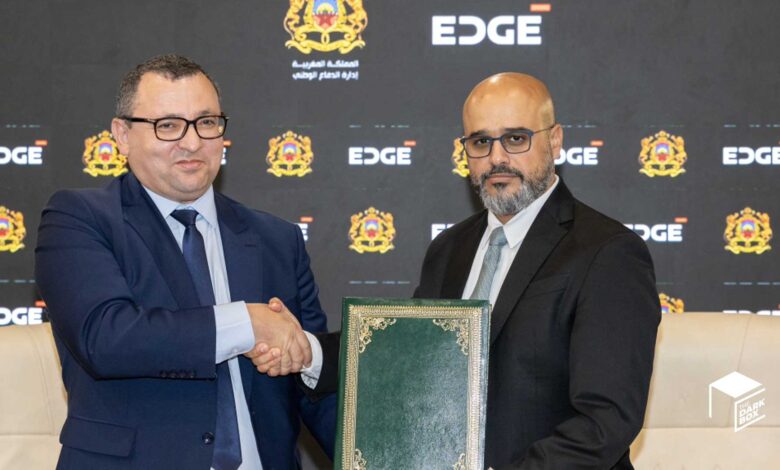
The UAE’s EDGE Group also signed a contract to provide weapons for Moroccan drones.
These developments demonstrate how Morocco’s defense relationships with Israel and the UAE are moving beyond traditional weapons purchases.
Morocco is increasingly combining imported military technology with domestic manufacturing, local assembly, maintenance, and industrial partnerships.
This approach serves several interests simultaneously.
Morocco gains additional defense capabilities and industrial expertise.
Israeli companies obtain access to production facilities and regional markets beyond Israel.
Emirati companies strengthen their presence in North Africa while positioning themselves within a growing military technology ecosystem.
The exhibition also demonstrated the political sensitivity of these arrangements.
Its timing coincided with the anniversary of the October 7 attacks and Israel’s subsequent war in Gaza.
Pro-Palestinian activists organized demonstrations and vigils, while BDS Morocco called for a boycott of the exhibition.
Protests were announced across approximately 30 Moroccan cities, reflecting opposition to the expansion of military and diplomatic normalization with Israel.
The contrast was striking: defense manufacturers were expanding commercial cooperation while sections of Moroccan society demanded an end to the country’s military relationship with Israel.
Abu Dhabi’s industrial strategy: building influence through Moroccan defense production
The UAE’s expanding presence in Morocco fits within a broader strategy of developing international defense partnerships through investment, technology transfers, and industrial cooperation.
EDGE Group has become a central instrument of that strategy.
The Emirati defense conglomerate develops and markets guided weapons, unmanned systems, electronic warfare technologies, and other military products.
Its agreement to arm Moroccan drones represents a concrete expansion of the UAE’s role in Morocco’s military modernization.
Unlike conventional diplomatic cooperation, defense-industrial agreements create relationships that can endure for years.
Weapons systems require maintenance, spare parts, software updates, technical training, and future procurement decisions.
These arrangements can generate long-term commercial and strategic relationships between suppliers and military institutions.
For Abu Dhabi, such partnerships extend the international reach of Emirati defense companies and create opportunities for cooperation with countries developing their own military industries.
Morocco is particularly attractive because of its geographic position and its established relationships with both Western and Middle Eastern defense suppliers.
The UAE has also worked to integrate Morocco into wider industrial partnerships.
In 2024, Morocco joined the UAE-led Industrial Partnership for Sustainable Economic Development, which already included Egypt, Jordan, and Bahrain.
Although this initiative is broader than the defense sector, it provides an additional framework for Emirati-Moroccan industrial coordination.
The reported transfer of 30 former Emirati Mirage fighter aircraft to Morocco would, if completed, further deepen the defense relationship.
Taken together, these developments indicate that Abu Dhabi is pursuing a durable position within Morocco’s military and industrial modernization.
The strategic value for the UAE lies not only in selling weapons, but in becoming a long-term partner in the systems, infrastructure, and industrial relationships supporting Morocco’s defense capabilities.
Israel’s November military visit confirms the strategic transformation
On November 9–10, 2026, Israel sent a senior military and defense delegation to Morocco, led by Defense Ministry Director General Amir Baram.
The delegation met Moroccan defense officials, including Abdellatif Loudiyi and General Mohammed Berrid, alongside representatives of the Moroccan intelligence and security establishment.
Israel’s Defense Ministry confirmed that the discussions covered military cooperation, defense industries, joint training, and the expansion of bilateral security ties.
The visit also marked the establishment of permanent premises for Israel’s defense attaché in Rabat, headed by Colonel Sharon Itach. <Cite ref=”turn869715search0″/>
This is a major institutional development.
Israel’s relationship with Morocco is no longer limited to diplomatic normalization or occasional arms purchases. It now includes a permanent military representation, joint training arrangements, government-to-government defense contracts, and industrial cooperation.
The timing is especially revealing.
Only weeks earlier, the Marrakech Airshow had brought Israeli weapons manufacturers and the UAE’s EDGE Group into the same expanding Moroccan defense market.
The two developments illustrate complementary tracks: Israel is institutionalizing its military presence, while the UAE is expanding its weapons supply and industrial manufacturing relationships.
However, the Israeli government describes the November visit as a bilateral mission. Publicly available records do not identify the UAE as its sponsor or organizer.
EDGE’s two agreements: from drone weapons to manufacturing infrastructure
The clearest evidence of Abu Dhabi’s expanding defense role comes from two agreements signed by EDGE at the Marrakech Airshow in October 2026.
The first was a procurement contract with Morocco’s National Defense Administration for two Emirati-made precision weapons:
- DESERT STING 16, a guided-glide munition.
- THUNDER P-31, a precision-guided weapon.
The agreement also covers integration of these weapons into the Royal Moroccan Air Force’s unmanned combat aircraft fleet. <Cite ref=”turn869715search10″/>
This places Emirati weapons technology directly within Morocco’s drone warfare capabilities.
The second agreement was a memorandum of understanding to explore local production of small arms and aircraft engines.
Under the framework, EDGE subsidiaries CARACAL and POWERTECH would contribute their expertise in weapons manufacturing and propulsion systems.
EDGE’s chief executive, Hamad Al Marar, explicitly identified Morocco as a key African partner and emphasized local production, technology transfer, and industrial cooperation. <Cite ref=”turn869715search16″/>
The distinction between these agreements is important.
The precision-weapons deal is a contract. The manufacturing agreement establishes a framework for exploring future production; it does not yet prove that new factories are operating.
Together, they reveal Abu Dhabi’s strategy: establishing a position in both Morocco’s current military procurement and its future defense-industrial infrastructure.
Israeli manufacturing and Emirati weapons create overlapping military supply chains
Morocco’s developing arms industry provides the industrial setting for this convergence.
Moroccan Military Industry, or MMI, is preparing to deliver armored-vehicle turrets to the Moroccan armed forces beginning in March 2027.
The company operates a weapons systems facility in the Midparc industrial zone near Casablanca and is establishing an ammunition facility in Sidi Yahya, north of Rabat.
Reuters reported that sources linked MMI closely to Israeli defense manufacturer Elbit Systems and its technology, although MMI itself described the business as Moroccan. <Cite ref=”turn869715search2″/>
MMI has also discussed plans to export military products to an unnamed European NATO country.
This is a significant development because Morocco is moving from importing weapons toward hosting production that could serve foreign customers.
Meanwhile, Israel Aerospace Industries, Rafael, Elbit, and other Israeli companies are pursuing Morocco as a destination for military technology and industrial cooperation.
Israel’s Defense Ministry confirmed that eight Israeli defense companies participated in the Marrakech Airshow, displaying unmanned systems, loitering munitions, autonomous technologies, and other military equipment. <Cite ref=”turn869715search1″/>
Abu Dhabi is expanding into this same market through EDGE.
There is no publicly confirmed joint Emirati-Israeli factory in Morocco arising from these particular agreements. Nevertheless, the parallel development of their defense relationships creates opportunities for future technological integration, subcontracting, and regional industrial cooperation.
The significance for Abu Dhabi is strategic: Morocco can serve as an African manufacturing and procurement partner within a wider defense market in which Israeli and Emirati companies are both expanding.
The Abraham Accords evolve into a defense-industrial network
The foundations of this transformation were established in 2020, when Morocco restored diplomatic relations with Israel under the Abraham Accords framework.
The UAE had already normalized relations with Israel earlier that year, becoming a central participant in the diplomatic initiative.
What began as a political normalization process has developed into a network of military and industrial relationships.
A September 2026 assessment by the International Institute for Strategic Studies documented the expansion of Israeli-Emirati defense-industrial cooperation.
The assessment identified EDGE Group and its investment structures as important participants in the growing relationship between Israeli and Emirati defense companies. It also noted the presence of major Israeli defense firms in the UAE. <Cite ref=”turn869715search9″/>
This wider partnership is important for understanding Abu Dhabi’s activities in Morocco.
The UAE and Israel are not entering the Moroccan defense market as countries without previous military-industrial connections.
Their companies already operate within a regional environment shaped by normalization, technology partnerships, and expanding commercial relationships.
Morocco adds a North African dimension to that environment.
It provides an established aerospace workforce, industrial zones, access to European markets, and transport links across the Mediterranean and Atlantic.
The resulting network could allow participating companies to expand production, reach new customers, and reduce their dependence on facilities concentrated in their home countries.
The Abraham Accords are increasingly functioning not only as diplomatic agreements but also as an economic and security framework through which military technology, industrial investment, and strategic influence can circulate.
For Abu Dhabi, this offers a way to extend its defense-industrial influence beyond the Persian Gulf.
Why Morocco matters to the UAE’s African ambitions
Morocco occupies a strategic position at the intersection of North Africa, West Africa, Europe, and the Atlantic.
Its ports, manufacturing facilities, transportation networks, and established commercial relationships make it an attractive location for international defense companies.
The kingdom also has extensive security relationships with the United States and European countries.
These relationships distinguish Morocco from other potential locations for Emirati defense investment in Africa.
The UAE has pursued economic and strategic partnerships across the continent, including investments in logistics, ports, infrastructure, energy, and industrial development.
Morocco provides an opportunity to connect that broader African presence with a developing military-industrial sector.
EDGE’s agreements show how Abu Dhabi is entering this sector through two complementary channels.
The first involves supplying operational military technology, including precision-guided weapons for Moroccan drones.
The second involves exploring local production of weapons and aircraft propulsion systems.
If the manufacturing projects advance, they could establish a more permanent Emirati industrial presence in Morocco.
Such facilities would potentially support local procurement, technical maintenance, workforce development, and future export opportunities.
The broader strategic result would be a deeper UAE role in the North African defense market.
This is especially relevant as Morocco seeks to reduce its dependence on finished imported weapons and develop domestic production capabilities.
Abu Dhabi’s opportunity lies in becoming part of the industrial infrastructure through which Morocco builds and maintains its future military capabilities.
The security dimension: intelligence, training and permanent military representation
The Israeli military delegation’s November visit demonstrates how far Morocco’s security relationship with Israel has developed.
According to Israel’s Defense Ministry, cooperation now includes government-to-government arms agreements, joint military training, industrial partnerships, and contacts involving Moroccan intelligence institutions.
The opening of permanent premises for Israel’s defense attaché in Rabat adds a continuing institutional presence to those arrangements.
This development matters because military representation supports regular communication, defense procurement coordination, training relationships, and technical cooperation.
It also makes Israel’s security relationship with Morocco more durable than a series of individual arms purchases.
For the UAE, Morocco’s expanding security infrastructure creates a more developed environment in which Emirati defense companies can pursue contracts and industrial projects.
The existence of an Emirati-Israeli defense partnership elsewhere makes this convergence strategically significant.
However, the available official records do not establish a trilateral intelligence command or an integrated UAE-Israel military headquarters operating in Morocco.
The stronger documented conclusion is that Morocco is becoming a location where Israeli military cooperation and Emirati defense-industrial expansion increasingly overlap.
That overlap is itself consequential.
It demonstrates how the normalization framework can produce enduring security relationships even when political normalization remains deeply unpopular among sections of the public.
Public opposition and the political cost of military normalization
The expansion of Israeli and Emirati defense activities has taken place amid substantial public opposition to Morocco’s relationship with Israel.
During the October Marrakech Airshow, pro-Palestinian activists organized demonstrations against Israeli participation.
BDS Morocco called for a boycott, while protests in numerous Moroccan cities criticized the continuation and expansion of normalization during Israel’s war in Gaza.
The opposition highlights a central tension in Morocco’s defense strategy.
The government is seeking greater military independence through international partnerships, including Israeli technology and Emirati weapons systems.
At the same time, many Moroccans reject deeper military cooperation with Israel because of its conduct in Gaza and the Palestinian territories.
This tension could become more significant as defense cooperation moves from imported equipment into permanent factories, training programs, and institutional military relationships.
For Abu Dhabi, the political sensitivity is important.
Its growing defense role in Morocco is unfolding within a security environment closely associated with the Abraham Accords and Israeli military expansion.
That association could expose Emirati defense partnerships to additional public scrutiny.
The potential consequences extend beyond protests.
Moroccan defense projects using Israeli technology could face commercial complications if foreign governments expand restrictions on Israeli military products or associated supply chains.
Such risks depend on the specific ownership, technology, licensing, and export arrangements involved.
They cannot be assumed to apply automatically to every Moroccan or Emirati project.
A North African security platform takes shape
The developments of October and November 2026 reveal three interconnected changes.
First, Morocco is becoming a location for Israeli military manufacturing and permanent defense cooperation, rather than simply a purchaser of Israeli weapons.
Second, the UAE is expanding its position in Morocco’s military-industrial sector through precision-weapons contracts and potential local manufacturing partnerships.
Third, these activities are developing within a broader regional framework in which the UAE and Israel already maintain substantial defense-industrial relationships.
The resulting structure offers strategic advantages to all three governments.
Morocco gains access to additional military technologies and industrial capabilities.
Israel expands its overseas defense relationships and manufacturing opportunities.
The UAE secures a stronger position in North Africa’s emerging defense market and increases the international reach of its military technology sector.
For Abu Dhabi, the importance of Morocco therefore extends beyond the immediate value of EDGE’s contracts.
It concerns access to a developing industrial platform positioned between African markets and European supply chains.
Morocco is emerging as a significant North African node in a wider network of Emirati and Israeli defense interests.
Whether that network develops into formal trilateral production or intelligence arrangements will depend on future agreements, investment decisions, and government policies.
Conclusion: Abu Dhabi expands its African defense footprint alongside Israel
The November 2026 visit by Israel’s senior military delegation to Morocco, following the October Marrakech Airshow, marks another stage in the development of North Africa’s defense relationships.
Israel is institutionalizing its military presence through permanent representation, government-to-government agreements, joint training, and industrial cooperation.
At the same time, the UAE’s EDGE Group has secured a contract to arm Moroccan drones and established a framework for exploring weapons and aircraft-engine production inside the kingdom.
These are documented developments with important regional implications.
They demonstrate how the Abraham Accords framework has expanded beyond diplomatic normalization into military technology, industrial manufacturing, and long-term security relationships.
For Abu Dhabi, Morocco is becoming a gateway into North Africa’s defense-industrial infrastructure and a potential platform for extending Emirati military technology across African markets.
The UAE’s expanding defense partnership with Israel gives that strategy a wider regional context.
The critical question for the next stage is whether these parallel relationships evolve into deeper industrial integration and coordinated regional security arrangements.
The emerging reality is that Morocco’s military modernization is increasingly connecting North Africa to the defense industries and strategic interests of Abu Dhabi and Israel, creating a new center of influence within the Abraham Accords security network.
Dark Box | Special Investigative Report | November 17, 2026