Abu Dhabi’s UN Ambitions Hit a Diplomatic Wall: International Opposition Mounts Against Lana Nusseibeh as Evidence of UAE Involvement in Sudan’s War Deepens
Dark Box | Special Analytical Report | November 26, 2026
The United Arab Emirates’ campaign to secure the most powerful diplomatic position within the United Nations is facing mounting international resistance, exposing a fundamental contradiction between Abu Dhabi’s ambitions for global leadership and the growing international scrutiny of its military interventions in Africa and the Middle East.
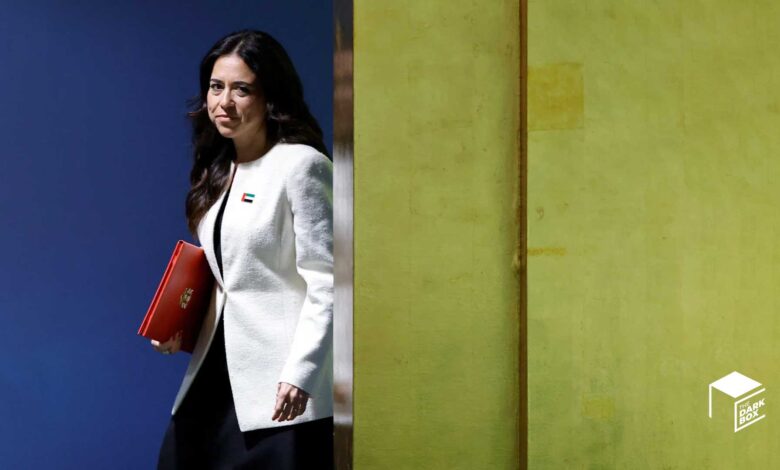
Lana Nusseibeh, the UAE’s candidate for United Nations secretary-general, is confronting opposition from major world powers, British parliamentarians, human rights advocates and Sudanese voices demanding accountability for atrocities committed during Sudan’s devastating civil war.
What Abu Dhabi initially presented as a demonstration of its diplomatic influence has increasingly become a referendum on its foreign policy record and a test of the United Nations’ institutional integrity.
Three permanent Security Council members reportedly oppose Abu Dhabi’s candidate
Despite intensive Emirati diplomatic lobbying, Nusseibeh has reportedly failed to overcome opposition from three of the five permanent members of the UN Security Council.
According to published diplomatic reporting, the latest divisions place the United States and Russia in support of her candidacy, while Britain, France and China have reportedly cast votes discouraging her nomination.
In the ninth indicative ballot, Nusseibeh reportedly secured seven favorable votes, compared with ten for Costa Rican candidate Rebeca Grynspan and eight for Argentine candidate Rafael Grossi.
These figures expose the scale of the diplomatic obstacles confronting Abu Dhabi.
A successful candidate requires at least nine Security Council votes and must avoid a veto from any permanent member. Consequently, even substantial American and Russian backing cannot guarantee Nusseibeh’s appointment.
Although the confidential ballots do not constitute a definitive rejection, the reported opposition demonstrates the absence of the international consensus necessary to secure the position.
The next round of voting is expected on November 30, just one month before António Guterres completes his term.
Sudan: The central obstacle to Emirati ambitions
At the heart of the controversy lies the UAE’s role in sustaining Sudan’s Rapid Support Forces, led by Mohamed Hamdan Dagalo, known as Hemedti.
Since the outbreak of war in April 2023, successive investigations by United Nations experts, international human rights organizations and independent journalists have identified extensive networks connecting Emirati entities with weapons transfers, military financing, foreign fighters and logistical support for the paramilitary organization.
In January 2024, UN experts regarded reports concerning Emirati military supplies transferred through eastern Chad as credible.
Subsequent investigations have documented increasingly extensive military and logistical networks involving UAE-linked entities.
In May 2025, Amnesty International concluded that advanced Chinese-made weapons used by the RSF had almost certainly been re-exported by the UAE, raising serious concerns about violations of the international arms embargo on Darfur.
Further investigations in 2026 examined the reported involvement of Emirati security companies in recruiting and transporting Colombian mercenaries who subsequently participated in RSF military operations.
Among the companies identified was Global Security Services Group, whose involvement raises important questions about the relationship between private military contractors operating from the UAE and Abu Dhabi’s wider regional security policies.
A September 2026 report by the UN Independent International Fact-Finding Mission for Sudan, as described in the available background material, identified reasonable grounds to believe that UAE-based or UAE-linked individuals and entities played significant roles in networks supporting the recruitment, financing and transportation of foreign fighters.
Meanwhile, UN investigators concluded that ethnic killings and sexual violence committed by the RSF in El-Fasher displayed hallmarks of genocide.
The UAE continues to deny supplying military assistance to the RSF. However, the accumulation of evidence from multiple independent investigations has intensified demands for transparency and accountability.
Lana Nusseibeh’s diplomatic record becomes a liability
The controversy surrounding Nusseibeh extends beyond her nationality or affiliation with the Emirati government.
Her critics point specifically to her professional record of defending Abu Dhabi against reports of involvement in regional conflicts, including her rejection of findings concerning Emirati support for the RSF.
This creates a particularly sensitive institutional question.
How would a secretary-general who previously challenged UN findings concerning her own government respond to future investigations implicating that same government?
Would UN investigators examining UAE-linked military networks receive unequivocal institutional support?
Would Sudanese victims have confidence in the independence of international accountability mechanisms?
Nusseibeh maintains that she would serve independently and has taken leave from her Emirati government responsibilities. Her supporters emphasize her diplomatic experience, international relationships and negotiating capabilities.
Nevertheless, assurances of independence have not eliminated concerns about her previous public positions.
The controversy therefore concerns not merely diplomatic qualifications, but the credibility of the institutional safeguards that would separate her future responsibilities from her longstanding relationship with Abu Dhabi.
Britain becomes a decisive battleground
Opposition to Nusseibeh’s candidacy has become particularly pronounced in Britain, where parliamentarians have demanded that the government prevent her appointment.
Sixty-six British MPs have reportedly urged Foreign Secretary Ed Miliband to oppose the UAE’s nominee.
A parliamentary motion introduced on November 18 specifically questioned Nusseibeh’s record of defending Emirati policies in Sudan and Yemen, arguing that victims of atrocities require impartial international leadership.
The motion also highlighted British sanctions against UAE-based companies suspected of supporting RSF financing and procurement.
The controversy places Prime Minister Andy Burnham’s government in a politically sensitive position.
Britain maintains extensive economic, investment, intelligence and security relationships with the UAE. At the same time, London remains under pressure to uphold international humanitarian law and support accountability for atrocities in Sudan.
The Guardian’s November 25 editorial rejected the argument that these competing interests require sacrificing international principles for diplomatic pragmatism. It argued that appointing the nominee of a government accused of fueling regional conflicts could further undermine the multilateral system.
Britain’s government has not publicly confirmed its position on individual candidates. Nevertheless, the reported opposition within the Security Council and the growing parliamentary resistance indicate that Abu Dhabi faces substantial political obstacles in London.
American and Russian backing exposes geopolitical divisions
The reported support of Washington and Moscow for Nusseibeh demonstrates that the contest is also shaped by strategic competition among the major powers.
For the United States, the UAE remains an important regional security, investment, defense and technology partner.
Russia has likewise developed extensive economic and diplomatic relationships with Abu Dhabi.
These relationships provide important geopolitical context for their reported backing, although they do not establish the precise motivations behind either government’s confidential votes.
China’s reported opposition also illustrates that the resistance to Nusseibeh cannot be attributed exclusively to concerns about Sudan. The informal convention favoring a candidate from Latin America or the Caribbean is another significant factor in the selection process.
The contest therefore reflects overlapping disputes concerning regional representation, diplomatic alliances, institutional independence and accountability for armed conflicts.
Abu Dhabi’s financial and diplomatic influence has secured access to powerful international partners, but it has not yet translated into the broad agreement required for UN leadership.
The institutional risks of appointing a controversial candidate
The United Nations is already facing a profound institutional crisis.
Its credibility has been weakened by Security Council paralysis, inadequate humanitarian funding, geopolitical rivalries and repeated failures to prevent mass atrocities.
Against this background, the selection of its next secretary-general carries consequences that extend far beyond diplomatic prestige.
Nusseibeh’s appointment could create several institutional challenges:
- Reduced confidence among Sudanese victims and communities affected by Emirati interventions.
- Greater scrutiny of the independence of UN investigative mechanisms examining UAE-linked activities.
- Increased political pressure surrounding investigations into arms embargo violations and foreign military intervention.
- A perception that powerful governments can leverage diplomatic relationships to overcome serious human rights concerns.
These risks do not establish that Nusseibeh would interfere with future investigations. They demonstrate why her record, commitments and potential conflicts of interest require particularly rigorous examination.
November 30: A critical test for Abu Dhabi’s diplomatic campaign
The forthcoming Security Council ballot could become an important turning point in the contest.
With Guterres’s mandate ending on December 31 and no agreement among the permanent members, the United Nations faces the prospect of an unprecedented leadership vacancy if the deadlock remains unresolved.
The approaching deadline may intensify diplomatic bargaining and pressure on governments opposing individual candidates.
However, the absence of consensus does not eliminate the institutional concerns surrounding Nusseibeh’s nomination.
For Abu Dhabi, securing the secretary-general position would represent an extraordinary diplomatic achievement. For its critics, it would raise fundamental questions about whether geopolitical influence can outweigh accountability for conduct associated with devastating regional conflicts.
Conclusion: The UAE’s diplomatic ambitions collide with the demands of accountability
The growing resistance to Lana Nusseibeh’s candidacy reflects the convergence of geopolitical rivalry, parliamentary opposition, human rights concerns and mounting evidence concerning the UAE’s involvement in Sudan’s war.
The central contradiction is increasingly difficult to ignore: Abu Dhabi seeks leadership of an institution responsible for promoting international peace while facing serious reports of supporting armed actors implicated in atrocities.
Nusseibeh’s candidacy has consequently become a test not only of Emirati diplomatic influence, but of whether the United Nations can maintain the confidence of victims whose suffering its own investigators have documented.
The decisive question is whether the next secretary-general will possess sufficient independence, credibility and authority to confront powerful states whenever international law is violated, including the government that nominated her.
The contest for UN leadership will ultimately reveal how the international community reconciles geopolitical interests with its commitments to peace, institutional independence and accountability.Dark Box | Investigative Journalism and Geopolitical Analysis