Did Egypt’s Alignment With Abu Dhabi Cost Cairo a Place in the Saudi–Turkey–Pakistan Defense Pact?
Dark Box Investigation
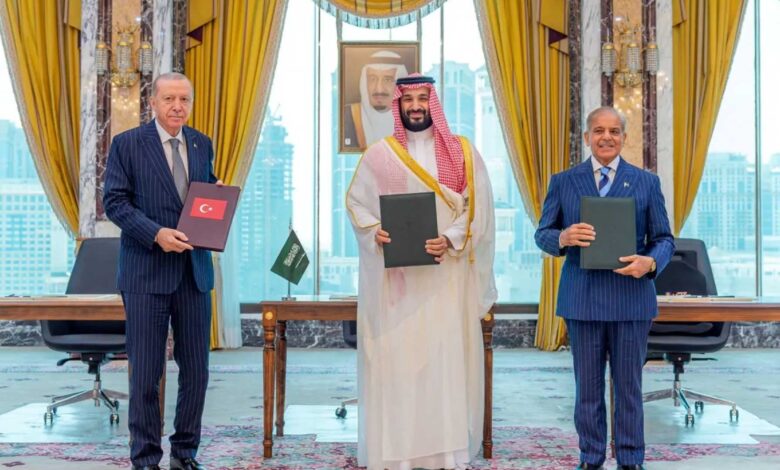
Saudi Arabia’s reported opposition to Egypt joining the new Mecca Joint Defence Agreement exposes a deeper transformation underway in the Middle East: Riyadh is reassessing not only who its most valuable military partners are, but also which governments it considers strategically reliable as tensions with the United Arab Emirates increasingly spill into regional security calculations.
According to sources cited in the material reviewed by Dark Box, Turkey pushed for Egypt to participate in the defense framework alongside Saudi Arabia, Turkey, and Pakistan. Riyadh, however, opposed Cairo’s inclusion “at least for now.”
At the center of the Saudi reservations, according to a former senior adviser to the Saudi monarchy cited in the reporting, was President Abdel Fattah el-Sisi’s relationship with UAE President Mohamed bin Zayed.
The significance of that claim extends far beyond Egypt.
Dark Box’s analysis indicates that Cairo’s exclusion can be read as another manifestation of the widening strategic fault line between Saudi Arabia and the UAE, with Egypt increasingly caught between the two Gulf powers.
The Mecca Agreement and a New Security Architecture
Signed in Mecca on 7 August, the Mecca Joint Defence Agreement commits Saudi Arabia, Turkey, and Pakistan to regard an armed attack against one member as an attack against all three.
Although important questions remain over its operational mechanisms, military triggers, and how assistance would work during an actual conflict, the agreement carries considerable political significance.
Saudi Arabia is aligning itself with two of the Muslim world’s most consequential military powers.
Turkey possesses a rapidly developing defense-industrial base encompassing drones, missiles, armored systems, aerospace technology, and electronic warfare.
Pakistan brings a large standing military, an established defense industry, extensive operational experience, and nuclear capability.
Egypt, historically one of the Arab world’s dominant military powers, might have appeared a natural fourth member.
Turkey apparently thought so.
According to the material provided to Dark Box, Turkish officials made substantial efforts to secure Egypt’s participation and formally proposed its inclusion.
Saudi Arabia resisted.
The MBZ Factor
The Saudi sources cited in the reporting present several reasons for Riyadh’s position, but one stands out politically: growing concern about Sisi’s alignment with Abu Dhabi.
A former senior adviser to the Saudi monarchy reportedly said decision-makers had serious concerns about Sisi’s loyalty and did not regard him as being as dependable as the Turkish and Pakistani leaderships.
The sources specifically pointed to Cairo’s increasingly close relationship with Mohamed bin Zayed.
This is particularly significant because Saudi–Emirati relations themselves have entered a period of visible disagreement over regional strategy.
The dispute is no longer confined to subtle diplomatic differences.
Saudi and Emirati voices have publicly clashed over the Mecca agreement, while the two countries have developed divergent positions on several of the region’s most sensitive theaters.
In that environment, Cairo’s proximity to Abu Dhabi potentially becomes more than an Egyptian foreign-policy choice.
From Riyadh’s perspective, according to the sources cited in the material, it becomes a question of strategic reliability.
Egypt’s Response During the Iran War
The reporting points to Egypt’s conduct during the Iran conflict as one example that reportedly intensified Saudi concerns.
Two sources noted that Egypt dispatched fighter aircraft to Abu Dhabi in response to Iranian attacks.
Sisi was also described as being eager to visit Mohamed bin Zayed repeatedly during the conflict.
According to those sources, Saudi Arabia received no comparable Egyptian gesture.
Viewed independently, diplomatic visits or military support for the UAE would not establish hostility toward Saudi Arabia.
But within an already deteriorating Saudi assessment of Cairo, the sources say the contrast carried political weight.
For Riyadh, the question increasingly became whether Egypt would act as an independent strategic partner—or whether its regional calculations had become too closely connected to Abu Dhabi.
Saudi Arabia’s Wider Problem With Emirati Policy
That concern becomes clearer when placed alongside Saudi disagreements with the UAE elsewhere in the region.
The sources cited by the report specifically highlighted Emirati support for southern Yemeni separatist forces as an issue Riyadh views as threatening Saudi national security and interests.
Yemen therefore appears particularly important to understanding the deterioration.
Saudi Arabia and the UAE entered the Yemeni conflict as partners, but their priorities subsequently diverged. Riyadh has prioritized threats along its southern frontier and Yemen’s broader territorial and security balance, while Abu Dhabi developed close relationships with southern forces pursuing their own political objectives.
The material argues that this divergence has affected how Riyadh views other governments aligned with Abu Dhabi.
Egypt is one of them.
From Somaliland to Sudan
The Saudi sources cited in the material also identified other Emirati policies they regard as conflicting with Egyptian strategic interests.
These include the UAE’s involvement in Somaliland, its strategic relationship with Israel, its relationship with Ethiopia amid the dispute over the Grand Ethiopian Renaissance Dam, and reports surrounding Emirati support for the Rapid Support Forces in Sudan.
These issues are especially sensitive for Cairo.
The Nile dispute with Ethiopia concerns Egypt’s fundamental water-security calculations.
Sudan directly borders Egypt and represents a major component of Cairo’s southern strategic environment.
Red Sea and Horn of Africa developments similarly affect Egyptian maritime and national-security interests.
Yet according to the Saudi interpretation presented in the reporting, Sisi has continued maintaining a particularly close relationship with Abu Dhabi despite these divergences.
For Riyadh, the sources say, that has deepened questions over Cairo’s strategic independence.
From Saudi Beneficiary to Questioned Partner
The dispute also reflects accumulated Saudi frustration with Egypt itself.
According to the sources, Saudi Arabia was the largest financial supporter of Sisi’s government after he seized power in 2013, initially providing approximately $25 billion to support Egypt’s struggling economy.
But Riyadh reportedly believes that this enormous financial commitment has not generated comparable Egyptian support on Saudi security priorities.
One source characterized Egypt’s contribution during the Saudi campaign against the Houthis as “minimal and unreliable.”
The sources also criticized Cairo’s position during the U.S.–Israeli war with Iran.
The former Saudi adviser summarized the frustration in particularly severe terms, describing Egypt as historically dependent on Saudi Arabia, the United States, and other external powers while providing insufficient strategic returns.
The dispute therefore combines two Saudi concerns: Egypt is viewed as offering diminishing military value while simultaneously becoming too closely aligned with a UAE whose regional policies increasingly conflict with Saudi priorities.
Military Capability Also Matters
Dark Box notes that the material does not attribute Saudi opposition exclusively to Egypt’s relationship with the UAE.
Saudi sources also questioned what Egypt could practically contribute to the emerging defense architecture.
Turkey offers an increasingly sophisticated domestic defense industry.
Pakistan possesses extensive weapons-production capabilities and a large, experienced military establishment.
The sources argued that Egypt’s defense manufacturing does not currently provide comparable advanced capabilities and questioned the combat effectiveness of its armed forces.
One source criticized the Egyptian military for devoting resources to civilian economic activities instead of strengthening indigenous military manufacturing.
Riyadh’s calculation, according to this account, was therefore both political and military.
Saudi Arabia wants partners it considers dependable and capable of providing tangible strategic value.
The sources suggest that Cairo currently fails both tests in Riyadh’s assessment.
The Emirati Backlash
Perhaps the clearest indication that the Mecca agreement intersects with Saudi–UAE tensions came after its announcement.
Abdulkhaleq Abdulla, a political analyst and former adviser to Mohamed bin Zayed, publicly questioned the logic of Saudi Arabia building a security arrangement with Turkey and Pakistan instead of concentrating on Gulf military unity.
His comments triggered unusually sharp Saudi responses.
Saudi Prince Abdulrahman bin Musaid defended Riyadh’s sovereign right to establish security partnerships that serve its interests and questioned why Emirati intellectual circles appeared particularly troubled by the agreement.
Other Saudi voices went further, invoking the UAE’s own normalization and security relationship with Israel and asking why Abu Dhabi could pursue independent strategic partnerships while questioning Saudi Arabia’s right to do the same.
The argument therefore evolved beyond the merits of the Mecca agreement.
It became a public debate over who has the right to define the Gulf’s future security architecture.
Two Competing Regional Visions
This is the broader geopolitical significance of the controversy.
The emerging Saudi strategy described in the supplied material increasingly looks beyond the traditional Gulf framework.
Riyadh is developing deeper defense ties with Ankara and Islamabad, two major Muslim military powers possessing capabilities that Gulf states cannot easily reproduce domestically.
The UAE has followed a different trajectory, developing particularly extensive strategic, technological, and security relations with Israel while simultaneously constructing its own network of partnerships across the Red Sea, Horn of Africa, and wider region.
Egypt’s position between these emerging approaches is becoming increasingly difficult.
Under Sisi, Cairo has developed an exceptionally close relationship with Abu Dhabi.
But if Saudi Arabia increasingly regards Emirati regional strategy as incompatible with its own security interests, Egypt’s proximity to MBZ could carry a growing strategic cost.
According to the Saudi sources cited in the material, the Mecca agreement may be the first major example.
Egypt’s Diminishing Regional Weight
The episode also reflects a larger decline in Egypt’s traditional regional position.
For decades, Cairo was considered indispensable to Arab military and diplomatic architecture.
Egyptian forces participated in the coalition that expelled Iraqi troops from Kuwait in 1991, and the Egyptian military was historically treated as one of the foundations of Arab collective security.
The emerging Mecca framework tells a different story.
Saudi Arabia is now looking toward Turkey and Pakistan for capabilities that it once might have expected Egypt to provide.
The material even notes that Kuwait is reportedly more interested in joining the new framework than relying on the kind of Egyptian military partnership that characterized earlier periods.
That shift is strategically significant.
It suggests that Cairo’s historic status is no longer sufficient to guarantee it a central position in new regional security arrangements.
Conclusion: Abu Dhabi’s Shadow Over Cairo’s Exclusion
The sources cited in the material stress that Saudi Arabia has not permanently closed the door to Egyptian membership.
But Riyadh reportedly wants Cairo outside the agreement for now.
Dark Box concludes that this distinction is important.
Egypt’s reported exclusion from the Mecca Joint Defence Agreement cannot be reduced to a dispute over military capabilities. Nor can it be explained solely through Saudi dissatisfaction with Egypt’s contribution to previous conflicts.
The political dimension is equally significant.
According to the Saudi sources cited in the reporting, Riyadh increasingly questions whether Sisi’s Egypt can be considered a dependable strategic partner while Cairo remains so closely aligned with Mohamed bin Zayed and Abu Dhabi’s regional agenda.
That distrust comes as Saudi–UAE disagreements become increasingly visible—from Yemen and the Red Sea to competing regional alliances and relations with Israel.
The Mecca agreement therefore reveals something larger than the exclusion of one country from one defense treaty.
It points toward a restructuring of regional power.
Saudi Arabia is building a security architecture around partners it believes offer military capability, strategic reliability, and reciprocal commitment. Turkey and Pakistan currently meet that standard in Riyadh’s assessment. Egypt, according to the sources, does not.
And hanging over that judgment is Abu Dhabi.
For Cairo, the message emerging from the reporting is consequential: Sisi’s closeness to the UAE may no longer merely shape Egypt’s relationships with Abu Dhabi’s rivals. It may now be affecting Egypt’s place inside the new defense structures being built around it.
For the wider region, the implications are even greater. As Saudi Arabia and the UAE pursue increasingly distinct security strategies, governments closely aligned with one may find their relationships with the other subjected to a new test of loyalty, capability, and strategic independence.
The dispute over Egypt’s place in the Mecca agreement may therefore represent an early sign of a much larger realignment—one in which the widening Saudi–Emirati divide is beginning to redraw the map of Middle Eastern military alliances.