Public Messages, Hidden Fractures: The Controversial Tweet That Exposed Tensions Inside the UAE Leadership
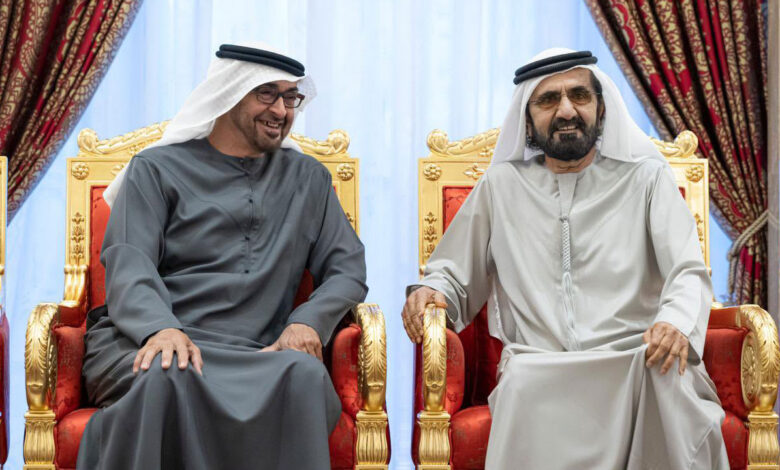
A controversial public statement by Dubai ruler and UAE Prime Minister Mohammed bin Rashid Al Maktoum has triggered widespread political interpretation across the region, not because of the words themselves, but because of the timing, the reactions that followed, and the unusual manner in which the message was communicated. What appeared at first glance to be a general reflection on responsibility and public service quickly evolved into a revealing episode exposing deeper tensions within the Emirati ruling structure.
In his statement, Mohammed bin Rashid emphasized that responsibility is a trust and that officials focused solely on personal success are unworthy of that trust. He warned against selfishness within governance and argued that officials who fail to care about the success of others within the state become a burden on the nation rather than servants of it. The language was unusually pointed for a public communication issued by a senior Gulf ruler, particularly one who occupies the position of Prime Minister within a highly centralized political system.
The controversy intensified because the statement was followed almost immediately by public reactions from Emirati ministers, including the Minister of Information and the Minister of Industry, Sultan Al Jaber. Their responses, delivered publicly through social media platforms rather than through institutional channels, transformed what might have remained a symbolic statement into a visible political moment. The exchange created the impression that internal messages were being delivered in public rather than behind closed doors.
This is where the political significance of the episode begins to emerge. In most centralized Gulf systems, communication between senior leadership and ministers is tightly managed through official institutional structures. Public messaging of this type, especially involving the Prime Minister and cabinet ministers, is highly unusual. The fact that ministers felt compelled to publicly respond suggests that the original statement was understood internally as carrying political weight beyond moral advice.
The broader context surrounding the UAE makes these developments even more significant. Over recent years, the federation has experienced increasing centralization of power, with Abu Dhabi consolidating political, security, and strategic authority across key sectors of the state. While Dubai remains economically influential and internationally visible, many observers have noted a gradual narrowing of its independent political space within the federal structure.
Against this backdrop, Mohammed bin Rashid’s statement appears less like a generic reflection on leadership and more like an indirect commentary on the direction of governance inside the UAE. The repeated emphasis on collective responsibility, concern for the nation as a whole, and criticism of officials focused on personal success carries implicit political meaning in a federation where questions of influence, authority, and internal balance are increasingly sensitive.
The situation became even more striking when the Crown Prince of Dubai issued remarks focused specifically on the people of Dubai shortly before the controversy escalated. This sequence created the impression of parallel messaging emerging from Dubai at a moment of visible strain within the federation. Rather than emphasizing federal unity in abstract terms, the discourse appeared increasingly centered around Dubai’s identity, role, and position within the broader Emirati structure.
The choice to conduct these exchanges publicly through social media platforms is itself revealing. In systems built around internal consensus and controlled political communication, social media becomes politically significant when senior figures use it to transmit messages that would traditionally remain confined to internal meetings. Public platforms create audiences, interpretations, and political pressure. They also allow elite disagreements to become visible without being openly acknowledged.
This dynamic has fueled growing speculation about deeper cracks inside the ruling structure of the UAE, particularly between the leadership centers of Abu Dhabi and Dubai. While such tensions are rarely discussed publicly inside the country, the increasing frequency of indirect messaging, symbolic statements, and carefully worded public interventions suggests an evolving internal landscape shaped by competing visions of governance and authority.
The content of Mohammed bin Rashid’s message further reinforces this interpretation. His criticism of selfish leadership and officials concerned only with personal achievement can be read as a warning against governance models driven by centralization of influence rather than collective national balance. The repeated emphasis on serving the entire nation implicitly challenges political behavior perceived as prioritizing factional or individual dominance.
The ministers’ public reactions added another layer to the controversy. Instead of allowing the statement to stand on its own, their responses transformed it into a visible exchange between leadership figures and government officials. This gave the impression that political signaling was occurring in real time before the public rather than within institutional frameworks.
The implications of this episode extend beyond social media controversy. They point toward an increasingly visible tension between the image of unity projected by the Emirati federation and the reality of competing internal centers of influence. As economic pressures, regional instability, and strategic disagreements intensify, these underlying fractures appear to be becoming harder to conceal.
In conclusion, the controversy surrounding Mohammed bin Rashid’s tweet is significant not because of the language alone, but because of what it revealed about the evolving political atmosphere inside the UAE. The public nature of the exchange, the reactions from ministers, and the broader context of centralization and shifting power dynamics all suggest that internal tensions are no longer entirely hidden behind institutional silence.
What emerged from this episode was not merely a debate about public service ethics, but a rare glimpse into the fragile balance shaping the Emirati federation itself.