Trump Signals Ground Assault on Kharg Island to Mask the Real Front: The Plan Is Taking Shape in Northwestern Iran
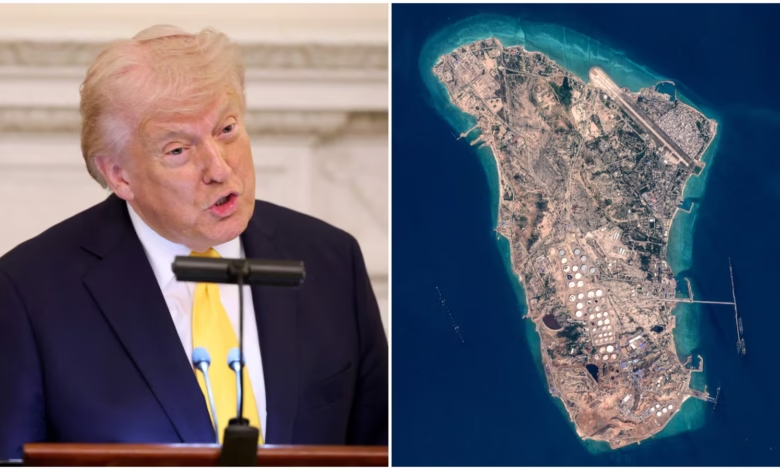
Dark Box intelligence and security analysis of the ongoing war, intersecting American statements, Kurdish movements, and recent political communications has reached a clear conclusion: the intense U.S. focus on Kharg Island is not the core of the plan, but its cover.
Washington has pushed Kharg to the forefront of discussion because it is an easy visual target for the media, highly symbolic, and widely understood as a sensitive oil hub. However, from both a military and political perspective, Kharg imposes the image of a full scale direct war on the United States, placing American troops in an exposed kill zone under missiles, drones, and mines. It appears that the Iranian system is prepared to burn the island and everything on it if a ground invasion takes place, turning it into a tool of attrition rather than a decisive objective. This is no longer just analytical speculation; American reports themselves indicate that while occupying Kharg may be possible, it would leave U.S. forces highly vulnerable and prolong the war instead of ending it.
This is where the real plan begins. The objective is not a dramatic amphibious landing on an oil island, but the opening of a front that creates the perception that Iran is internally destabilized. This type of effect does not emerge from the Gulf, but from ethnic fault lines, national vulnerabilities, and regions that can be framed in the media as internal rebellion or uprising against the central authority. Northwestern Iran provides this entire theater: rugged border geography, armed Kurdish factions, proximity to the Kurdistan Region, high political deniability, and the ability to turn any military breach into a global narrative of internal fragmentation inside Iran.
This is not a theoretical assumption. Available information confirms that Israel has already supported plans involving Iranian Kurdish factions to seize border towns inside Iran. These groups have discussed with American actors how to target Iranian forces, and thousands of fighters have reportedly been mobilized on the Iraqi side of the border, with a clear effort to leverage the ongoing war to open a front from that direction.
The implications are highly significant. Trump does not need a prolonged and complex occupation scenario, but rather a politically marketable outcome. Kharg offers him an isolated oil island under threat. The Kurdish front, however, offers a far more powerful narrative: Iran is tied down in a border war, the Revolutionary Guard is being drained on the periphery, internal instability is visible, and armed opposition is active during wartime.
In this sense, the focus on Kharg serves as an effective diversion. It consumes the attention of media and analysts focused on the Gulf, while the actual operational front is being constructed elsewhere, in a direction far more capable of generating political and psychological shock inside Iran. This aligns with recent reports highlighting the fluctuation in Trump’s war objectives, ranging between weakening the Iranian system, degrading its capabilities, and ultimately presenting the outcome as a political victory.
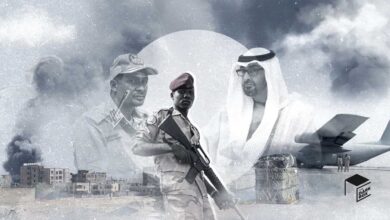
The most sensitive aspect of this trajectory is that the Kurdish front is not being managed as a spontaneous border movement, but as a carefully constructed, multi-layered operation. Kurdish factions operate on the surface, carrying out infiltrations and producing the initial battlefield image, while the United States and Israel manage the deeper structure: surveillance systems, target bank feeding, precision strike coordination, and the provision of international political cover. In the background, Abu Dhabi moves as an undeclared connector, opening communication channels, reshaping alignments within the region, and working to create an environment that allows this track to develop without early attention. At the same time, the media arena is tasked with fully reframing the event, presenting it as internal unrest or a border insurgency rather than an externally managed military operation. This architecture provides Washington and Tel Aviv with a decisive advantage: the ability to minimize their direct footprint and present the operation as an internal phenomenon, unlike any action originating from the Gulf, which cannot conceal its nature. Converging data indicating that Kurdish elements inside Iran are providing precise targeting information confirms that intelligence work is not a secondary support function, but the backbone of the operation, supported by an active field network guiding strikes deep in Iranian territory.
Within this framework, Erbil is transforming into a central anchor point in the overall picture, rather than simply a regional capital. The recent American communication with the regional leadership came at a calculated moment, following direct Iranian strikes targeting Peshmerga forces, and included explicit recognition of the region’s role in maintaining oil flows to global markets. This is not routine diplomatic language, but a consolidation of the region’s role as a logistical and political node within the structure of the conflict. Here, the Emirati role becomes more visible: working to solidify this positioning, presenting the region as a politically and economically reliable platform, reactivating channels of influence within Kurdish decision-making circles, and linking local calculations to the ceiling of American strategy. When combined with movements along the Iranian border and plans for gradual penetration, the region becomes part of the operational theater itself, not merely its geographic backdrop.
Abu Dhabi reframed the plan to Kurdish actors through a combination of historical incentive and fear of missing a critical moment. After the initial leak at the beginning of the war, Kurdish hesitation was driven by two concerns: the fear of being used as expendable forces in a major confrontation and then abandoned in the face of Iran, Turkey, and Baghdad, and the fear that the early exposure of the plan indicated its fragility and compromise. At this point, Abu Dhabi intervened with a completely different approach, redefining the moment rather than denying the risks. The message delivered to Kurdish elites and armed factions was clear: the region is undergoing a comprehensive restructuring, and this may be a rare political window that will not come again. Those who hesitate during a moment of redrawn maps risk being excluded for years to come.
The Emirati message was layered. Washington is prepared this time to provide direct backing, Israeli actors are ready to secure the intelligence and operational dimension, and the current regional context places Tehran under greater strain than at any previous moment, making the cost of hesitation higher than the cost of action. Through this logic, a long-standing ambition was revived, not as a distant aspiration, but as an operational opportunity directly tied to the war itself.
Because earlier Kurdish objections were rooted in a deep lack of trust, Abu Dhabi focused specifically on addressing this issue. Hesitant parties were told that the previous leak did not collapse the plan, but instead forced it to be redesigned in a more disciplined and covert manner. The new phase, they were assured, would not rely on an exposed push, but on carefully calculated penetrations, supported politically and through media narratives, and protected by an American umbrella that extends beyond statements to include operational support, intelligence, and deterrence.
Here, Abu Dhabi leveraged what it actually possesses: a network of relationships within Erbil, financial and political channels, and the ability to promote the idea that those who participate now will not be mere instruments, but partners in shaping the post-conflict order. In this way, Kurdish acceptance was gradually rebuilt, not by convincing them that risks had disappeared, but by persuading them that the alternative was missing a historic opportunity for independence once again, and that waiting would not bring a more favorable American moment or a more vulnerable Iranian position than the present one.
However, despite the apparent completeness of its tools, the plan faces serious obstacles. The first is Turkey. Ankara does not view any reactivation of the Kurdish armed card as a tactical move against Iran, but as a direct threat to its national security. This is why the Turkish stance has been firm in monitoring movements linked to PJAK, indicating that Turkey quickly understood that opening this front is not limited to Iran, but risks reviving a cross-border armed Kurdish arc, something it considers a non-negotiable red line. Any initial success of this front would expose Ankara to the risk of expanding separatist symbolism, even if the operation is nominally directed against Tehran.
The second obstacle is Baghdad. Iraq cannot afford to see the Kurdistan Region transformed into a platform for open confrontation with Iran under American and Israeli cover. This would not only threaten the fragile balance of the Iraqi state, but also place the central government in the midst of a power struggle on its own territory, risking renewed tensions between Baghdad, Erbil, and armed groups linked to Iran. This complexity is compounded by the escalation of strikes in Iraq itself against Iran-aligned factions, meaning the Iraqi arena is already volatile and could rapidly ignite if an offensive Kurdish corridor toward Iran is added.
The third obstacle is Iran itself. The American-Israeli calculation assumes that Tehran will be stretched thin along its peripheries and that the Kurdish front will impose both security and psychological pressure. However, an alternative reading suggests that Iran will interpret this track as a coordinated external war conducted through a local proxy, rather than a mere border issue. This opens the door to a broader response that goes beyond the Kurdish strip entirely: strikes deep in Iraq, targeting of Peshmerga forces, pressure on the Kurdistan Region, and expansion of signaling toward American interests across Iraq and the Gulf. The recent Iranian strike that killed and wounded Peshmerga elements near Erbil confirms that Tehran does not treat this arena as peripheral, but as an active front in the war.
The conclusion reached by Dark Box is decisive. Trump is not invoking Kharg Island randomly. He does so because Kharg serves as a distraction for global attention, while the Kurdish front is designed to destabilize Iran from within. The island feeds the noise. The border enables penetration. Kharg absorbs media focus. Kurdistan opens the real scenario.
Therefore, the most critical developments to watch are not the discussions of a naval landing in the Gulf, but what is being quietly built in northwestern Iran: coordination among factions, supply lines, air cover, political positioning in Erbil, and the calculations of Ankara, Baghdad, and Tehran in response to this unfolding strategy.