Kuwait Next? How Abu Dhabi Is Quietly Expanding the Abraham Accords After the Iran War
A Dark Box Investigative Report
The Abraham Accords are facing their most serious crisis since their creation. The war on Gaza, the regional fallout from the conflict with Iran, and growing skepticism across the Arab and Islamic worlds have weakened the political appeal of the normalization framework that the United Arab Emirates spent years promoting.
Yet instead of retreating, Abu Dhabi appears determined to expand the project.
Dark Box investigations indicate that Kuwait has increasingly emerged as the primary target of a new Emirati-led effort to revive and expand the Abraham Accords following the strategic setbacks suffered by the framework in recent years.
The significance of Kuwait goes far beyond its size.
For decades, Kuwait represented one of the strongest pro-Palestinian political environments in the Gulf. Unlike many neighboring states, it maintained an active parliament, a vibrant political culture, and a strong tradition of public engagement on regional issues. These institutional and political characteristics created natural barriers against normalization with Israel.
Today, however, those barriers are weakening.
Dark Box monitoring shows that Kuwait is undergoing profound political and institutional transformations that are steadily reshaping the country’s domestic landscape. At the same time, Abu Dhabi’s influence inside Kuwait appears to be expanding through political, security, and strategic channels.
The timing is not accidental.
The UAE urgently needs a new normalization success story.
The Abraham Accords have suffered significant reputational damage since the Gaza war. The recent conflict involving Iran further exposed weaknesses in the security architecture that normalization supporters promised would deliver stability and protection.
Rather than serving as a shield against conflict, the war demonstrated that states most closely integrated into the Abraham Accords framework became directly exposed to regional confrontation.
This created a major credibility problem for the project.
As a result, securing a new member would provide Abu Dhabi with an important political victory and allow it to claim that the normalization process continues expanding despite regional opposition.
Kuwait increasingly appears to be viewed as the most attainable candidate.
According to Dark Box findings, several developments have converged to create favorable conditions for such a push.
The first involves domestic political restructuring.
The gradual weakening of institutional opposition mechanisms has reduced the capacity of organized political forces to challenge major policy shifts. Changes affecting political participation, civil society activity, and public mobilization have altered the landscape that historically constrained any move toward normalization.
The second factor involves security narratives.
Following the regional conflict with Iran, security concerns have become increasingly prominent across the Gulf. This environment creates opportunities for advocates of normalization to present the Abraham Accords not as a political choice but as a security necessity.
This is a crucial distinction.
The normalization campaign no longer relies primarily on economic promises or diplomatic arguments. Instead, it increasingly promotes the idea that integration into the Abraham Accords framework provides access to advanced defense cooperation, intelligence coordination, and strategic protection.
Dark Box investigations indicate that this message is being amplified across multiple channels.
The third factor is Abu Dhabi’s broader regional strategy.
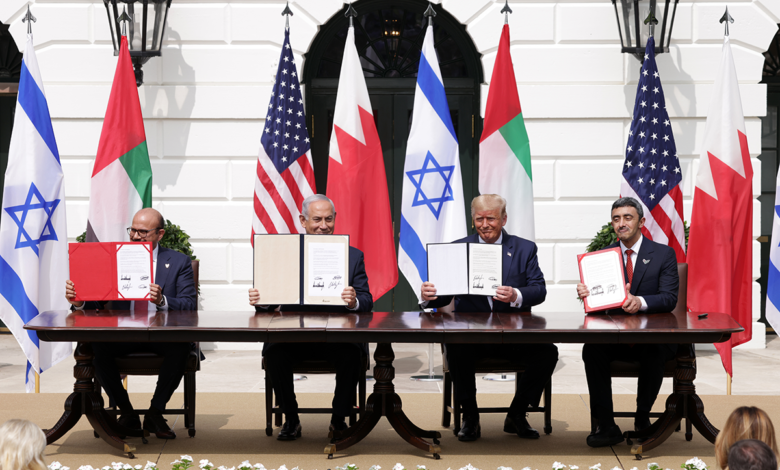
For years, the UAE has pursued an ambitious project aimed at reshaping regional alliances. The Abraham Accords became one of the most important instruments through which Abu Dhabi expanded its influence and deepened its partnership with Israel.
What began as a bilateral normalization agreement evolved into something much larger.
Military cooperation expanded.
Intelligence coordination deepened.
Joint security initiatives multiplied.
Regional diplomacy increasingly became intertwined with strategic cooperation between Abu Dhabi and Tel Aviv.
The Iran war accelerated this transformation dramatically.
The deployment of Israeli defense assets to support the UAE during the conflict illustrated how normalization had evolved from diplomacy into security integration.
Abu Dhabi now appears eager to replicate and expand this model.
Kuwait occupies a special place within these calculations because its accession would carry enormous symbolic value.
Unlike previous signatories, Kuwait historically maintained a strong political identity centered on support for Palestine and resistance to normalization.
Bringing Kuwait into the framework would allow Abu Dhabi to argue that opposition to normalization inside the Gulf has effectively collapsed.
Dark Box findings suggest that this objective extends beyond Kuwait itself.
The larger goal appears to be the gradual construction of a broader political and security bloc linking Gulf states more closely to Israel through interconnected military, intelligence, and strategic arrangements.
This explains why normalization is increasingly being marketed through the language of security and protection rather than diplomacy alone.
The strategy reflects a broader shift within the Abraham Accords project.
Instead of emphasizing peace, advocates increasingly emphasize threats.
Instead of discussing coexistence, they focus on deterrence.
Instead of highlighting economic integration, they stress military coordination.
The result is the emergence of a framework that looks increasingly like a regional security architecture centered on Israeli strategic interests and strongly supported by Abu Dhabi.
This evolution has generated concern among many regional observers.
Critics argue that such arrangements risk deepening regional polarization rather than reducing it.
Others fear that integrating additional Gulf states into this framework could increase tensions and draw more countries into future regional confrontations.
For Kuwait, the debate carries profound implications.
Any movement toward normalization would represent one of the most significant foreign policy shifts in modern Kuwaiti history.
It would also test whether the country’s traditional political identity can withstand the growing influence of regional realignment projects promoted by Abu Dhabi.
Dark Box assessments indicate that the coming period will likely witness intensified efforts to reshape public perceptions regarding normalization and regional security.
Whether those efforts succeed remains uncertain.
What is increasingly clear, however, is that the struggle over Kuwait’s future orientation has become an important front in a broader regional contest over the future of the Abraham Accords themselves.
The central question is no longer whether Abu Dhabi seeks to expand the framework.
The question is whether Kuwait will become the next state drawn into a project that increasingly resembles a regional security alliance rather than a conventional peace agreement.
The answer could reshape Gulf politics for years to come.