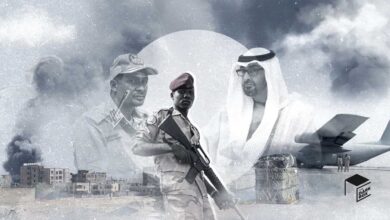
Exclusive: Libya Connection (Part II) – Dark Box Investigation Reveals How the RSF Supply Network Adapted and Expanded
By Dark Box Investigations
Shortly after Dark Box exposed the existence of a RSF training network operating through eastern Libya, new findings indicate that the infrastructure supporting Sudan’s Rapid Support Forces has not diminished. Instead, it has evolved.
Dark Box has established that military facilities across eastern and southern Libya continue to serve as key logistical and training hubs supporting RSF operations inside Sudan. The network appears to have adapted to increasing regional military pressure by shifting routes, expanding infrastructure, and reorganizing supply corridors without disrupting the overall flow of personnel and military equipment.
A Network That Never Stopped
According to information obtained by Dark Box, RSF fighters continue to receive military instruction inside multiple facilities located in territory controlled by the Libyan Arab Armed Forces (LAAF).
The camps are reportedly used not only for basic military preparation but also for advanced weapons instruction, tactical coordination, vehicle maintenance, and logistical organization before fighters are moved toward the Sudanese border.
Dark Box has identified four principal locations operating within this network:
- Seweidiya, near Al-Kufra
- Sabha
- Al-Jufra
- Camp 17, east of Benghazi
Investigative findings indicate that these facilities function as interconnected nodes rather than isolated camps, allowing personnel and equipment to move between them before deployment toward Sudan.
Camp 17 Emerges as a Central Hub
Among the identified facilities, Camp 17 appears to play a particularly significant role.
Dark Box has learned that fighters arriving from southern Libya are routinely transferred to the camp after passing through Al-Kufra and Benghazi.
Evidence gathered during the investigation suggests the camp serves as a principal reception point for military equipment before onward movement toward Sudan.
Sources familiar with operations described the site as containing weapons stockpiles, vehicles, fuel reserves and logistical support intended for RSF operations.
The facility also reportedly serves as a distribution point where newly arrived equipment is reorganized before transport to Darfur.
Training Extends Beyond Basic Combat
Dark Box’s investigation found that training provided inside Libya extends far beyond conventional infantry preparation.
Instruction reportedly includes:
- Heavy machine gun operations
- Rocket-propelled grenade systems
- Rocket launchers
- Heavy vehicle operation
- Military logistics
- Convoy movement under desert conditions
The emphasis on heavy weapons suggests efforts to prepare fighters for sustained battlefield operations rather than short-term deployments.
Weapons Continue to Enter Through Libya
Dark Box has gathered information indicating that military supplies continue arriving by air before being transferred through eastern Libya.
Sources familiar with the logistics network describe repeated deliveries of weapons, ammunition, armored vehicles, pickup trucks and fuel before redistribution toward Sudan.
Several individuals involved in the logistics chain stated that the equipment was understood internally to originate from the United Arab Emirates.
While much of the equipment reportedly arrived without identifiable markings, investigators documented instances in which certain armored vehicles carried manufacturing indications linking them to the Emirates.
Regional Pressure Forced Tactical Changes — Not Withdrawal
The investigation indicates that recent regional military developments disrupted—but did not halt—the supply network.
Following intensified strikes targeting RSF convoys moving from Libya into northern Darfur, operators behind the logistics system reportedly altered transportation routes rather than suspending operations.
Dark Box has established that the network shifted part of its air bridge away from southeastern Libya toward eastern Chad, allowing supplies to continue reaching RSF-controlled territory through alternative corridors.
Rather than ending support activities, the network appears to have dispersed critical logistics across multiple transit points.
Eastern Chad Becomes a Critical Link
Dark Box has obtained information showing that eastern Chad has assumed a growing role within the logistics chain.
Investigative findings indicate that aircraft continued arriving after route adjustments, with cargo subsequently transported overland through established corridors connecting Chad to western Sudan.
Sources familiar with regional military movements described expanded infrastructure capable of handling large cargo aircraft, drone operations and logistical coordination.
The evolving transportation system appears designed to reduce vulnerability while maintaining uninterrupted deliveries toward Darfur.
The Libya–Chad–Sudan Corridor
According to information reviewed by Dark Box, a principal overland corridor now connects eastern Libya to western Sudan through Chad.
The route begins near Gate 17 on the Libya–Chad frontier before extending toward Abéché and Adré, eventually reaching RSF-held areas inside Darfur.
The corridor allows military cargo, fuel, vehicles and personnel to move in stages rather than through a single direct route, making detection considerably more difficult.
Analysts monitoring regional security describe the corridor as one of the most strategically important logistical arteries supporting continued RSF military operations.
Foreign Personnel Inside the Network
Dark Box has also gathered evidence indicating the presence of foreign contractors operating within parts of the Libyan training infrastructure.
Information reviewed during the investigation suggests that foreign personnel have been observed alongside trainers involved in military instruction and logistical support.
Their reported presence highlights the increasingly international character of the network supporting operations connected to the conflict in Sudan.
An Adaptive Support System
The latest findings suggest that pressure from regional actors has not dismantled the support architecture surrounding the RSF.
Instead, the network appears to have become more flexible, relying on multiple transit hubs, alternative air routes and decentralized logistics to sustain operations.
The evolving infrastructure demonstrates a capacity to absorb disruptions while continuing to facilitate the movement of fighters, equipment and military supplies across Libya, Chad and into Sudan.
For investigators monitoring the conflict, the significance lies not only in the existence of individual camps but in the emergence of an integrated cross-border system capable of adapting under pressure.
As Sudan’s conflict enters another critical phase, Dark Box’s investigation indicates that the external logistical architecture supporting the war remains active, increasingly sophisticated and deeply embedded across the Libya–Chad–Sudan corridor.