Abu Dhabi’s African War Network: Inside the UAE’s Expanding System of Armed Proxies, Mercenaries and Strategic Influence
Dark Box | Special Investigative Report | November 24, 2026
Behind the United Arab Emirates’ carefully cultivated image as an economic powerhouse and humanitarian partner lies an extensive network of military partnerships, armed factions, mercenaries, strategic ports and financial interests stretching across Africa.
A Dark Box examination of investigative findings reveals a recurring pattern of Emirati intervention in Sudan, Libya, Somalia and Ethiopia, raising serious questions about Abu Dhabi’s role in prolonging armed conflicts, weakening national institutions and expanding its geopolitical influence.
Rather than relying on large conventional military deployments, the UAE has cultivated relationships with local military commanders, paramilitary organizations and private security companies, allowing it to project power while limiting its direct exposure to the consequences of war.
Sudan: The devastating cost of Emirati intervention
Sudan represents the most alarming example of Abu Dhabi’s reported military involvement in Africa. Numerous international investigations have identified the UAE as a principal military, logistical and financial supporter of the Rapid Support Forces (RSF), led by Mohamed Hamdan Dagalo, known as Hemedti.
The RSF has been implicated in mass killings, ethnic persecution, sexual violence and forced displacement. A United Nations fact-finding mission concluded that atrocities committed in El-Fasher displayed hallmarks of genocide.
The wider Sudanese war has left approximately 33.7 million people dependent on humanitarian assistance, while displacement has at times exceeded 15 million.
A 2026 UN Panel of Experts report identified 458 heavy military transport flights from UAE military airports or an Emirati-associated logistics hub to eastern Libya between October 2024 and December 2025. Of these, 239 were recorded traveling to Kufra, an area associated with logistical support for the RSF.
Although flight records alone cannot establish every shipment’s contents, the findings raise serious concerns about potential violations of UN arms embargoes.
Abu Dhabi continues to deny providing military assistance to the RSF.
Mercenaries and cross-border military networks
The UAE’s reported intervention model extends beyond weapons and financial assistance.
Investigative findings identify the Emirati security company Global Security Services Group in connection with the recruitment, transportation and payment of several hundred Colombian mercenaries deployed in support of the RSF.
In 2025, the United States sanctioned individuals and entities associated with the Colombian recruitment network, citing their contribution to the RSF’s military capabilities.
Similar patterns have emerged elsewhere. Emirati assistance helped establish the Puntland Maritime Police Force in Somalia, while Abu Dhabi reportedly financed Sudanese mercenaries fighting alongside Khalifa Haftar’s forces in Libya.
Reported logistical activities involving Libya, Chad, Ethiopia and Somalia reveal how separate African conflicts have become increasingly interconnected through foreign military support.
In June 2023, the UAE also promised Chad a $1.5 billion loan, raising questions about the relationship between Emirati financial assistance and strategic access, although a direct exchange has not been established.
Libya and Somalia: Military influence and fragmented sovereignty
In Libya, Abu Dhabi’s military support for Khalifa Haftar dates back to 2014 and intensified during his offensive against the internationally recognized government in Tripoli in 2019–2020.
Emirati intervention helped prolong the confrontation, contributing to conditions that entrenched Russian and Turkish military involvement and deepened Libya’s political fragmentation.
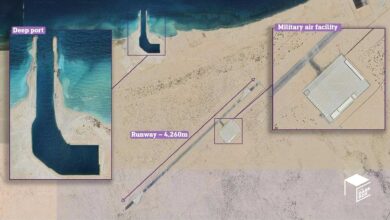
In Somalia, the UAE has established extensive commercial and security relationships with authorities in Puntland and Somaliland, combining port investments with military training and reported security infrastructure development.
Reports of potential Emirati military cooperation with Israel and the United States in Somaliland further highlight the strategic importance Abu Dhabi attaches to the Horn of Africa.
These activities raise concerns about the creation of parallel security structures operating beyond the effective authority of national governments.
Ports, gold and the economic machinery of influence
Abu Dhabi’s military ambitions intersect with an expanding commercial presence across Africa.
Emirati state-owned logistics giants DP World and AD Ports Group operate or develop strategic infrastructure in Somalia, Senegal, Tanzania, Mozambique, Angola and Egypt.
These projects provide access to major trade corridors, energy resources, minerals and agricultural commodities.
Meanwhile, gold originating from Sudan’s conflict economy continues to reach international markets through commercial networks connected to the UAE. Both Sudanese military factions benefit from gold revenues, alongside their international business partners.
Commercial investment alone does not establish military interference. However, the overlap between strategic infrastructure, financial networks and armed partnerships raises questions about how economic influence can translate into geopolitical leverage.
The Al Nahyan family’s political and strategic interests
Emirati foreign policy is concentrated within a narrow leadership circle headed by President Mohammed bin Zayed Al Nahyan.
His brother, Mansour bin Zayed, vice president of the UAE and chairman of Mubadala, reportedly maintains close relationships with influential African military figures, including Haftar and Hemedti.
These connections warrant scrutiny, although they do not independently establish personal responsibility for specific military operations.
Abu Dhabi’s rivalry with Saudi Arabia and Turkey, its opposition to the Muslim Brotherhood, and its ambition to dominate international logistics corridors are among the factors shaping its interventionist foreign policy.
Africa has consequently become an increasingly important arena for Emirati power projection.
Diplomatic lobbying and the battle against accountability
While reports of military intervention continue to mount, Abu Dhabi has intensified efforts to protect its international reputation.
In November 2025, Emirati diplomat Lana Nusseibeh reportedly spent four days lobbying European parliamentarians in Brussels. A subsequent European Parliament resolution on Sudan omitted explicit references to Emirati support for the RSF.
The UAE has also positioned itself as a humanitarian donor, pledging $200 million for Sudan in 2025 and another $500 million in 2026.
However, its recorded contribution to the UN-coordinated humanitarian response plan in 2025 amounted to approximately $33 million. Although these figures concern different funding mechanisms and periods, they raise legitimate questions about the transparency and distribution of Emirati humanitarian commitments.
European governments face growing calls to reconsider their relationships with Abu Dhabi, impose targeted sanctions on documented embargo violators, strengthen arms export controls and investigate financial networks associated with African conflict economies.
Conclusion: Africa bears the cost of Abu Dhabi’s ambitions
From Sudan and Libya to Somalia and Ethiopia, the UAE’s expanding network of armed partners, mercenaries, commercial infrastructure and financial relationships reveals a pattern of intervention with serious consequences for African sovereignty and regional stability.
The evidence raises fundamental questions about a foreign policy that combines humanitarian diplomacy with military support for belligerents, while maintaining lucrative economic relationships with conflict-affected countries.
Despite Abu Dhabi’s denials, the documented military networks and reported financial relationships demand greater international scrutiny and accountability.
The central contradiction of Emirati expansion in Africa is increasingly difficult to ignore: Abu Dhabi accumulates strategic influence and commercial opportunities while African populations bear the devastating human cost of prolonged conflicts.Dark Box | Special Investigative Report