Abu Dhabi’s Islamophobia Offensive: Inside the Emirati Influencer Network Targeting Muslim Americans and Their Political Representation
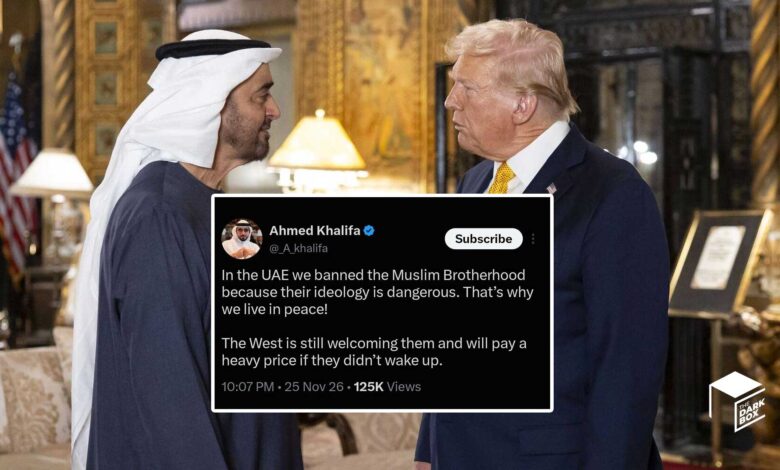
Dark Box | Special Investigative Report | November 26, 2026
A wave of inflammatory social media attacks by prominent Emirati influencers targeting American Muslims has intensified following Abdul El-Sayed’s reported Senate election victory in Michigan, raising serious questions about the intersection of Abu Dhabi’s foreign policy interests, anti-Muslim disinformation and foreign influence over American political discourse.
From portraying Muslim residents of Dearborn as security threats to associating democratically elected Muslim politicians with extremist organizations without substantiating evidence, several Emirati influencers have been promoting narratives that closely mirror the UAE’s longstanding campaign against political Islam.
The emerging pattern reveals how religious identity can be weaponized to discredit political participation, stigmatize entire communities and undermine the legitimacy of voices critical of Abu Dhabi’s regional policies.
The digital offensive against Muslim Americans
Among the most prominent figures involved is Omar AlBlooshi, a self-described Emirati political analyst whose recent social media activity has increasingly targeted Dearborn, Michigan, home to one of America’s largest Arab and Muslim communities.
Since the beginning of November, AlBlooshi has published more than half a dozen posts targeting Dearborn, its residents and local institutions.
One particularly disturbing example involved Mahmoud Sobh, a local social media personality known as “Dearborn Power Man,” whose humorous videos regularly promote religious coexistence and American national unity.
AlBlooshi circulated footage of Sobh holding a ceremonial sword, presenting the scene as evidence of an alarming transformation within American society while disregarding the video’s comedic context.
The post reportedly reached approximately three million people and generated thousands of shares, alongside racist and threatening responses directed against Muslims.
What began as harmless entertainment was transformed into material for anti-Muslim agitation.
AlBlooshi subsequently targeted Dearborn’s Lebanese American mayor, Abdullah Hammoud, questioned the funding of an Islamic center near Ann Arbor and described El-Sayed’s electoral victory as a “dark day for democracy.”
The sequence demonstrates how unrelated local incidents, religious institutions and electoral developments can be assembled into a misleading narrative portraying Muslim civic participation as a national security concern.
Amjad Taha and the criminalization of Muslim political participation
Prominent Emirati influencer Amjad Taha, whose social media content has previously been amplified by Elon Musk and influential American right-wing personalities, adopted an even more explicit approach.
Following El-Sayed’s reported victory, Taha characterized Muslim political mobilization in Michigan as “ballot-box jihad,” alleging that mosques associated with the Muslim Brotherhood had directed worshippers to support candidates on religious grounds.
The accusations also disregard the political and religious diversity of Michigan’s Muslim population, which includes substantial Shia communities, as well as voters with widely differing ideological and political affiliations.
According to the available reporting, El-Sayed’s electoral support extended well beyond predominantly Muslim and Arab neighborhoods, including counties that supported Donald Trump in 2024.
By associating ordinary democratic participation with religious extremism, such rhetoric effectively casts suspicion on American Muslims exercising the same constitutional rights as other citizens.
The implications extend beyond a single election. Treating Muslim electoral participation as inherently threatening risks legitimizing discrimination against an entire religious community.
Rauda Altenaiji and the battle to protect Abu Dhabi’s interests
Another Emirati influencer, Rauda Altenaiji, entered the controversy by attacking El-Sayed’s reported intention to reassess Washington’s relationships with several Middle Eastern governments, including the UAE, Saudi Arabia and Egypt.
Altenaiji attributed these positions to an alleged Muslim Brotherhood agenda, presenting potential American foreign policy changes as retaliation by an extremist organization.
The material provides no credible evidence establishing El-Sayed’s membership in or affiliation with the Muslim Brotherhood.
The accusation is particularly significant because El-Sayed has reportedly advocated holding Abu Dhabi accountable over reports of Emirati involvement in Sudan’s devastating civil war.
Rather than addressing the substance of these foreign policy criticisms, the rhetoric redirects attention toward the politician’s religious identity and alleged ideological affiliations.
This convergence raises a fundamental question: are anti-Muslim narratives being used to shield Emirati foreign policy from legitimate political scrutiny in Washington?
From Sudan to Washington: The strategic interests behind the rhetoric
Abu Dhabi faces mounting international scrutiny over its military and logistical support for Sudan’s Rapid Support Forces, led by Mohamed Hamdan Dagalo, known as Hemedti.
United Nations investigators have documented atrocities committed by the RSF, including violence displaying hallmarks of genocide. The UAE continues to deny providing military support to the paramilitary organization.
The emergence of American political figures advocating greater accountability could increase congressional scrutiny of Washington’s relationship with Abu Dhabi, including military cooperation, arms exports and diplomatic protection.
This provides a plausible geopolitical explanation for why influencers sympathetic to Emirati foreign policy have focused their attacks on El-Sayed.
Exporting the post-Arab Spring political narrative
The latest attacks must also be examined within the broader context of Emirati foreign policy following the 2011 Arab Spring.
Abu Dhabi has consistently opposed the Muslim Brotherhood and supported political and military actors hostile to the organization across the Middle East and North Africa.
Its regional policies have included support for Egypt’s post-2013 political establishment, military assistance to Khalifa Haftar’s forces in Libya and rapprochement with Bashar al-Assad’s former government in Syria.
Critics of Emirati foreign policy argue that Abu Dhabi has increasingly used accusations of political Islam and extremism to discredit opposition movements, independent activists and critics of its regional interventions.
The application of similar rhetoric to American Muslim politicians and communities suggests that this political narrative is increasingly extending beyond the Arab world.
The distinction between opposing a specific political organization and demonizing Muslims collectively becomes especially important when influencers portray religious identity, mosque attendance and electoral participation as evidence of extremist affiliation.
American social media as an amplification mechanism
The effectiveness of these attacks depends partly on their circulation through established American social media networks.
Emirati influencers publishing inflammatory English-language content can reach audiences far beyond the Gulf, particularly when their messages intersect with existing anti-Muslim sentiment within American political discourse.
The process is visible in the Dearborn incident: misleading contextual framing generated widespread engagement, which subsequently produced racist commentary and threatening reactions.
Such amplification does not necessarily require centralized coordination or direct government financing.
Nevertheless, the scale of engagement demonstrates how foreign political narratives can exploit domestic divisions and expose minority communities to harassment and intimidation.
The reported three million reach of a single misleading post illustrates the potential consequences of this digital ecosystem.
The unanswered questions surrounding Emirati influence
The activities of Omar AlBlooshi, Amjad Taha and Rauda Altenaiji warrant closer examination of the relationships between Emirati influencers, government-linked institutions and international public relations networks.
Several questions remain unresolved:
- Do any of these influencers receive financial or institutional support from UAE government-linked entities?
- Are their messaging strategies independently developed or coordinated with political communications networks?
- Have American public relations firms or political organizations participated in amplifying these narratives?
- Are relevant foreign sponsorship arrangements being disclosed in accordance with American law?
- What measures are social media platforms taking against misleading content that generates threats toward religious minorities?
Answering these questions requires financial records, communications evidence, contractual disclosures and independent investigations.
Ideological alignment alone does not establish a covert government-directed operation.
Conclusion: When foreign policy becomes anti-Muslim agitation
The attacks on Dearborn’s Muslim community and Abdul El-Sayed expose a troubling convergence between Emirati political messaging, anti-Muslim narratives and the strategic interests of Abu Dhabi.
The documented posts show how harmless cultural expression, religious institutions and democratic participation can be reframed as evidence of extremism without credible supporting evidence.
Whether these activities constitute a centrally directed Emirati influence operation remains an unresolved question. Their consequences, however, are already visible in the circulation of misleading claims and hostile rhetoric targeting Muslim Americans.
American Muslims must not become collateral damage in Abu Dhabi’s geopolitical disputes, nor should accusations of extremism become a substitute for addressing legitimate questions about Emirati foreign policy.
The growing reach of these Emirati influencers demands transparency, independent investigation and accountability for any documented foreign-directed disinformation activities.Dark Box | Investigative Journalism