Inside Abu Dhabi’s Secret Military Network in Somalia: How UAE Bases, Armed Forces and Strategic Ports Operate Beyond Mogadishu’s Control
Dark Box | Special Investigative Report | November 19, 2026
An expanding military network hidden behind strategic infrastructure
An examination by Dark Box of published investigations, satellite evidence, security reporting, and official records reveals an expanding Emirati military footprint across Somalia, where strategic airports, ports, and armed security formations have become central to Abu Dhabi’s operations in the Horn of Africa.
At the center of this network are Berbera in Somaliland and Bosaso in Puntland, two strategically located facilities where independent investigations have documented Emirati military involvement, infrastructure expansion, and security activities extending beyond Somalia’s borders.
The significance of these facilities goes far beyond conventional defense cooperation.
They provide access to the Gulf of Aden, maritime routes approaching the Red Sea, and aviation corridors connecting the Arabian Peninsula with East Africa.
Their development has also exposed a fundamental sovereignty dispute: the UAE has established military relationships with regional administrations while Somalia’s internationally recognized federal government disputes the authority of those administrations to authorize foreign military operations independently.
Dark Box’s examination identifies a pattern of Emirati military expansion built around regional agreements, strategic transport infrastructure, and security forces operating outside Mogadishu’s direct command.
The available evidence is strongest at Berbera and Bosaso. Claims concerning additional undisclosed installations require further independent verification.
Berbera: Satellite evidence reveals an expanding military installation
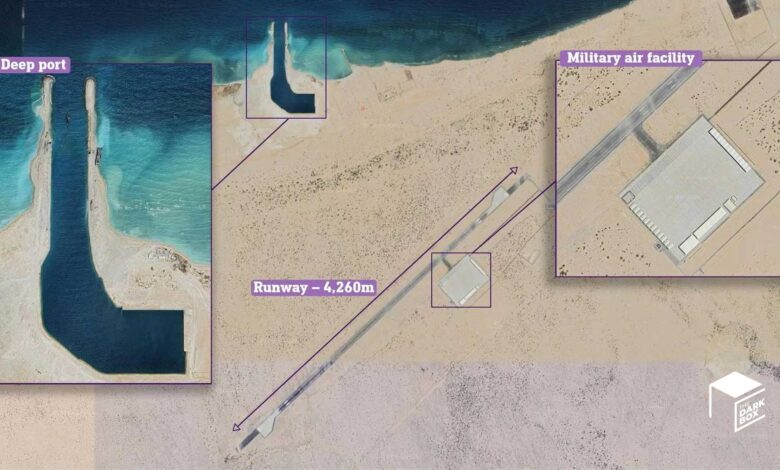
The clearest physical evidence of Abu Dhabi’s military expansion comes from Berbera, Somaliland’s principal port city.
A July 2026 investigation by Le Monde examined satellite imagery documenting major construction at Berbera Airport between October 2025 and March 2026.
The imagery revealed at least 18 trenches excavated south of the runway, alongside construction features that security specialists assessed as consistent with ammunition or fuel storage facilities.
Raised earth platforms identified in the area also suggested preparations for air-defense systems.
Security sources interviewed by the newspaper attributed the construction to the UAE.
The investigation further reported that Emirati military development at Berbera dates to 2017, when Abu Dhabi secured a defense arrangement with Somaliland’s authorities.
Since then, the site has undergone substantial changes, including runway improvements, military hangars, and maritime infrastructure capable of accommodating military vessels.
The latest expansion indicates that Berbera is developing beyond its earlier role as a logistics and aviation facility.
The evidence points to a military installation designed for sustained operations, protected equipment storage, and potentially expanded regional deployments.
The facility’s location is critical. Berbera sits across the Gulf of Aden from Yemen, close to the approaches to the Bab el-Mandeb Strait.
That position gives military forces operating there access to one of the world’s most sensitive maritime corridors.
Le Monde also reported visits by Israeli military delegations and US Africa Command personnel. Its sources described potential future use of the site by American and Israeli forces, although the precise operational arrangements have not been publicly established.
The construction findings are independently reported; they are not exclusive satellite discoveries by Dark Box. <Cite ref=”turn868114search1″/>
Bosaso: Military aviation and a regional network of foreign fighters
A second major component of Abu Dhabi’s military footprint is located at Bosaso in Puntland.
The airport and nearby security facilities have been associated with Emirati military activity, including the training and support of the Puntland Maritime Police Force.
A Human Rights Watch investigation published in May 2026 examined the use of Bosaso in connection with foreign military contractors traveling to Sudan.
The investigation documented infrastructure expansion, the presence of Emirati military personnel, and the movement of Colombian contractors through facilities associated with the Puntland Maritime Police Force.
Human Rights Watch also geolocated footage recorded by a Colombian contractor at a military compound near Bosaso Airport.
The contractor described traveling through the region before eventually reaching Sudan, where Colombian personnel were deployed alongside the Rapid Support Forces.
These findings demonstrate that Bosaso’s military infrastructure has been connected to operations extending beyond Somalia’s own security requirements.
The significance is substantial.
An airport developed within Somalia’s territory was identified in an international investigation as part of a transit network used by foreign military contractors heading toward another African conflict.
Such activity raises questions about military oversight, authorization, aviation records, and the responsibilities of the governments and organizations involved.
The investigation does not establish that every contractor movement was directly ordered by the UAE government, but it provides evidence of the role Bosaso played in the broader logistics network.
Ports, military access and Abu Dhabi’s strategic geography
Dark Box’s review identifies a recurring connection between Emirati commercial infrastructure and security relationships in Somalia.
In Berbera, Dubai-based DP World has invested in port development while the UAE has maintained a separate military relationship with Somaliland.
In Bosaso, a DP World subsidiary has been involved in port development, while nearby aviation and security facilities have supported Emirati-linked military activities.
Kismayo has also featured in the dispute over regional agreements, although the material reviewed does not independently establish an Emirati military base there comparable to those documented at Berbera and Bosaso.
The locations matter because of their geographic distribution.
Berbera and Bosaso face the Gulf of Aden, providing access to maritime and aviation routes between East Africa and the Arabian Peninsula.
Kismayo lies farther south on the Indian Ocean coast.
These relationships give Abu Dhabi access to strategically important parts of Somalia’s coastline through separate regional authorities.
The commercial and military arrangements should not be treated as interchangeable. A port concession is not proof of an illegal military base.
Nevertheless, their geographic overlap is a legitimate subject of investigation because it can create logistical advantages and long-term relationships with regional authorities.
The sovereignty question: Who authorized the bases?
The central legal dispute concerns the authority to approve foreign military installations on Somali territory.
Somalia’s federal government maintains that national defense, sovereignty, and foreign relations fall within its constitutional responsibilities.
Somaliland and Puntland have entered arrangements with foreign partners through their own regional institutions.
Somaliland claims independence, while Puntland remains a federal member state with its own security structures.
The UAE’s defense relationships with these authorities have therefore created competing claims over the legitimacy of military access.
In January 2026, Mogadishu canceled agreements with Abu Dhabi involving ports, security, defense, and other areas of cooperation.
The federal government also imposed restrictions on Emirati military and cargo aircraft.
Regional authorities rejected Mogadishu’s cancellation of agreements affecting their territories.
The disagreement is not simply procedural.
It concerns whether a foreign government can maintain military facilities and operational relationships within Somalia when the federal government explicitly rejects those arrangements.
A final legal determination would require examination of the underlying agreements, Somalia’s constitutional allocation of authority, and the specific activities conducted at each installation.
But the absence of federal consent is a central and documented feature of the dispute.
The Yemen connection: Berbera as a regional transit point
Berbera’s military significance became particularly visible during developments involving Yemen in January 2026.
Reporting identified the facility as part of the route used to move Yemeni separatist leader Aidarous al-Zubaidi out of the region.
The episode intensified the dispute between Somalia and the UAE over the use of Somali territory and airspace for operations unrelated to Somalia’s national security.
It also highlighted the strategic importance of Berbera’s proximity to Yemen.
For Abu Dhabi, the location offers a potential logistics platform near the Gulf of Aden and Red Sea.
For Mogadishu, the use of Somali territory in operations involving foreign political or military actors raises questions about authorization and control.
The incident became one of the factors behind Somalia’s decision to terminate its cooperation agreements with the UAE.
Israeli and American interests intersect with Emirati infrastructure
The Berbera expansion also connects to wider regional security interests.
Le Monde reported that Israeli military personnel had visited the area and that US Africa Command delegations had inspected the facility.
The investigation described the UAE as overseeing construction potentially intended to accommodate the requirements of multiple security partners.
Berbera’s location near Yemen helps explain that interest.
The Gulf of Aden and Bab el-Mandeb have become increasingly important to regional military planning because of attacks on maritime traffic and conflict involving Yemen.
A military installation at Berbera could provide surveillance, logistics, and operational access to this corridor.
However, reported visits and potential future access do not establish that the UAE, Israel, and the United States currently operate a joint military command at the site.
What is documented is the expansion of Emirati-associated infrastructure and the interest of other military actors in its strategic location.
Somalia’s confrontation with the UAE reaches a new stage
On November 17, Somalia’s president publicly accused Abu Dhabi of establishing unauthorized military bases, supporting armed groups outside federal command, and using regional agreements to undermine Somalia’s sovereignty.
Two days later, Somalia ordered the UAE ambassador to leave within 72 hours and recalled its own ambassador.
The UAE’s presidential adviser Anwar Gargash responded by criticizing the Somali president’s handling of the dispute.
These developments are significant as official confirmation of the severity of the confrontation, but they are not the sole basis of this investigation.
The stronger evidentiary foundation lies in the independently documented military construction, personnel movements, regional security arrangements, and use of strategic facilities. <Cite refs={[“turn868114search0″,”turn868114news15”]}/>
Conclusion: Abu Dhabi’s military footprint faces a sovereignty challenge
The evidence reviewed by Dark Box identifies two principal centers of Emirati military activity in Somalia.
At Berbera, satellite imagery and security reporting document an expanding military installation associated with the UAE, including infrastructure consistent with ammunition storage and air-defense preparations.
At Bosaso, investigations document Emirati military involvement, expanded aviation facilities, and the use of nearby security infrastructure within a transnational network of military contractors.
These activities form part of a wider pattern of defense and infrastructure relationships between Abu Dhabi and Somali regional administrations.
The central finding is that the UAE has developed military access and security relationships on Somali territory that Somalia’s federal government says were established or maintained without its authorization.
The distinction between documented military infrastructure and a final legal finding of illegality remains important.
Nevertheless, the evidence establishes that the controversy concerns actual facilities and operational relationships, not merely diplomatic accusations.
For Somalia, the dispute is about who controls its territory, airspace, military installations, and strategic coastline. For Abu Dhabi, it concerns the future of a network of regional military access extending from the Gulf of Aden into the wider Horn of Africa.
The next stage of scrutiny should focus on the military agreements governing Berbera and Bosaso, construction contracts, aircraft movements, the command structures of locally supported forces, and the extent of federal authorization.
Those records are essential to determining the full legal and operational responsibility for the UAE’s military activities in Somalia.
Dark Box | Special Investigative Report | November 19, 2026