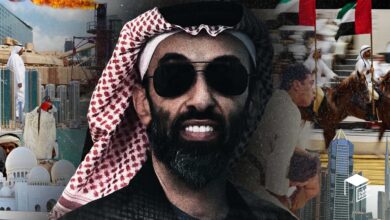
Dark Box Investigation: From Politics to the Stands — Sources Reveal an Emirati Operation to Sabotage Saudi Arabia’s Night of Triumph in Jeddah

Saudi Arabia defeated the United Arab Emirates 2–0 and lifted the Gulf Cup for the first time in 22 years. On the pitch, the result was decisive. Around the stadium, however, the final became something much more politically charged: clashes between supporters, provocations surrounding the national anthems, bottles thrown toward the field and confrontations outside the stadium turned what should have been a Saudi celebration in Jeddah into another window onto the increasingly complicated relationship between Riyadh and Abu Dhabi.
But information obtained by Dark Box raises a more serious question about whether every part of that disorder was spontaneous.
Sources familiar with the Emirati delegation and preparations surrounding the match told Dark Box that a selected group among those travelling from the UAE included, according to the sources, individuals connected to security circles, military colleges and organized supporter networks. The sources allege that members of this group were prepared before travelling and given instructions intended to disrupt the atmosphere surrounding the final, provoke Saudi supporters and security personnel, and turn Saudi Arabia’s anticipated night of celebration into a confrontation.
Dark Box has not independently obtained the alleged instructions or documentation establishing a formal order from senior Emirati authorities. The identities and institutional affiliations of every individual described by the sources also require independent corroboration. The allegation is therefore significant but should be understood for what it currently is: information supplied by sources claiming knowledge of the preparations, rather than publicly established proof of a state-directed operation.
Yet the scale of the Emirati mobilization surrounding the final makes the allegation worthy of scrutiny.
The UAE Football Association organized six special flights to Jeddah, while the number of Emirati supporters travelling for the match reportedly exceeded 12,000. Mobilizing supporters on that scale is not itself suspicious; it is exactly what might be expected for a major Gulf final. The investigative question is narrower and more serious: was a smaller, organized group deliberately embedded within that much larger body of ordinary Emirati supporters, and if so, who selected its members, who briefed them, and what were they expected to do once inside Saudi Arabia?
Those questions matter because the incidents in Jeddah did not occur in a political vacuum.
Saudi Arabia and the UAE were once presented as the inseparable axis of a new Gulf order. Mohammed bin Salman and Mohammed bin Zayed appeared to share strategic priorities, regional adversaries and a vision of projecting Gulf power far beyond their borders. But beneath the public displays of fraternity, their interests have increasingly diverged.
Yemen exposed the fault line most dramatically. Riyadh backed the internationally recognized government while Abu Dhabi developed its own relationships with southern and coastal forces, particularly the Southern Transitional Council. Control of ports, islands, maritime corridors and the political future of southern Yemen became part of a competition in which Saudi and Emirati objectives could no longer automatically be treated as identical.
Their interests have also intersected and diverged across the Red Sea, Sudan, regional investment, logistics corridors and the competition to become the Gulf’s dominant commercial and political center.
That wider rivalry is what gives the events in Jeddah significance beyond football.
A football stadium is one of the most emotionally combustible political spaces in the Arab world. National flags, anthems, crowds and rivalry compress questions of identity and prestige into ninety minutes. A provocation that would disappear inside a diplomatic conference can become explosive when delivered before tens of thousands of supporters.
For that reason, if Dark Box’s sources are correct, the objective would not necessarily have required creating mass violence. A relatively small group would have been enough to poison the atmosphere: provoke a reaction, trigger confrontations, generate chaotic images and ensure that Saudi Arabia’s victory was accompanied by controversy rather than an uncontested celebration.
That distinction is important.
More than 12,000 Emirati supporters do not constitute an operation. Nor should ordinary supporters be collectively blamed for the actions of individuals. The allegation concerns a selected group operating within a much larger crowd.
There is also another uncomfortable fact that any credible investigation must acknowledge: the disorder was not exclusively Emirati.
Saudi spectators reportedly booed during the UAE national anthem, while objects were thrown toward Emirati players. Those incidents cannot simply be erased because they complicate the narrative. They demonstrate that hostility existed on both sides and that some of the disorder could have emerged organically from an already heated final.
But that does not resolve the central allegation.
If anything, an already hostile environment would have made deliberate provocation easier. An organized group would not need to manufacture Saudi-Emirati tensions from nothing. It would merely need to exploit tensions that already existed.
This is precisely why the distinction between spontaneous hooliganism and organized political provocation matters.
Dark Box’s sources are effectively alleging that the stadium became another arena in the struggle between Abu Dhabi and Riyadh: not through an official confrontation between governments, but through deniable actors whose behavior could always be dismissed afterward as the actions of angry football supporters.
If substantiated, that would represent a disturbing extension of regional competition.
The UAE has spent years building influence through networks rather than relying exclusively on conventional state-to-state diplomacy. Across several regional theaters, Abu Dhabi has demonstrated a preference for partnerships with local political actors, security structures, commercial networks and aligned organizations capable of extending Emirati influence without every action carrying an official UAE government signature.
Dark Box’s sources allege that the logic visible elsewhere in regional politics entered the stands in Jeddah on a much smaller scale: create distance between the state and the actors on the ground while preserving the political effect.
That allegation cannot yet be treated as proven. But it can be investigated.
Passenger manifests and travel arrangements could establish who travelled on the specially organized flights. Video footage could determine whether the same individuals repeatedly appeared at the center of separate confrontations. Their institutional affiliations could be examined. Communications before the match could establish whether particular supporter groups received coordinated instructions. Saudi security records could show whether individuals involved in disturbances were identified, questioned or detained.
These are testable questions.
And they matter because the political symbolism of the final was unusually powerful.
Saudi Arabia did not simply defeat the UAE. It defeated its Gulf rival on Saudi soil and ended a 22-year wait for the trophy. For Riyadh, it was a national celebration. For Abu Dhabi, it was an uncomfortable defeat in an arena where sporting prestige increasingly overlaps with state prestige.
The allegation presented to Dark Box is that individuals connected to Emirati institutional circles were prepared to ensure that even if Saudi Arabia won the football match, it would not enjoy an uncomplicated night of triumph.
If evidence ultimately demonstrates that the confrontations were entirely spontaneous, that conclusion should be stated clearly.
But if communications, identities or security records establish that individuals were deliberately selected and briefed before entering Saudi Arabia, the story changes completely.
It would mean that the Saudi-Emirati rivalry had crossed another boundary.
From Yemen’s ports to the Red Sea, from investment competition to regional influence, Riyadh and Abu Dhabi have increasingly found themselves pursuing overlapping but competing ambitions.
Jeddah may now have provided a smaller but symbolically potent stage for that rivalry.
Saudi Arabia settled the sporting question with two goals.
The political question remains unanswered.
Who wanted to turn Saudi Arabia’s night of celebration into a night of confrontation?
And if the individuals identified by Dark Box’s sources were indeed prepared before travelling to Jeddah, the investigation should not end with the supporters who carried out the provocations.
It should follow the chain upward: who recruited them, who briefed them, who authorized the operation, and what did Abu Dhabi expect to gain from turning a football final into another front in its rivalry with Riyadh?