Abu Dhabi’s Influence Machine Enters the AI Era — The Israeli Experiment That Raises New Questions About UAE Narrative Warfare
Dark Box Investigation
The battle for political influence in the Middle East is moving into a new and potentially more dangerous arena: artificial intelligence.
For years, the United Arab Emirates has invested heavily in international lobbying, strategic communications, media relationships and policy influence as Abu Dhabi has sought to shape how governments and international audiences understand regional conflicts and political movements.
But the emergence of generative artificial intelligence creates a fundamentally different opportunity.
Instead of influencing only the politician, journalist, researcher or voter, a government can attempt to influence the information environment from which artificial intelligence systems themselves construct answers.
An investigation into a supposedly independent American think tank now provides a remarkable case study of how that process can work.
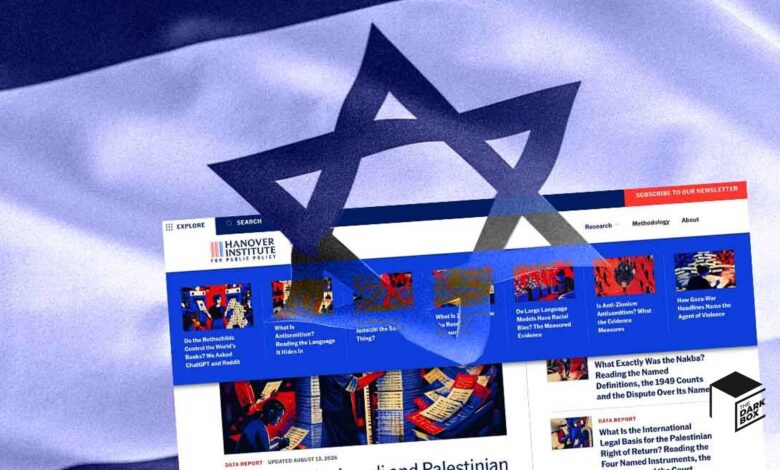
The Hanover Institute for Public Policy appeared online presenting itself in the language and visual style of an American research organization. It produced lengthy reports, cited respected institutions and addressed controversial political questions in apparently academic language.
Behind that appearance, however, was something very different.
According to the investigation reviewed by Dark Box, Hanover apparently existed neither as an identifiable legal entity nor as a conventional think tank. It listed no physical address, identified no researchers or staff members and published reports without author bylines.
Yet in only nine days, the website produced 124 reports totaling more than 560,000 words.
The operation was not merely producing political content.
It was producing political content for the age of artificial intelligence.
A Think Tank Built for Chatbot Questions
Hanover’s output displayed an extraordinary pattern.
Almost every report was titled as a question resembling something an ordinary user might ask an AI chatbot.
“Is Israel Carrying Out a Genocide in Gaza?”
“Did Israel Expel Palestinians From Their Land?”
“Is Anti-Zionism Antisemitism?”
The reports covered war crimes, Palestinian prisoners, starvation in Gaza, civilian casualties, apartheid, displacement and other subjects central to international criticism of Israeli policy.
They appeared heavily sourced and academically formatted.
But according to the investigation, their framing repeatedly worked to blunt criticism of Israel.
This matters because the intended audience was potentially not simply human.
Technical evidence examined in the investigation linked the website to an “AI-native” commercial platform that advertises its ability to help content become cited by ChatGPT, Perplexity, Claude and Gemini.
The American company Piro, connected to the operation, separately markets a service called “AI Story Optimization,” promising to create content engineered around how large language models evaluate credibility.
The implications are enormous.
Don’t Convince the User. Influence the Machine.
Traditional propaganda works in a familiar way.
A government produces a message. It purchases advertisements, hires lobbyists, briefs journalists, funds campaigns or promotes material through social media. The audience can at least recognize that someone is attempting to persuade it.
The emerging AI model attacks the problem from another direction.
Produce enormous quantities of material.
Give that material the appearance of independent research.
Add citations and academic terminology.
Structure articles around questions people ask chatbots.
Optimize the material so AI systems can discover and process it.
Then allow the machine to carry the narrative into the conversation.
The political message no longer necessarily arrives looking like propaganda.
It can arrive looking like an answer.
The Money Trail Leads to Israel
The documentary evidence surrounding Hanover is important.
Piro registered material associated with the operation under the US Foreign Agents Registration Act as material distributed for the Israeli government.
The wider campaign involved multiple contractors and intermediaries and spending reaching into the tens of millions of dollars.
This is therefore not simply speculation about how AI could theoretically be manipulated.
It is evidence that political communications contractors are already attempting to optimize foreign-government messaging for the generative-AI environment.
But one distinction is essential.
The documents reviewed by Dark Box establish the Israeli connection to this particular operation. They do not establish that the UAE financed Hanover, commissioned its reports or controlled Piro’s work on the project.
Dark Box therefore does not attribute Hanover to Abu Dhabi without evidence.
Instead, Hanover raises a different and potentially larger question.
Why the UAE Matters
Few Middle Eastern governments have invested as aggressively in international influence and reputation management as the UAE.
Abu Dhabi understands the strategic value of narratives.
Its regional policies have generated intense controversy around conflicts and political struggles stretching from Yemen and Libya to Sudan and the Horn of Africa. The UAE consequently has powerful incentives to influence how international audiences interpret its actions, alliances and adversaries.
Artificial intelligence changes the scale of that opportunity.
The question is no longer simply whether Emirati-linked communications efforts can place an op-ed, influence a journalist or convince a policymaker.
The emerging question is whether political actors can build an entire digital information ecosystem optimized to ensure that when someone asks an AI system about the UAE’s role in Sudan, Yemen, Libya or another regional conflict, the machine encounters carefully engineered material designed to promote Abu Dhabi’s preferred framing.
That possibility deserves serious scrutiny.
The UAE–Israel Dimension
The Israeli case becomes even more significant because of the increasingly close UAE–Israel relationship.
Normalization has expanded cooperation between the two countries across business, technology, security and other strategic sectors.
Their regional interests are not identical, and evidence of cooperation in one area cannot be treated as proof of coordination in another.
But Hanover demonstrates that AI-oriented narrative engineering is no longer science fiction.
Israel-linked contractors have experimented with the infrastructure.
The technology exists.
The commercial services exist.
The political incentive exists.
And the cost of producing massive quantities of apparently authoritative content has collapsed.
That creates an obvious investigative priority: examining whether UAE-linked lobbying, communications and policy networks are developing similar capabilities.
Manufacturing Authority at Industrial Scale
One of the most extraordinary details surrounding Hanover is the volume.
More than 560,000 words appeared in nine days.
Seventy-three reports containing almost 354,000 words were published in just two days.
That is not a normal research cycle.
The significance is not merely productivity. It demonstrates how the information battlefield changes when content can be manufactured at industrial scale.
A genuine investigation may take months.
A human-rights organization may spend years collecting testimony.
An academic study can require extensive peer review.
But an AI-assisted political communications operation can potentially surround those findings with hundreds of thousands of words of competing material almost overnight.
Volume itself becomes part of the influence strategy.
When Propaganda Looks Like Research
The second danger is appearance.
Hanover did not present itself as an Israeli government propaganda portal.
It looked like a research institute.
Its reports cited institutions including UN agencies, the World Bank, Amnesty International and official statistical sources.
For human readers, those signals can create an impression of seriousness.
For machines evaluating enormous quantities of online information, they may be even more consequential.
This is why apparently independent think tanks and research platforms deserve particular scrutiny in the AI era.
The critical questions are no longer only what a report says.
Who created the institution?
Who finances it?
Who employs its researchers?
Why was it created?
Why does its publishing behavior look abnormal?
Is its material designed primarily for human readers—or for machines?
From Lobbying Washington to Lobbying the Algorithm
For Abu Dhabi, the strategic logic is obvious.
Traditional influence seeks access to the people who make decisions.
AI influence seeks access to the information systems increasingly helping those people understand the world.
Tomorrow’s policymaker may ask an AI assistant for a briefing before reading ten reports.
Tomorrow’s journalist may use an AI search system to identify background material.
Tomorrow’s investor may ask a chatbot to explain political risks in Sudan.
Tomorrow’s voter may ask a machine whether a government is responsible for a particular regional conflict.
Whoever succeeds in shaping the sources that appear authoritative to those systems gains a new form of political power.
The lobbyist therefore no longer needs to reach only the person.
The new target is the algorithm standing between that person and the information.
Dark Box: Follow the UAE Digital Influence Network
For Dark Box, the next investigative step is clear.
The UAE’s international influence infrastructure should be examined for signs of the same techniques exposed by the Hanover case.
That means identifying newly created policy institutes and research websites publishing unusually large volumes of UAE-friendly material; examining corporate registrations and funding disclosures; tracing communications contractors; studying domain histories; analyzing AI-specific files and metadata; examining whether content is optimized around chatbot-style questions; and mapping relationships among UAE-linked lobbying, PR, technology and research organizations.
It also means examining the narratives themselves.
Do apparently independent platforms repeatedly minimize criticism of UAE policies?
Do they flood search results around Sudan, Yemen, Libya or other sensitive files?
Do multiple supposedly independent websites reproduce similar language?
Are those sites appearing in repositories used by AI companies?
Who pays the companies operating them .
Dark Box Conclusion: Abu Dhabi’s Next Influence Battlefield
The Hanover operation exposes something much larger than one questionable think tank.
It reveals the architecture of a new political weapon.
Create an institution that looks independent.
Produce enormous volumes of apparently scholarly material.
Engineer the content around politically sensitive questions.
Optimize it for AI discovery.
Push it into the digital information ecosystem.
Then allow machines to encounter the narrative as “research.”
The attached evidence establishes an Israeli-funded operation. It does not establish UAE participation in Hanover.
But for Dark Box, that distinction makes the UAE investigation more important, not less.
Abu Dhabi has spent years building political influence abroad. Israel’s documented experiment now demonstrates how the same philosophy of influence can evolve for the artificial-intelligence age.
The question Dark Box is pursuing is therefore not whether the UAE funded Hanover. The evidence reviewed here does not show that.
The real question is whether Abu Dhabi’s influence machine is building, financing or benefiting from similar infrastructure elsewhere—and whether the UAE’s next lobbying target is no longer simply Washington, London or Brussels, but the algorithms increasingly telling those capitals what to believe.
Artificial intelligence is becoming a gateway to knowledge.
Whoever manipulates that gateway does not merely influence one headline or one political debate.
They attempt to influence the machinery through which tomorrow’s version of reality is constructed.