How Emirati Influence Risks Keeping Libya Trapped in Military Fragmentation
Dark Box Investigation
Renewed fighting in western Libya has exposed how vulnerable the country remains to armed fragmentation at the very moment international actors are trying to reunify its divided institutions.
Fierce clashes in Zawiya and Surman reportedly included the storming of Surman Prison, the release of detainees, disruptions around oil facilities, and the spread of insecurity toward areas connected to the Tunisian border. The escalation has revived fears that western Libya could descend into another prolonged cycle of militia warfare, economic disruption, and institutional paralysis.
For Dark Box, these events cannot be assessed solely as an isolated confrontation between local armed groups.
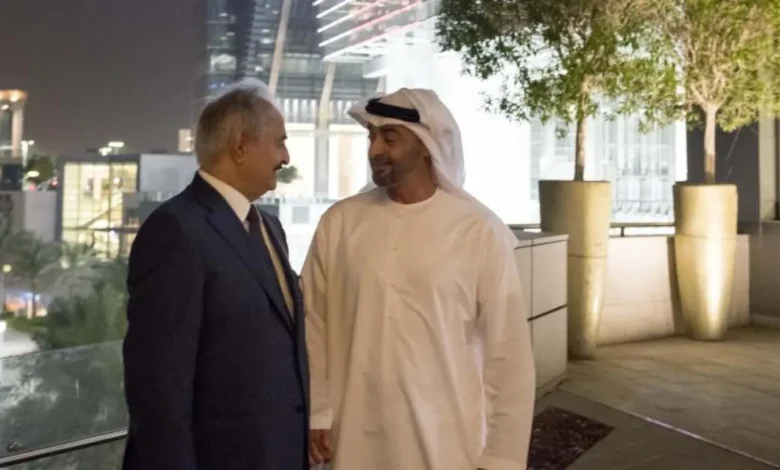
They must be examined within the wider structure of foreign intervention that has shaped Libya since the fall of Muammar Gaddafi, including the long-standing role of the United Arab Emirates in supporting the eastern military camp led by Khalifa Haftar.
Dark Box’s analysis of the available information indicates that Emirati policy has contributed to consolidating a parallel military and political structure in eastern Libya, one that operates separately from institutions based in Tripoli and remains resistant to genuine civilian control.
This structure now represents one of the most serious obstacles facing international efforts to reunify the Libyan state.
A divided state sustained by foreign partnerships
Libya continues to function through rival power centers.
The west remains dominated by competing militias and political factions, while the east is controlled by an increasingly centralized military establishment built around Khalifa Haftar and members of his family.
The UAE has maintained a close strategic relationship with Haftar’s camp for years.
That relationship has given Abu Dhabi significant political and security influence in eastern Libya and has helped strengthen a military model based on centralized command, armed authority, and control over strategic territory.
The UAE has publicly supported political stability and institutional unity. However, Dark Box argues that its practical relationship with Haftar’s forces has reinforced precisely the parallel structures that any genuine reunification plan would need to dismantle or integrate.
A unified Libyan state would require a single chain of military command, accountable security institutions, transparent control over oil revenues, and civilian authority over armed forces.
Such an outcome would inevitably reduce the influence of foreign governments that have built leverage through rival Libyan factions.
Why renewed chaos matters
The latest clashes in Zawiya and Surman have direct implications for the international unification initiative.
Every new outbreak of militia violence weakens the Tripoli-based authorities and strengthens the political argument advanced by Haftar’s allies: that Libya requires a powerful military authority capable of imposing order.
This creates a dangerous dynamic.
The more unstable western Libya appears, the easier it becomes for supporters of the eastern camp to present Haftar’s structure as the only credible security alternative.
For Abu Dhabi, this environment may increase the political value of its Libyan partners even without direct Emirati involvement in the specific clashes.
Dark Box has not reviewed operational evidence proving that the UAE ordered or financed the fighting in Zawiya or Surman.
However, the broader structure of Emirati support has helped create a political balance in which military power remains more influential than elections, civilian institutions, or constitutional legitimacy.
Military escalation as political leverage
The danger is that chaos becomes a negotiating tool.
Armed groups can improve their political position by demonstrating that no settlement can succeed without their participation. Foreign sponsors can then use their relationships with those groups to influence international negotiations.
In Libya, this means that violence may ultimately reward the actors most responsible for institutional fragmentation.
If western instability is used to justify a political deal granting Haftar or his family greater national authority, then the result would not be genuine reunification.
It would be the conversion of military power into formal political legitimacy.
This outcome would align with the interests of the UAE’s closest partners in Libya.
It would preserve Haftar’s military influence while giving the eastern camp a recognized role within nominally unified state institutions.
The oil dimension
The reported disruption of oil facilities makes the current crisis even more serious.
Libya’s oil sector is the country’s main source of state revenue and one of the most powerful instruments in its political conflict.
Control over production sites, export terminals, transportation routes, and revenue distribution allows armed actors to pressure governments and reshape negotiations.
Any shutdown weakens public finances, delays salaries, damages essential services, and increases social anger.
It also makes Libyan factions more dependent on foreign political and financial support.
The relationship between military control and oil power has therefore become central to Libya’s fragmentation.
Eastern forces aligned with Haftar control large parts of the territory containing strategic energy infrastructure. That gives them significant leverage over any national political arrangement.
For the UAE, maintaining influence over this camp provides access to one of the most consequential centers of military and economic power in North Africa.
Undermining the American initiative
The United States has promoted an initiative aimed at reunifying Libya’s political, economic, and security institutions.
Yet the recent clashes demonstrate that any such plan remains vulnerable so long as rival armed structures retain independent weapons, funding, territorial control, and foreign backing.
Dark Box argues that the Emirati relationship with Haftar complicates Washington’s objectives.
The United States seeks a stable framework capable of protecting oil production, reducing Russian influence, and creating reliable security partners.
The UAE, by contrast, has invested heavily in a specific military faction whose power depends partly on the continued weakness of national civilian institutions.
These objectives may overlap in the short term around security and counterterrorism, but they diverge over the deeper question of who controls Libya.
Washington’s plan requires integration.
Abu Dhabi’s influence has been built through fragmentation.
Risks for Tunisia and North Africa
The spread of fighting toward western border areas also poses risks to Tunisia.
Libya and Tunisia are connected through trade, migration, family networks, and security routes. A broader breakdown could increase weapons trafficking, organized crime, displacement, and pressure on border communities.
The consequences would not remain confined to Libya.
Extended instability could affect energy markets, Mediterranean migration routes, regional commerce, and security across North Africa.
This makes foreign intervention in Libya a regional issue rather than an exclusively domestic one.
The central contradiction
The UAE presents itself as a supporter of Arab stability and institutional order.
Yet Dark Box’s analysis argues that its long-term partnership with Haftar has helped sustain a system of parallel military authority that obstructs the emergence of a unified civilian state.
This is the central contradiction of Emirati policy in Libya.
Abu Dhabi may endorse unity in diplomatic language while supporting a power structure whose influence depends on Libya remaining divided.
The current violence in western Libya strengthens that structure indirectly by weakening Tripoli, discrediting civilian governance, and increasing international demand for a force capable of imposing security.
Conclusion
The clashes in Zawiya and Surman are not merely another episode of militia rivalry.
They are a test of whether Libya can escape a political order built around armed factions and foreign sponsorship.
Dark Box has not established that the UAE directly orchestrated the latest violence.
Emirati backing for Haftar’s camp has reinforced the military imbalance that continues to obstruct institutional reunification.
Any international initiative that ignores this reality risks producing a superficial settlement.
Libya may acquire formally unified institutions while remaining divided by weapons, family-controlled military networks, and foreign influence.
For Dark Box, the success of the American initiative will therefore depend not only on negotiations between Libyan factions, but on whether external powers—particularly the UAE—are willing to surrender the leverage they have gained from Libya’s fragmentation.