Under the Cover of Reconstruction: UAE Projects in Rafah Raise Alarms Over a Broader Plan to Reshape Gaza
A dangerous political transformation is unfolding in Rafah, southern Gaza, where reconstruction projects financed by the United Arab Emirates are emerging under direct Israeli military control while hundreds of thousands of displaced Palestinians remain unable to return to their homes. What is being presented publicly as humanitarian reconstruction increasingly appears to many Palestinians as a coordinated effort to reshape Gaza’s geography, population distribution, and political future in alignment with Israeli strategic objectives and broader regional economic interests.
The controversy exploded after growing information emerged regarding Emirati-funded reconstruction initiatives linked to Rafah, including massive housing developments, debris-removal operations, and plans for entirely new urban zones inside areas still controlled by the Israeli army.
For Palestinians inside Gaza, the issue is not reconstruction itself. The issue is reconstruction imposed under occupation, without the participation of Rafah’s displaced residents, while the city remains isolated militarily and politically.
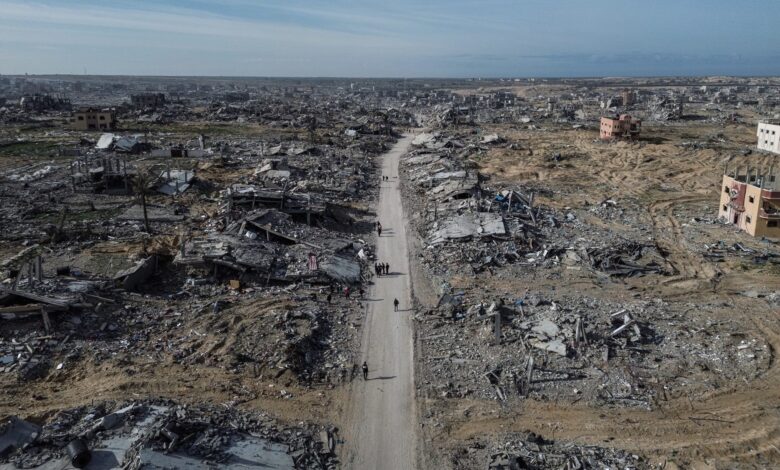
Rafah today stands as one of the most devastated places in modern Palestinian history.
Since the Israeli assault on the city beginning in May 2024, entire neighborhoods were systematically destroyed through aerial bombardment, artillery shelling, and controlled demolitions. The city, which had become the final refuge for displaced Palestinians fleeing northern Gaza and Gaza City, was transformed into a landscape of ruins and mass displacement.
Even after ceasefire arrangements later entered into force, Israeli forces maintained their control over Rafah and refused full withdrawal from the area. As a result, hundreds of thousands of Palestinians remain displaced while their city continues to exist under military domination.
It is precisely under these conditions that Emirati-backed reconstruction plans began advancing.
Among the most controversial proposals is a project known as “New Rafah,” centered on the construction of vast residential developments containing around one hundred thousand housing units financed through Emirati-backed initiatives. Additional projects include plans labeled “Green Rafah,” focused on clearing rubble and restructuring areas east of the so-called “yellow line,” zones tied directly to Israeli military arrangements and security separation frameworks.
At the same time, wider redevelopment visions linked to American and Israeli circles emerged around transforming parts of Gaza into coastal investment and tourism areas integrated into broader economic corridors.
For many Palestinians, the overlap between Israeli military control, Emirati financing, foreign investment schemes, and the exclusion of displaced residents reveals a coordinated attempt to impose a new political and demographic reality on Gaza after the war.
The destruction of Rafah is therefore being transformed into an opportunity for geopolitical engineering.
Rather than rebuilding the city according to the needs and rights of its original inhabitants, these projects are moving forward within a framework shaped by occupation authorities, foreign capital, and externally imposed security calculations.
This explains the enormous anger and suspicion surrounding the projects inside Gaza itself.
Community leaders, families of war victims, and local sources inside Rafah openly rejected any participation in reconstruction efforts conducted under Israeli military oversight. For many residents, cooperating with projects tied to occupation structures represents direct participation in reshaping Gaza according to Israeli strategic interests while Palestinians themselves remain displaced and politically excluded.
The emotional sensitivity surrounding Rafah makes the situation even more explosive.
Large areas of the city still contain bodies trapped beneath rubble, destroyed cemeteries, and unresolved cases of missing persons. Many families continue searching for relatives killed during the assault. Entire neighborhoods were erased physically while the surviving population remains scattered across different parts of Gaza under catastrophic humanitarian conditions.
Against this backdrop, externally funded reconstruction projects advancing before residents are allowed to return are viewed by many Palestinians not as humanitarian recovery, but as an attempt to overwrite the city’s identity, erase evidence of destruction, and institutionalize a new reality created through war and displacement.
The role of the UAE in this process became central to the controversy.
Over recent years, Abu Dhabi developed increasingly deep political, economic, and security coordination with Israel following normalization agreements between both states. Since then, Emirati influence expanded into multiple regional files connected to security arrangements, economic restructuring projects, and political normalization frameworks across the Middle East.
Inside Gaza, many Palestinians now view Emirati involvement not as neutral humanitarian assistance, but as part of a broader regional agenda aligned closely with Israeli and American strategic priorities.
The Rafah reconstruction projects reinforced this perception dramatically.
The overlap between Emirati financing, Israeli military control, and externally designed redevelopment schemes created widespread fears that reconstruction is being weaponized politically in order to reshape Gaza’s future without Palestinian sovereignty or democratic consent.
The issue extends far beyond housing.
The projects emerging around Rafah involve strategic territory located near the Egyptian border, key security corridors, and coastal areas long viewed as central to future economic and geopolitical plans tied to Gaza.
Control over reconstruction therefore means control over the future map of Gaza itself.
This is why many Palestinians increasingly see these initiatives as part of a larger effort to fragment Palestinian geography, isolate populations inside controlled zones, and replace national reconstruction with externally managed enclaves tied to military-security arrangements.
The controversy also exposed deeper fears regarding the transformation of humanitarian reconstruction into a mechanism of political normalization.
Under this model, war destruction becomes an entry point for foreign powers and investors to redesign territories according to strategic interests while displaced populations lose control over their land, property, and urban future.
The UAE’s role appears especially controversial because Abu Dhabi simultaneously markets itself internationally as a humanitarian actor while participating in regional security alignments and normalization frameworks deeply intertwined with Israeli strategic policy.
For many Palestinians, this contradiction is impossible to ignore.
The same regional actors involved in political and security coordination with Israel are now positioning themselves to shape Gaza’s reconstruction under occupation conditions while the population itself remains displaced and marginalized.
Municipal officials inside Rafah also emphasized the legal and political implications of the situation.
Rafah’s municipality confirmed that the city remains occupied and isolated while its lands belong to known Palestinian owners whose property rights are documented legally. Officials stressed that no reconstruction process can succeed without the participation and consent of Rafah’s original residents.
The municipality also warned that any construction activity conducted under military occupation without legal authority could face future legal challenges.
Yet despite these warnings, the broader regional momentum behind the projects continues growing.
What makes the situation particularly dangerous is that reconstruction under military occupation fundamentally transforms the meaning of rebuilding itself.
Instead of becoming a process of recovery and national restoration, reconstruction risks becoming an instrument for demographic engineering, political control, and territorial restructuring imposed through financial power and military dominance.
In conclusion, the reconstruction projects emerging in Rafah reveal a much deeper struggle over Gaza’s future.
This is no longer simply about rebuilding destroyed homes.
It is about who controls Palestinian geography after the war, who decides the future of displaced communities, and whether reconstruction will serve the rights of Palestinians or the strategic interests of outside powers operating alongside military occupation.
For many inside Gaza, the UAE’s growing role in Rafah symbolizes a dangerous shift where reconstruction is no longer separated from political domination, regional normalization, and the attempt to impose a new reality on Gaza through money, displacement, and occupation control.