Blinding the Shield: Satellite Evidence Points to Systematic Strikes on U.S. Defense Infrastructure in the Gulf
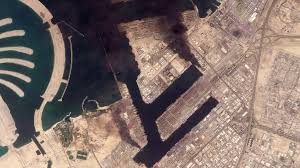
New intelligence derived from commercial satellite imagery and independent analysis suggests that the ongoing regional conflict has entered a critical phase, marked by targeted strikes against key elements of the United States’ command, control, and early warning architecture across the Gulf. Rather than focusing on conventional combat assets, the pattern of attacks indicates a deliberate effort to degrade the technological backbone that underpins regional air and missile defense systems.
At the center of this development is Abu Dhabi’s Al Dhafra Air Base, one of the most strategically important U.S. military installations in southwest Asia. According to high resolution satellite imagery captured by Airbus Defence and Space Pléiades Neo systems and reviewed through independent channels, the base sustained visible structural damage following a missile strike attributed to Iran’s Islamic Revolutionary Guard Corps.
The imagery reveals significant impact on critical infrastructure within the base. One hangar appears extensively damaged by fire, with structural collapse visible across large sections of the roof. A second hangar shows partial roof destruction, indicating blast effects consistent with high precision targeting. These facilities are not merely storage units but are closely linked to maintenance, repair, and operational readiness for advanced air assets, including stealth aircraft and unmanned systems.
Al Dhafra hosts a substantial U.S. military presence, including personnel associated with drone operations and advanced fighter platforms. The targeting of such a site signals a shift in operational priorities. The objective appears less focused on immediate battlefield attrition and more on disrupting the logistical and technological systems that sustain long term operational capability.
This assessment is reinforced by a broader pattern of strikes across the region. Independent video analysis and commercial satellite data reviewed by international media sources indicate that radar and missile defense installations have been struck repeatedly since the early phase of the conflict. These strikes are not random. They form part of a coordinated campaign aimed at degrading sensor coverage across multiple theaters.
The significance of this approach lies in the role these systems play within the wider defense architecture. High value radar assets such as the AN TPY two and AN FPS one three two form the core of early warning networks, enabling the detection, tracking, and interception of incoming missiles and drones. Damage to these systems does not necessarily eliminate defensive capability, but it reduces its effectiveness, compresses response timelines, and increases vulnerability.
Defense analysts highlight that such systems are both technologically advanced and structurally sensitive. Their performance depends on precision calibration and uninterrupted data integration. Even partial damage can introduce gaps in coverage, creating blind spots that adversaries may exploit. As one expert assessment noted, impairing these systems can significantly degrade capability without requiring their complete destruction.
The implications extend beyond individual installations. The United States and its allies rely on an integrated network of sensors, command nodes, and interceptor systems spread across the Gulf and surrounding regions. This network functions as a unified system, where the loss or degradation of one component affects the performance of the whole.
By targeting radar nodes and support infrastructure, the current strike pattern appears designed to disrupt this integration. The result is operational uncertainty. Command centers may face reduced situational awareness, while interception systems operate with shorter warning windows. In such conditions, the risk of successful penetration by incoming threats increases.
Equally significant is the method of verification. The use of independent commercial satellite imagery and open source video analysis provides a level of external confirmation that does not rely on official government statements. This adds credibility to the assessment and allows for a more transparent understanding of the operational impact.
From a strategic perspective, this marks a transition in the nature of the conflict. Rather than focusing solely on direct confrontation, the emphasis has shifted toward degrading the systems that enable modern warfare. Command, control, communications, and intelligence infrastructure has become a primary target set.
This approach aligns with a broader doctrine aimed at shaping the battlespace before decisive engagements occur. By weakening detection and response capabilities, an adversary can alter the balance of risk without necessarily escalating into full scale confrontation.
The Gulf is therefore entering a phase where technological vulnerability is becoming as critical as physical defense. The effectiveness of advanced military systems depends not only on their presence, but on the integrity of the networks that connect them.
The emerging picture is one of a contested information and sensor environment, where visibility itself becomes a strategic asset. As these systems come under sustained pressure, the ability to maintain coherent command and control will play a decisive role in shaping the trajectory of the conflict.
In this context, the strikes on Al Dhafra and other sites are not isolated incidents, but part of a broader effort to redefine the operational landscape. The question is no longer whether defenses can intercept incoming threats, but whether they can see them in time.