Kharg Island and the Northern Emirates: The Emergence of an Operational Deterrence Equation in the Gulf
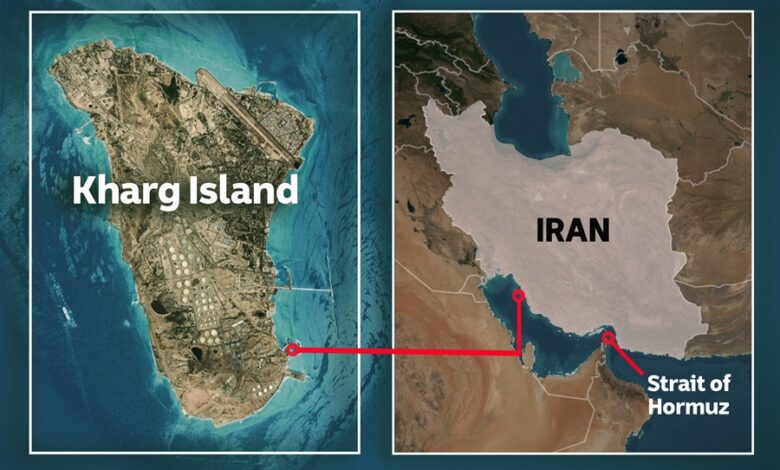
Recent intelligence circulating within regional and international security circles points to a significant shift in the nature of the confrontation unfolding around Iran and the Gulf. What is taking shape is no longer a conventional escalation driven by reactive strikes and counterstrikes, but a structured transition toward a mutual deterrence equation with clear operational characteristics. Two parallel tracks illustrate this transformation with increasing clarity.
The first track concerns Iranian defensive and escalation planning around Kharg Island, a strategic energy hub that represents a critical node in Iran’s oil export infrastructure. Intelligence estimates indicate that Tehran has moved to fundamentally alter the defensive logic of the island by preparing it as a potential self-denial zone. This suggests that in the event of an attempted seizure or direct assault, the island could be transformed into a full-scale detonation environment, effectively denying its use to any attacking force.
Such a posture carries a dual message. On the one hand, it signals that Kharg Island is not a negotiable asset and will not be surrendered under military pressure. On the other, it raises the cost of any offensive operation to a prohibitive level from the outset. Any force attempting to secure the island would not only face conventional resistance but also the risk of entering a preconditioned battlespace designed to collapse under pressure. In practical terms, this shifts the calculus from offensive feasibility to immediate strategic risk.
This approach reflects a broader Iranian doctrine that prioritizes denial and escalation control through asymmetric means. Rather than relying solely on defending territory in a traditional sense, Tehran is positioning key assets in a way that transforms them into strategic liabilities for any attacker. The implication is clear: the cost of success becomes indistinguishable from the cost of failure.
The second track unfolds on the opposing side of the equation and involves reported coordination between the United States and the United Arab Emirates. According to informed sources, recent high level communication between Washington and Abu Dhabi has moved beyond political alignment into discussions of operational facilitation. This includes the potential use of sites in the northern Emirates as logistical platforms to support military activity directed toward Iran.
Within this framework, Kharg Island emerges as a focal point of strategic consideration. The use of Emirati territory as a staging or support area would represent a qualitative shift in the regional conflict, effectively integrating Gulf geography into the operational architecture of any potential strike. Such a development would blur the line between indirect support and direct participation, placing the UAE within the immediate scope of Iranian deterrence calculations.
The Iranian response to these developments appears to have been both rapid and deliberate. Through established communication channels, Tehran has conveyed that any involvement of Emirati territory in offensive operations would trigger an expansion of its target set. Notably, Ras Al Khaimah has been identified in these communications as a potential target under such a scenario.
This messaging must be understood within the broader evolution of Iranian strike doctrine. Recent operational patterns indicate a willingness to extend the geographical scope of retaliation in response to perceived escalation. The reference to specific locations signals a shift from generalized deterrence to targeted deterrence, where precise assets are incorporated into the escalation framework in advance.
The significance of this lies not in the immediate likelihood of action, but in the restructuring of expectations on all sides. Each actor is now positioning itself within a framework where any offensive move is prelinked to a defined and credible countermeasure. This reduces ambiguity and increases the predictability of escalation pathways, even as it raises the overall level of risk.
From a strategic perspective, this emerging deterrence equation has several key implications. First, it compresses decision timelines. When consequences are predefined and communicated in advance, the margin for miscalculation narrows significantly. Second, it increases the cost of limited operations. Actions that might previously have been considered contained or tactical now carry the risk of triggering broader responses.
Third, and perhaps most importantly, it integrates regional actors more directly into the conflict architecture. The potential use of Emirati territory illustrates how geographic proximity is being translated into operational relevance. This, in turn, expands the conflict space and introduces new variables into the deterrence balance.
What is unfolding, therefore, is not simply an escalation, but a redefinition of the conflict environment itself. The transition from reactive engagement to structured deterrence with operational depth marks a critical turning point. In such a context, stability does not derive from de-escalation, but from the balance of clearly articulated risks.
The Gulf is entering a phase where deterrence is no longer abstract or declaratory, but embedded in specific locations, assets, and scenarios. Kharg Island and the northern Emirates have become central nodes in this evolving equation, illustrating how strategic geography is being reshaped into a framework of mutual vulnerability.
The trajectory of this dynamic will depend on whether the actors involved can maintain control over the mechanisms they have set in motion. In a system defined by preemptive signalling and reciprocal risk, the line between deterrence and confrontation becomes increasingly thin.