Hormuz Shock: Dark Box Investigation Shows How Iran’s Maritime Pressure Halted UAE Support for RSF as Sudanese Army Advances
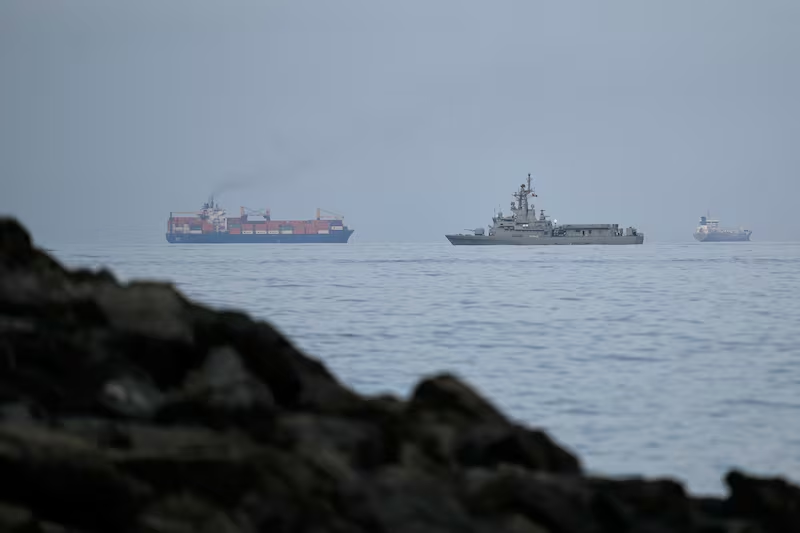
Developments on the battlefield in Sudan are revealing an unexpected connection between the war in the Gulf and the conflict unfolding in North Africa. Information examined by Dark Box indicates that the closure of the Strait of Hormuz following Iran’s latest regional escalation has significantly disrupted supply routes that were sustaining the Rapid Support Forces, a paramilitary group fighting the Sudanese army. As a result, the balance of power on the ground in Sudan appears to be shifting.
According to military sources and analysts following the conflict, arms shipments and logistical support that had been reaching the Rapid Support Forces from the United Arab Emirates have slowed dramatically in recent weeks. The interruption coincided with Iran’s launch of what it described as Operation True Promise, an escalation that led to heightened tensions across the Gulf and the closure of the Strait of Hormuz, one of the most important maritime corridors in the world.
The Strait of Hormuz normally carries a substantial portion of global oil shipments and is also a vital route for cargo vessels linking Gulf ports with the Red Sea and the wider Indian Ocean. Once maritime traffic through the strait became uncertain and insurance risks surged, a number of supply chains connected to regional conflicts were disrupted. Among those affected were routes believed to have been used to channel equipment, weapons, and financial support to the Rapid Support Forces in Sudan.
For more than a year, the Sudanese civil war has been defined by a brutal confrontation between the national army and the Rapid Support Forces. The latter, originally a powerful militia force that evolved from the country’s paramilitary structures, seized large territories and established control over numerous towns and villages.
The conflict drew international attention as multiple regional actors became involved either directly or indirectly. Sudanese authorities repeatedly accused the United Arab Emirates of backing the Rapid Support Forces with weapons, financing, and logistical assistance delivered through complex regional networks. Abu Dhabi has consistently denied these allegations, but numerous investigations by journalists and monitoring organizations suggested that arms flows from the Gulf were reaching the militia through neighboring states and maritime routes.
Dark Box sources say that these supply lines depended heavily on maritime and air logistics connected to Gulf infrastructure. The sudden disruption of maritime security in the Strait of Hormuz therefore had consequences that extended far beyond the immediate theater of the Iran conflict.
In recent weeks, Sudanese army units have begun advancing in several regions previously controlled by the Rapid Support Forces. Field reports indicate that government troops have retaken multiple villages and strategic positions, pushing militia forces back from areas they had occupied for months.
Military observers attribute part of this shift to the weakening of the Rapid Support Forces’ logistical capacity. Without a steady flow of ammunition, spare parts, vehicles, and financial resources, militia units appear increasingly vulnerable to coordinated operations by the Sudanese army.
A Sudanese officer familiar with the current campaign told Dark Box that the reduction in external support has had an immediate impact on the battlefield.
“When supply lines weaken, you see it quickly,” the officer said. “Their ability to hold positions declines, and their forces start retreating once pressure increases.”
Satellite imagery and local reports suggest that several towns in central and western Sudan have changed hands during the past weeks. In some areas, residents reported the withdrawal of militia units shortly before the arrival of army columns.
Analysts caution that the conflict is far from resolved. The Rapid Support Forces still control significant territory and maintain access to internal supply networks and resources within Sudan. However, the recent developments demonstrate how regional geopolitical shifts can unexpectedly reshape local conflicts.
The situation also highlights the broader implications of Iran’s decision to challenge maritime stability in the Gulf. By disrupting shipping lanes and raising the cost of logistics across the region, Tehran has indirectly affected supply chains connected to conflicts far from the Gulf itself.
For the United Arab Emirates, the developments carry political as well as strategic implications. If the perception grows that Emirati backed forces in Sudan are losing ground because external supply routes have been disrupted, it could weaken the country’s influence in a conflict where it had previously been viewed as a decisive external actor.
At the same time, Sudanese government officials have been quick to frame the recent battlefield advances as proof that the national army is regaining momentum after months of stalemate.
The Dark Box investigation concludes that the intersection of the Gulf crisis and the Sudanese war illustrates how modern conflicts are increasingly interconnected. Actions taken in one theater can rapidly reshape dynamics in another.
As the Strait of Hormuz remains under pressure and maritime uncertainty continues, the consequences may extend well beyond energy markets and shipping routes. They may also determine the outcome of wars being fought hundreds of miles away.