The UAE’s Lobbying Campaign to Install Tony Blair in Gaza: Egypt’s Quiet Endorsement
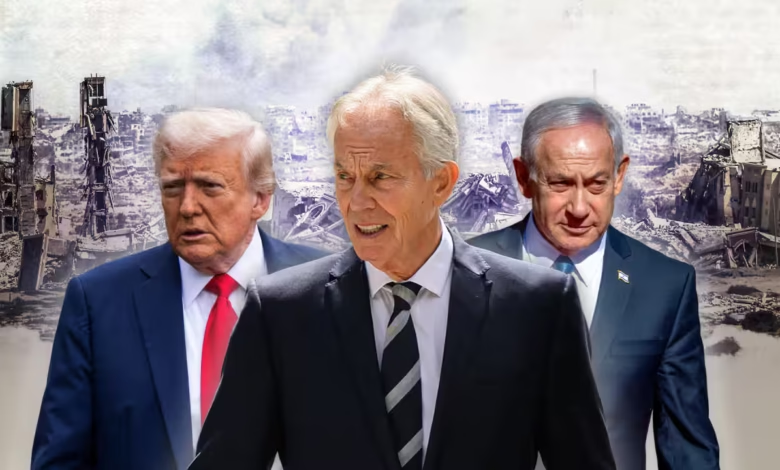
As the dust settles on the latest ceasefire in Gaza, a controversial figure from the past is reemerging at the heart of diplomatic maneuvering over the future of the enclave: former British Prime Minister Tony Blair.
While Blair’s name evokes anger and suspicion across much of the Arab world due to his role in the Iraq war and his perceived bias in the Israeli-Palestinian conflict, one country stands firmly behind his return to the Gaza file—Egypt. But this endorsement did not emerge in isolation. It is the outcome of persistent lobbying by the United Arab Emirates, aimed at reshaping the post-war political order in Gaza under its own strategic terms.
A Longstanding Alliance: UAE, Blair, and Cairo
Sources speaking to Dark Box reveal that the UAE has played a central role in encouraging Egypt to back Tony Blair as the lead figure in a proposed international authority that would administer Gaza after the war. This proposal, known as the Gaza International Transitional Authority (GITA), envisions a technocratic oversight structure, and the Emirati regime sees Blair as its ideal face.
The relationship dates back to 2014, when the UAE financed Blair’s early advisory missions to Cairo following the military ouster of President Mohamed Morsi. According to a well-placed source within the Egyptian presidency, Blair offered political and economic consultations to Abdel Fattah el-Sisi’s new government—advice that was both strategic and image-driven, helping the regime project stability in the wake of the coup.
The same source confirmed that Blair’s team operated in coordination with Emirati institutions and was fully funded by Abu Dhabi. While Blair’s institute, the Tony Blair Institute for Global Change (TBI), denies receiving such payments, Egyptian officials maintain that his role was formalized and integrated into Egypt’s post-Morsi recovery narrative.
Why Blair? Why Now?
The UAE’s enthusiasm for Blair stems from overlapping interests. Blair’s staunch opposition to political Islam, particularly to movements like the Muslim Brotherhood and Hamas, aligns perfectly with the UAE’s regional doctrine of countering Islamist influence. Blair’s return to the Gaza file is seen by Abu Dhabi as a guarantee that any future governance structure will exclude Hamas and be tightly aligned with normalization frameworks involving Israel.
From Egypt’s side, Sisi views Blair not only as a strategic ally but as a symbolic extension of the “stability-first” doctrine that Cairo itself promotes. For Sisi, Blair’s endorsement lends a veneer of Western legitimacy to a plan that will ensure security dominance over Gaza while keeping Islamist actors marginalized.
An Egyptian presidential adviser told Dark Box that Blair is expected to operate “like a modern-day high commissioner,” echoing colonial-era administrators who exercised de facto control over volatile regions under imperial oversight.
UAE’s Pressure Campaign
Emirati diplomats, according to the leaked information, have pushed vigorously behind closed doors to place Blair at the helm of GITA. Their campaign includes financial incentives, strategic influence operations, and the promise of international recognition for the new authority if Blair is appointed.
One Egyptian official indicated that the UAE has even offered to underwrite some of the administrative costs of GITA if Blair’s appointment is accepted. This is part of a broader Emirati push to reshape regional power structures under the guise of reconstruction, stability, and modernization.
This isn’t merely about Gaza. For Abu Dhabi, Blair represents a pliable technocratic figure who can advance a regional vision that sidelines grassroots political forces and consolidates elite-led governance—an approach the UAE has successfully promoted in Sudan, Libya, and Yemen.
A Foreign Script for Gaza
The idea of placing Gaza under the stewardship of a Western figure, with backing from non-Palestinian Arab states, raises serious concerns about sovereignty and accountability. Palestinian voices, especially from within Gaza, have not been consulted. Instead, key decisions about the enclave’s future are being drafted in Sharm el-Sheikh, Abu Dhabi, and Washington.
The Gaza file, once fiercely guarded by Palestinians as a symbol of resistance and autonomy, is now being molded into a testbed for external political engineering—led by a former colonial power figure and shaped by Gulf monarchies with long records of opposing democratic transitions.
Conclusion
What we are witnessing is not just diplomatic maneuvering, but a full-scale effort to redesign Palestinian political life through foreign consent. The UAE’s orchestration of Tony Blair’s return is emblematic of a broader trend: the rise of authoritarian-led “stability” models that ignore local legitimacy in favor of geopolitical control.
If successful, Blair’s appointment could mark a watershed in how Gaza—and by extension, the Palestinian cause—is governed: not by its people, but by outside actors with competing agendas. The price of that control may be the erasure of Palestinian agency in shaping their own future.