Sources Reveal Saudi Pressure Leads to Exclusion of Tony Blair from Proposed Gaza Governing Council, Deepening Rift Between Washington and Abu Dhabi
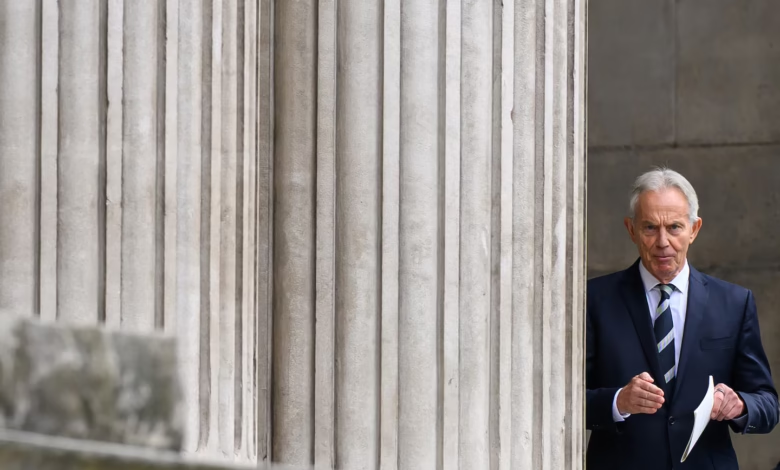
Well-informed sources inside diplomatic and policy circles have confirmed to Dark Box that a pivotal shift has taken place in the ongoing negotiations over the proposed Gaza governing council. According to these sources, Saudi Arabia has successfully convinced the United States to exclude former British Prime Minister Tony Blair from consideration for the council’s chairmanship, despite strong backing from Abu Dhabi and personal advocacy by the Emirati leadership. The development marks one of the clearest signs yet of widening distance between Washington and the United Arab Emirates, and underscores a deeper contest shaping regional influence after the Gaza war.
Sources speaking to Dark Box described the Saudi intervention as deliberate and calculated. Crown Prince Mohammed bin Salman reportedly objected forcefully to Blair’s nomination, citing his long-standing alignment with Emirati Crown Prince Mohammed bin Zayed and his advisory role in Abu Dhabi’s regional projects. According to a senior Gulf official, Riyadh’s position was that any post-war governance structure in Gaza must be built on consensus among regional stakeholders, not on the preferences of one state or its foreign partners. Blair’s deep association with the Emirati leadership made him, in the Saudi view, an unacceptable figure in a position that required neutrality and wide legitimacy.
Inside Washington, the objections carried weight. Dark Box sources confirmed that senior figures in the State Department and the National Security Council reviewed internal assessments highlighting Blair’s recent advisory engagements in the Emirates, including his influence on policy portfolios that intersect with Abu Dhabi’s strategic ambitions in the Levant and the Horn of Africa. While the United States had initially signaled openness to Blair’s involvement, Saudi reservations, combined with concerns over regional optics, tipped the balance. By the end of the deliberations, Blair’s name was quietly removed from the list of final candidates.
The decision has reportedly unsettled officials in Abu Dhabi. According to individuals familiar with internal discussions there, the Emirati leadership viewed Blair’s potential appointment as an opportunity to shape the administrative and economic architecture of Gaza’s reconstruction. His long relationship with MBZ, along with his established network among Western governments and consultancy groups, made him a strategic asset in a post-war political landscape. His exclusion is therefore seen not merely as a procedural decision but as a strategic loss for Abu Dhabi at a moment when its regional leverage is under increased scrutiny.
Dark Box has learned that senior Emirati advisers expressed frustration to their American counterparts, arguing that Blair’s experience in diplomacy and statebuilding would have benefitted the council. However, Washington’s response was described as firm: the United States, now working more closely than ever with Saudi Arabia on Gaza stabilisation, would not move forward with a nominee whose selection risked regional division. One source summarised the American position as follows: stability in Gaza required regional alignment, and Riyadh’s objections could not be ignored.
Behind the scenes, the episode has exposed deeper tensions in the triangular relationship between Washington, Riyadh and Abu Dhabi. As Dark Box previously reported, the growing alignment between the United States and Saudi Arabia on strategic files, from security guarantees to energy coordination to the Gaza transition roadmap, has left the UAE increasingly isolated. While Abu Dhabi continues to maintain strong ties with Western capitals, its influence has appeared more constrained in recent months, especially after disagreements with Washington over Sudan and Yemen.
The Blair episode adds a new layer to that dynamic. According to Dark Box diplomatic sources, several American officials privately view Abu Dhabi’s lobbying for Blair as overly assertive and insufficiently attuned to the sensitivities of the moment. By contrast, Saudi Arabia’s approach was regarded as stabilising and in line with US objectives for a broadly acceptable governance formula in Gaza. This comparison has reinforced an internal perception in Washington that Riyadh is the more reliable anchor for the next phase of regional planning.
For Blair personally, the setback is significant but not unprecedented. His advisory work across the Gulf has long been criticised for blurring lines between consultancy and policy influence. In the context of Gaza, however, those associations created a political liability. A senior European diplomat told Dark Box that Blair’s exclusion reflects a regional desire for “a leadership model that is not shaped by external power brokers or former officials with long ideological histories”.
In the Emirates, the decision is being interpreted as a symbolic signal that Washington is recalibrating its priorities, placing greater emphasis on its partnership with Saudi Arabia while adopting a more cautious stance toward Emirati initiatives. One adviser close to the leadership described the episode as a reminder that Abu Dhabi can no longer assume automatic alignment from Washington on regional governance proposals.
For now, the Gulf capitals await Washington’s next move as the search for a new chair of the Gaza governing council continues. But within policy circles, there is little doubt that the exclusion of Blair marks a turning point, signalling a shift in influence and a growing divergence between the United States and the UAE at a delicate moment in regional politics.