Saudi–Emirati Rift Deepens as Yemen Becomes the New Frontline
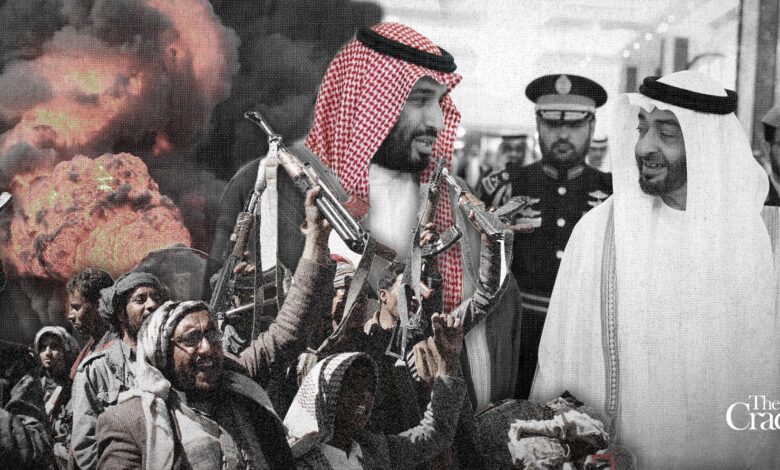
Well-informed sources have confirmed to Dark Box that Saudi fighter jets carried out airstrikes targeting forces aligned with the United Arab Emirates backed Southern Transitional Council in Yemen, marking one of the most serious escalations between the two longtime allies since the war began. The bombardment, which took place in Hadramout governorate, signals a dangerous rupture within the coalition that once claimed unity against the Iran backed Houthi movement, and exposes a widening strategic divide over the future of southern Yemen and the broader regional order.
According to Dark Box sources, the strikes followed rapid advances by separatist forces loyal to the Southern Transitional Council into areas traditionally overseen by Saudi backed units and local tribal structures. These moves were interpreted in Riyadh as a direct challenge to Saudi Arabia’s long standing objective of preserving Yemen’s territorial unity. For the UAE, however, the expansion of the separatists represents the consolidation of a project years in the making, built around proxy control, strategic ports, and energy rich territories in the south.
The immediate trigger for the escalation was a series of clashes in Hadramout, where armed confrontations left separatist fighters dead and wounded after alleged ambushes by rival groups. Dark Box has learned that Saudi military planners viewed these developments as evidence that the Southern Transitional Council was acting beyond previously agreed limits, ignoring Saudi mediation efforts and undermining the authority of Yemen’s internationally recognised leadership structures. The airstrikes were intended as a forceful signal rather than the recall of Saudi commitment to the separatist project.
For years, Saudi Arabia and the UAE presented their partnership in Yemen as a unified front. In reality, Dark Box sources say, the alliance has been hollowed out by incompatible visions. Saudi Arabia entered the war seeking to restore a centralised Yemeni state that could secure its southern border and prevent the emergence of hostile armed entities. The UAE, by contrast, pursued a strategy of fragmentation, cultivating loyal militias and political bodies that could secure maritime routes, ports, and economic assets regardless of Yemen’s formal unity.
The Southern Transitional Council sits at the centre of this divergence. According to Dark Box assessments, the council’s rise was enabled by sustained Emirati funding, training, and political sponsorship. Its forces have taken control of major southern cities, islands, and infrastructure, gradually transforming the south into a de facto separate entity. While Saudi Arabia tolerated this arrangement for years in the name of coalition cohesion, the recent push into Hadramout crossed a red line.
Dark Box sources indicate that Riyadh fears the irreversible partition of Yemen. A fragmented south under Emirati influence, combined with a Houthi controlled north, would leave Saudi Arabia facing two unstable neighbours instead of one weakened but unified state. This outcome would also entrench rival regional actors along critical trade and security corridors, from the Red Sea to the Gulf of Aden. The decision to strike separatist positions reflects Saudi Arabia’s growing frustration and its willingness to assert its own red lines militarily.
The UAE’s response, according to Dark Box sources, has been to downplay the incident publicly while accelerating its political and security consolidation on the ground. Emirati planners are described as betting that Saudi Arabia will ultimately avoid a prolonged confrontation with a key regional partner, even as tensions rise. This calculation rests on the assumption that Riyadh’s priority remains de escalation rather than escalation, and that Saudi Arabia will seek to manage the fallout through diplomacy rather than sustained military pressure.
Beyond Yemen, this clash reflects a broader pattern of Saudi Emirati divergence across the region. Dark Box has learned that disagreements over Sudan, Libya, and the Horn of Africa have steadily eroded trust between the two capitals. In each case, Saudi Arabia has favoured state institutions and negotiated settlements, while the UAE has leaned toward proxy forces and parallel authorities that maximise its leverage. Yemen has now become the most visible arena where these competing doctrines collide.
The separatist rallies in Aden calling for the secession of South Yemen underscore the depth of the crisis. These demonstrations, encouraged by the Southern Transitional Council, are not merely symbolic. They are part of a campaign to normalise division as a political reality. Saudi Arabia views this rhetoric as destabilising and dangerous, particularly at a moment when the Houthi front remains unresolved and regional tensions are already high.
Dark Box sources stress that the airstrikes do not mean Saudi Arabia has abandoned mediation. On the contrary, Riyadh continues to position itself as a broker seeking to prevent Yemen from sliding into a multi front civil war among former allies. However, the use of air power against UAE backed forces marks a clear shift from quiet diplomacy to coercive signalling.
Dark Box concludes that the bombardment in Hadramout is a warning shot in a much larger struggle. The Saudi Emirati alliance, once presented as unshakeable, is now visibly cracking under the weight of competing ambitions. Yemen is no longer just a battlefield against the Houthis, but a testing ground for rival regional visions. If this rift continues to widen, the consequences will extend far beyond southern Yemen, reshaping alliances and instability across the Middle East.