Normalization in Exchange for Protection: Inside the US-Israel-UAE Pressure Campaign Targeting Saudi Arabia and Qatar
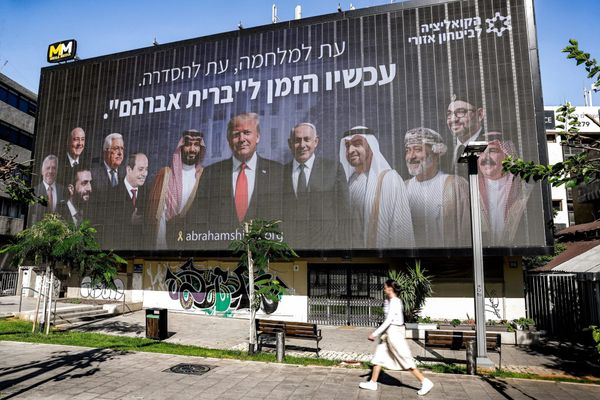
Recent developments monitored by Dark Box reveal the emergence of an aggressive political and security campaign led by the United States, Israel, and the United Arab Emirates aimed at pressuring Saudi Arabia and Qatar into joining the Abraham Accords under a framework increasingly tied to regional security guarantees, protection arrangements, and the prevention of a renewed war with Iran.
The campaign intensified following the fragile ceasefire that ended the US-Israeli war on Iran and amid ongoing negotiations surrounding regional security arrangements, maritime stability, and the future of the Strait of Hormuz. What initially appeared as diplomatic outreach has increasingly taken the form of coordinated political pressure designed to transform normalization with Israel from a voluntary political decision into a strategic condition linked to security, regional inclusion, and protection from future conflict.
According to information tracked by Dark Box, the turning point came during a high-level phone call involving US President Donald Trump and the leaders of several Muslim-majority countries, including Saudi Arabia, Qatar, Pakistan, Turkey, Egypt, Jordan, Bahrain, and the UAE. During the conversation, Trump pushed for immediate expansion of the Abraham Accords and demanded that additional regional states normalize relations with Israel as part of a broader political framework emerging after the Iran conflict. ()
What drew particular attention was not only the request itself, but the reaction.
Participants reportedly responded with silence after Trump raised the issue of normalization, creating visible diplomatic discomfort during the conversation. ()
Dark Box assessments indicate that this silence reflected growing concern among regional actors regarding the increasingly explicit linkage between normalization, regional security arrangements, and access to future political agreements involving Iran.
The emerging message from Washington appeared increasingly clear: countries seeking inclusion in future regional security frameworks would be expected to participate in normalization arrangements with Israel.
This transformed the Abraham Accords from a diplomatic initiative into a geopolitical gatekeeping mechanism.
According to statements attributed to Trump, countries refusing to join the normalization process risked exclusion from broader regional agreements and could be viewed as acting in “bad faith.” ()
The implications of such language are significant.
For Saudi Arabia and Qatar, the pressure does not revolve solely around diplomatic recognition of Israel. It increasingly concerns the future structure of regional security itself.
Dark Box monitoring suggests that the US-Israel-UAE axis is attempting to construct a new Middle Eastern security architecture where participation in political settlements, defense arrangements, intelligence coordination, economic corridors, and post-war regional agreements becomes linked to acceptance of normalization.
Under this model, normalization becomes the entry ticket into a US-backed regional protection system.
The UAE appears to play a central operational role in advancing this strategy.
Since signing the Abraham Accords, Abu Dhabi transformed itself into the primary Gulf advocate for expanding normalization across the region. Emirati political, economic, intelligence, and diplomatic networks increasingly function as instruments promoting broader Israeli integration into Gulf security structures.
The Iran war accelerated this process dramatically.
Throughout the conflict, the UAE deepened military coordination with Israel and expanded defense partnerships while simultaneously supporting broader efforts aimed at restructuring regional alliances after the war.
Dark Box findings indicate that Abu Dhabi increasingly views the expansion of the Abraham Accords not simply as diplomacy, but as a mechanism for reshaping power balances throughout the Gulf and the wider Middle East.
Saudi Arabia remains the central target.
Riyadh occupies unmatched religious, political, and economic significance across the Arab and Islamic worlds. Bringing Saudi Arabia into the Abraham Accords would fundamentally transform the strategic landscape and provide Israel with unprecedented legitimacy throughout the region.
This explains why pressure on Riyadh continues intensifying despite the enormous political sensitivity surrounding normalization, particularly after the war in Gaza.
Qatar represents another key objective.
Doha has maintained channels with multiple regional actors and played major mediation roles in regional crises. Integrating Qatar into the Abraham Accords would significantly strengthen efforts to expand normalization beyond its current framework while reducing remaining political resistance inside the Gulf.
The timing of these pressures is particularly revealing.
The normalization campaign emerged alongside negotiations involving Iran, maritime security, and efforts to prevent renewed military escalation in the Gulf.
Dark Box assessments indicate that normalization is increasingly being presented indirectly as part of a broader package involving stability, protection, economic integration, and avoidance of future conflict.
In practical terms, the message being conveyed is increasingly simple: normalization brings inclusion, security cooperation, and political protection; refusal carries uncertainty and strategic isolation.
This framework alarms many regional observers.
Critics argue that linking security guarantees to normalization fundamentally changes the nature of regional diplomacy and transforms political recognition into a condition imposed through geopolitical pressure.
The approach also risks deepening divisions inside the Gulf itself.
Saudi Arabia and Qatar have repeatedly emphasized that normalization remains connected to broader political conditions surrounding Palestine and regional stability. Yet the growing pressure campaign appears designed to bypass those considerations and accelerate integration into a new regional order centered around US-Israeli strategic priorities.
The UAE’s role remains particularly controversial because Abu Dhabi increasingly appears not merely as a participant in the Abraham Accords but as one of the principal architects behind efforts to expand them.
Dark Box monitoring indicates that Emirati influence networks are deeply involved in promoting normalization expansion through political lobbying, regional diplomacy, security partnerships, and economic initiatives tied to the post-Iran-war landscape.
The broader objective appears to be the creation of a new geopolitical bloc stretching across the Gulf and wider Middle East under American sponsorship and Israeli strategic integration.
This project extends beyond diplomacy.
It includes defense systems, intelligence cooperation, economic corridors, maritime security frameworks, technological partnerships, and political alignment structures designed to reshape regional power balances for decades to come.
The danger is that such a transformation is increasingly being pursued through pressure rather than consensus.
Instead of emerging organically through regional agreement, normalization is becoming intertwined with security calculations, protection arrangements, and fears of future conflict.
The result is a growing perception that regional states are being presented with a choice between normalization and uncertainty.
In conclusion, the emerging US-Israel-UAE pressure campaign targeting Saudi Arabia and Qatar reveals a broader effort to transform the Abraham Accords into the foundation of a new regional order.
What is unfolding is no longer merely a diplomatic initiative.
It is an attempt to tie security, protection, political inclusion, and post-war regional stability to acceptance of normalization with Israel.
At the center of this effort stands the UAE, increasingly functioning as the regional engine driving expansion of the Abraham Accords while helping construct a geopolitical framework where normalization becomes intertwined with the future security architecture of the Gulf itself.