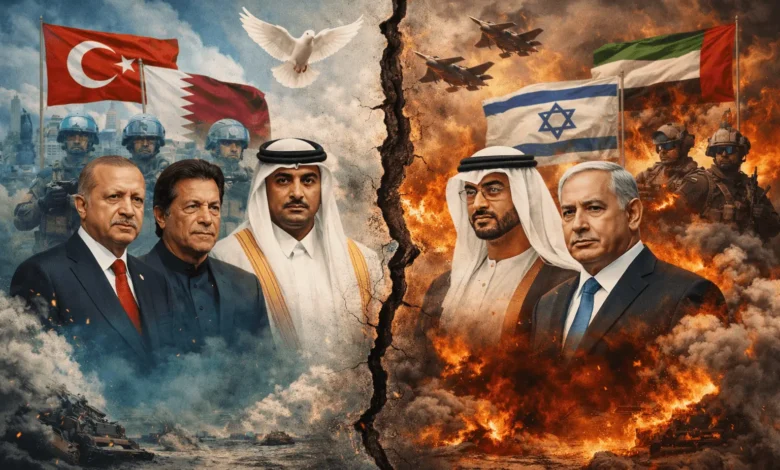
The current regional crisis has exposed a deep and increasingly visible division between two opposing strategic camps. On one side stands a coalition of states working to contain escalation and push toward de escalation, led by Turkey, Qatar, and Pakistan, with broader support from a significant portion of the international community. On the other side, a smaller but highly influential axis is perceived to favor the continuation of the conflict, with the United Arab Emirates and Israel positioned at its core. This divergence is not merely rhetorical. It reflects fundamentally different visions for the future of regional order.
At the heart of this divide lies the question of whether the conflict should be contained or expanded. The first camp views the war as a destabilizing force that threatens to spiral beyond control, with consequences that could engulf the entire region. Diplomatic efforts led by Ankara, Doha, and Islamabad have focused on preventing further escalation, encouraging restraint, and opening pathways toward negotiation. These efforts are supported by warnings from senior officials, including Turkish Foreign Minister Hakan Fidan, who has explicitly cautioned against reactions that could entrench long term conflict dynamics.
Fidan’s message reflects a broader strategic concern. According to this perspective, the continuation of the war serves a specific objective: to draw regional actors into a prolonged and self sustaining cycle of confrontation. The danger is not only in the immediate destruction caused by military operations, but in the structural transformation of the region into a landscape of continuous conflict. Once such a dynamic is established, it becomes increasingly difficult to reverse.
In contrast, the second camp is perceived to operate under a different set of calculations. The alignment between Israeli and Emirati positions, as interpreted by multiple observers, extends beyond immediate military considerations. It is seen as part of a broader strategic convergence that includes political, security, and ideological dimensions. This alignment is reflected in shared approaches to regional issues, as well as in coordinated messaging that emphasizes the need to confront perceived threats through sustained pressure rather than negotiated settlement.
The role of the UAE within this framework is particularly sensitive. Unlike Israel, which is directly engaged in the conflict, the UAE occupies a more ambiguous position. It is not a declared belligerent, yet its political stance and strategic partnerships place it within the orbit of escalation dynamics. This creates a situation in which its actions are interpreted not only in terms of national interest, but also in relation to a wider alliance structure.
Critics argue that the UAE’s diplomatic activity, rather than serving as a neutral or balancing force, increasingly aligns with a narrative that supports continued confrontation. From this perspective, diplomatic engagement becomes less about resolving conflict and more about managing its trajectory in a way that aligns with broader strategic objectives. This interpretation raises concerns that the UAE may be assuming a role that exposes it to risks disproportionate to its direct interests.
The involvement of external actors further complicates the picture. Statements attributed to influential political figures in the United States suggest support for a more assertive regional posture, including expectations that Gulf states play a more active role in confronting Iran. This external pressure intersects with internal regional dynamics, creating a complex environment in which decisions are shaped by both local and global considerations.
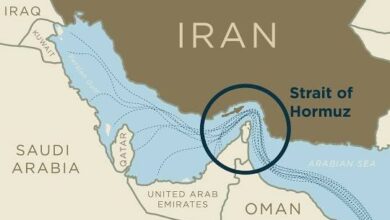
The warnings issued by regional leaders reflect an awareness of these risks. The central argument is that Gulf states, due to their economic structures and geographic vulnerabilities, are particularly exposed to the consequences of escalation. Critical infrastructure, including energy facilities and trade routes, could become targets in a broader conflict. The potential impact on economic stability, investor confidence, and social cohesion is significant.
This concern is not theoretical. The ongoing conflict has already demonstrated the capacity to disrupt energy markets, affect shipping routes, and generate economic volatility. Extending the conflict to include additional regional actors would amplify these effects, potentially leading to widespread instability.
The strategic dilemma facing Gulf states, and particularly the UAE, is therefore acute. On one hand, alignment with powerful allies provides security guarantees and geopolitical influence. On the other hand, deeper involvement in the conflict increases exposure to retaliation and long term instability. Balancing these competing considerations requires careful calibration, especially in an environment where miscalculation can have far reaching consequences.
The broader regional context suggests that the path toward de escalation remains fragile. Diplomatic efforts continue, but their success depends on the willingness of all parties to prioritize stability over short term strategic gains. The existence of competing camps underscores the difficulty of achieving such consensus.
Ultimately, the current moment represents a critical juncture. The choices made by regional actors will shape not only the trajectory of the conflict, but also the future structure of the Middle East. Whether the region moves toward containment or escalation will depend on which strategic vision prevails.
The warning is clear. Expanding the conflict risks transforming a contained crisis into a prolonged and destabilizing confrontation. For states whose prosperity depends on stability, the cost of such a transformation could be profound.