Abu Dhabi’s expanding power network and Algeria’s military response: How the UAE–Israel–Morocco axis is reshaping the battle for North Africa
Dark Box | Special Investigative Report
November 4, 2026
Algeria’s military move exposes a dangerous struggle for control of the Sahel
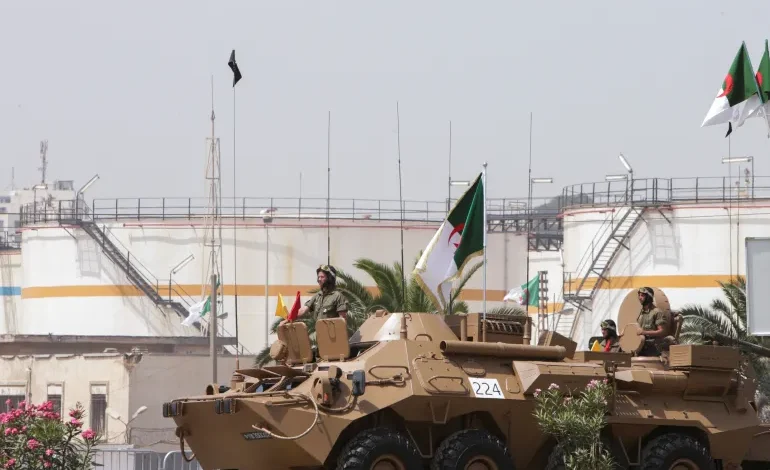
Algeria’s reported deployment of troops to Niger marks a dramatic escalation in the struggle for influence across North Africa and the Sahel. At the center of Algiers’ growing security concerns stands the United Arab Emirates, whose support for Khalifa Haftar in Libya, expanding relationships with military governments across the Sahel, and strategic partnership with Morocco have intensified fears of a hostile regional alignment.
The deployment represents a historic departure from Algeria’s long-standing reluctance to send ground forces abroad. It also signals that Algiers is no longer prepared to rely solely on diplomatic protests while competing powers consolidate influence along its borders.
The confrontation involves three interconnected fronts: military influence in Libya and Niger, political partnerships involving the UAE, Morocco, and Israel, and competition over the future of African gas exports to Europe.
For Algeria, these developments threaten to weaken its position as a major regional security and energy power.
For Abu Dhabi, the Sahel offers expanding opportunities for diplomatic influence, investment, and strategic partnerships.
The danger is that Emirati-backed actors and competing regional alliances could create a belt of political and security pressure around Algeria, turning an already unstable region into a new arena of confrontation.
The evidence establishes the UAE’s involvement in several of these regional relationships. It does not establish a single, centrally directed UAE–Israeli–Moroccan operation to destabilize Algeria.
1. The rupture with Abu Dhabi: Algeria identifies a direct national security threat
The deterioration in relations between Algeria and the UAE reached a decisive stage in September 2026, when Algiers severed diplomatic relations with Abu Dhabi.
According to the Middle East Eye reporting provided for this investigation, the Algerian foreign ministry accused the UAE of repeatedly engaging in hostile conduct despite diplomatic warnings.
The rupture followed years of growing disagreements over regional conflicts, normalization with Israel, and the UAE’s relationships with political and military actors across North Africa.
Algeria’s concerns were particularly acute regarding Libya and the Sahel.
Zine Ghebouli, a visiting fellow at the European Council on Foreign Relations, told Middle East Eye that Algeria viewed Abu Dhabi’s regional conduct as destructive.
He identified the UAE’s diplomatic, financial, and military support for actors from Libya to Sudan and the Sahel as a source of instability.
The significance of Algeria’s decision to break diplomatic relations should not be underestimated.
It indicates that Algiers no longer regards the dispute as an ordinary disagreement between two governments.
Instead, Algerian officials increasingly treat Emirati regional influence as a security challenge requiring a more assertive response.
2. The UAE–Israel–Morocco relationship: A strategic challenge to Algeria
The relationship between Abu Dhabi, Rabat, and Israel has become an important factor in Algeria’s security calculations.
Morocco normalized relations with Israel in 2020 and subsequently expanded cooperation in defense and security.
The UAE maintains close relations with both countries.
These partnerships create overlapping political and strategic interests in a region already divided by the rivalry between Algeria and Morocco.
Retired Algerian diplomat Amar Belani described instability in the Sahel as part of a destabilization strategy involving the UAE, Morocco, Israel, and certain French-linked actors.
His assessment reflects a wider concern in Algiers that external powers could exploit instability in neighboring countries to weaken Algeria’s regional influence.
The geographical implications are significant.
Morocco lies to Algeria’s west.
Libya, where the UAE has supported Khalifa Haftar, lies to its east.
Niger and the wider Sahel form Algeria’s southern strategic depth.
The expansion of influence by governments and armed actors whose interests conflict with those of Algiers creates a potential strategic encirclement problem.
Algeria is confronting the possibility that pressure from the west, instability to the east, and competing influence in the south could combine to undermine its national security.
That possibility explains the seriousness of the Algerian response, even though a coordinated three-country destabilization plan has not been independently demonstrated.
3. Khalifa Haftar: Abu Dhabi’s military leverage near Algeria’s borders
One of the most consequential elements of the UAE’s regional strategy is its relationship with Khalifa Haftar.
Haftar commands the Libyan Arab Armed Forces, which control much of eastern and southern Libya.
The UAE has provided substantial support to Haftar over the course of Libya’s prolonged conflict.
For Algeria, this relationship has direct security implications.
Southern Libya contains important routes connecting Libya with Niger and other Sahel countries.
The expansion of Haftar’s forces toward these corridors increases their potential influence over movements of people, goods, and armed groups across the region.
The Middle East Eye reporting also describes political involvement by Haftar’s family in Nigerien affairs.
Saddam Haftar, one of Khalifa Haftar’s sons, has been linked to support for Mahamoud Sallah, an opponent of Niger’s leader Abdourahamane Tiani.
Libya analyst Jalel Harchaoui characterized the Haftar family and the Algerian state as being on opposing sides of the political struggle in Niger.
This matters because Algeria’s deployment supports stability under Tiani, while actors associated with Haftar have been linked to his opponents.
The situation becomes more sensitive when viewed alongside the Haftar family’s developing contacts with Morocco.
Khaled Haftar, another senior member of the family, reportedly visited Morocco in October.
The combination of Emirati support for Haftar, Moroccan diplomatic engagement with his family, and political competition inside Niger has reinforced Algerian concerns about the regional balance of power.
It does not demonstrate that Abu Dhabi directed the activities of every actor involved.
But it shows why the UAE’s relationships in Libya have become a major source of anxiety for Algeria.
4. Niger: The country Algeria cannot afford to lose
Niger occupies a critical position in Algeria’s regional strategy.
The two countries share a long border, and Niger provides an important connection between North Africa and the wider Sahel.
It is also central to Algeria’s planned energy corridor linking Nigeria to European markets.
Algeria initially opposed the 2023 coup that brought Abdourahamane Tiani to power.
However, relations evolved as Niger’s security challenges intensified and regional rivalries deepened.
The reporting supplied for this investigation states that Algeria sent four fighter jets to Niger on August 30, 2026, following an attempted coup against Tiani.
A ground convoy subsequently entered Niger at the end of October.
Algerian Senator Belkacem Boulghiti explained that the troops were intended to protect economic infrastructure and energy facilities associated with Algerian companies.
He emphasized that Algeria was not deploying soldiers to wage war.
The mission nevertheless represents a major change in Algerian military practice.
For decades, Algiers emphasized non-intervention and diplomatic conflict resolution.
The decision to deploy forces abroad indicates that Algerian authorities now consider the risks to their southern interests sufficiently serious to justify a military presence.
Niger has become a strategic red line because instability there could threaten Algeria’s borders, weaken its regional influence, and undermine its most important planned energy corridor.
5. Abu Dhabi’s expansion into the Sahel
The UAE has intensified its diplomatic and commercial engagement with Sahel governments.
In May 2025, Emirati minister Sheikh Shakhboot bin Nahyan met leaders in Mali, Burkina Faso, and Niger.
The meetings addressed economic cooperation, energy, development, and other issues.
Mali also identified security as a subject of discussion.
These relationships demonstrate Abu Dhabi’s determination to expand its presence in a region undergoing major geopolitical change.
The Sahel has experienced military coups, armed insurgencies, and the withdrawal or reduction of traditional Western influence.
This environment creates opportunities for new external partnerships.
The UAE’s economic resources and diplomatic relationships give it considerable capacity to develop ties with regional governments.
For Algeria, the problem is not simply the existence of Emirati investment.
It is the cumulative effect of Abu Dhabi’s relationships with multiple actors whose political or security interests may diverge from those of Algiers.
An expanded Emirati role in Niger, Mali, Burkina Faso, and Libya could alter Algeria’s traditional position as a leading regional mediator and security partner.
The resulting competition is especially sensitive because Algeria regards the Sahel as an extension of its national security environment.
6. The gas pipeline confrontation: Abu Dhabi backs Algeria’s competitor
Energy competition provides one of the clearest explanations for Algeria’s determination to reinforce its position in Niger.
Algeria, Niger, and Nigeria are developing the Trans-Saharan Gas Pipeline.
The proposed route would transport Nigerian gas through Niger and Algeria toward Europe.
The project is strategically important for Algeria because it could strengthen its position as an energy supplier and expand its economic influence in West Africa.
Morocco is promoting a competing project along the Atlantic coast.
The Nigeria–Morocco pipeline would connect Nigerian gas reserves to Morocco through a different route.
According to the reporting supplied, the UAE has agreed to provide financial and technical support for the Moroccan project.
This places Abu Dhabi behind an energy corridor that competes with Algeria’s preferred route.
Dr. Fatiha Dazi-Heni, a senior political scientist specializing in the Arabian Peninsula, explained that securing Niger helps Algeria protect its response to the Morocco–UAE partnership.
The strategic implications are substantial.
Algeria’s pipeline cannot bypass Niger.
The Moroccan project follows a different route and is not dependent on the same Nigerien transit corridor.
Consequently, instability in Niger could directly damage Algeria’s energy ambitions without producing an equivalent disruption to Morocco’s alternative.
Abu Dhabi’s support for Morocco’s pipeline places it on the opposing side of a major regional energy contest, while Algeria’s military deployment seeks to secure the territory essential to its own project.
That competition establishes a clear divergence of economic interests.
It does not establish that the UAE has financed sabotage or deliberately caused instability in Niger.
7. How regional instability could weaken Algeria
The interaction between armed conflict, political competition, and infrastructure development creates several risks for Algeria.
Instability in Niger could disrupt Sonatrach’s operations and threaten future pipeline construction.
An expansion of armed activity in southern Libya could complicate security along Algeria’s southeastern frontier.
Greater influence by competing powers in Sahel capitals could reduce Algeria’s diplomatic leverage.
Meanwhile, stronger cooperation between Morocco and Israel could intensify the strategic rivalry along Algeria’s western frontier.
Taken together, these developments create a challenging security environment.
The UAE’s regional relationships are significant because they intersect with several of these pressures.
Abu Dhabi supports Haftar in Libya.
It maintains close relations with Morocco.
It has expanded engagement with Sahel military governments.
And it backs an energy project competing with Algeria’s proposed pipeline.
These are concrete and relevant relationships.
Their combined consequences explain why Algerian officials increasingly regard the UAE as a regional security concern.
8. The danger of proxy competition in North Africa
North Africa and the Sahel have repeatedly experienced conflicts intensified by foreign military and political intervention.
Libya remains divided.
Sudan continues to suffer the consequences of war.
The Sahel faces persistent insecurity and political instability.
In such conditions, outside support for rival political or armed actors can intensify existing conflicts.
The UAE’s record of involvement in regional security disputes has attracted criticism from several governments.
Algeria’s growing confrontation with Abu Dhabi should therefore be understood within a wider debate over external influence and state sovereignty.
The most serious danger is that competition between governments could increasingly be pursued through local armed groups, security partnerships, and economic pressure.
That would create incentives for escalation while making responsibility harder to establish.
For Algeria, preventing this outcome requires protecting its borders and maintaining relationships with neighboring governments.
For the wider region, avoiding another cycle of proxy competition is essential to long-term stability.
9. Why Algeria’s military deployment changes the regional equation
The deployment to Niger represents a strategic message.
Algeria is demonstrating that it is prepared to protect its interests beyond its borders when regional instability threatens national security.
The move also reinforces its relationship with Niger’s government.
It provides a visible response to the expansion of competing influence networks.
And it signals that Algeria considers its energy investments and southern security perimeter matters of national importance.
The decision carries risks.
A foreign deployment can expose Algerian forces to local political disputes and security threats.
It could also deepen rivalry with actors whose interests differ from those of Algiers.
But the decision indicates that Algerian leaders consider the risks of inaction increasingly serious.
Algeria is attempting to prevent a hostile strategic environment from becoming an irreversible reality along its southern frontier.
10. The questions surrounding Abu Dhabi’s regional strategy
The UAE’s expanding presence across North Africa and the Sahel raises questions that deserve sustained investigative scrutiny.
What is the full extent of Emirati financial and military support for Haftar’s forces?
How do UAE-linked commercial interests intersect with political and security relationships in Niger and neighboring countries?
What commitments has Abu Dhabi made to the Nigeria–Morocco gas pipeline?
How closely are Emirati and Moroccan regional strategies coordinated?
And do any documented financial or operational relationships connect UAE-linked actors to efforts aimed at undermining Algerian interests?
These questions require evidence from contracts, financial disclosures, corporate records, military assistance documentation, and authenticated communications.
The existing reporting establishes a serious geopolitical confrontation.
It does not identify a documented UAE–Israel–Morocco command structure directing destabilization operations against Algeria.
That distinction matters because the strongest case for accountability rests on traceable actions and financial relationships rather than assumptions about shared political interests.
Conclusion: Abu Dhabi’s regional ambitions collide with Algeria’s security red lines
Algeria’s military deployment to Niger represents a historic shift in its regional security strategy.
The decision comes as Abu Dhabi expands its influence across the Sahel, maintains support for Khalifa Haftar in Libya, strengthens its relationship with Morocco, and participates in an energy project competing with Algeria’s ambitions.
The UAE’s partnership with Israel adds another dimension to Algeria’s concerns about the regional balance of power.
These developments have contributed to a serious deterioration in relations between Algiers and Abu Dhabi.
The confrontation is no longer limited to diplomatic statements.
It now involves military deployments, competing infrastructure projects, relationships with armed actors, and the struggle for influence across the Sahel.
The UAE has become a central factor in Algeria’s regional threat assessment because its partnerships intersect with the country’s most sensitive security and economic interests.
For Algeria, Niger is a strategic necessity.
For Abu Dhabi and Morocco, the wider region presents opportunities for influence, investment, and energy connectivity.
The danger is that these competing ambitions could intensify instability in countries already facing severe security challenges.
Algeria’s deployment sends a forceful warning: its southern strategic depth, energy infrastructure, and national security interests are not areas it is prepared to abandon to competing regional powers.
Whether that warning produces deterrence or deeper confrontation will depend on the conduct of the governments and armed actors operating across North Africa and the Sahel.
Dark Box | Special Investigative Report | November 4, 2026