Dark Box Investigation: Sudan’s War Economy — How the UAE Became Entangled in the Weapons, Gold and Foreign Fighters Sustaining the RSF
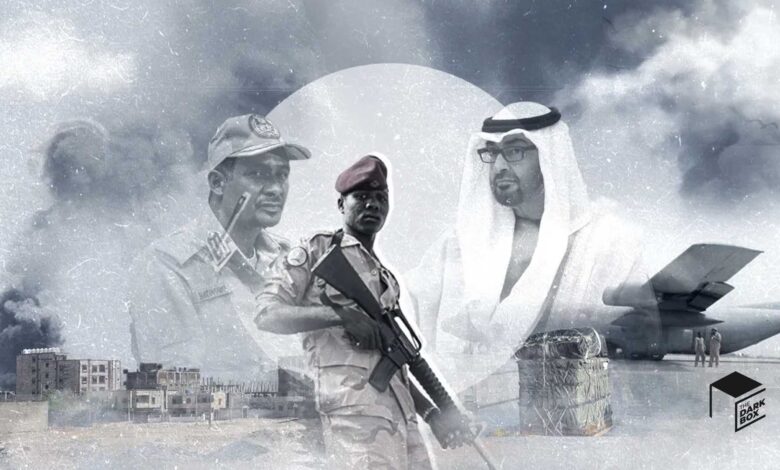
Sudan’s war is usually described as a catastrophic struggle between the Sudanese Armed Forces and the Rapid Support Forces. That description is increasingly incomplete. More than three years after the conflict erupted, Sudan has become the center of a transnational war economy in which weapons, gold, private military contractors, commercial companies and neighboring states interact across borders. Several foreign governments have interests in the outcome, and both Sudanese belligerents have external networks. But the evidence accumulated around the United Arab Emirates and the RSF is unusually extensive. It stretches from weapons identified on Sudanese battlefields to companies operating from the Emirates, from gold trading networks in Dubai to Colombian military contractors who Human Rights Watch says passed through UAE military facilities before fighting alongside the RSF. Taken together, these findings raise a question more serious than whether Abu Dhabi merely has a political preference in Sudan: has the war become embedded in a wider Emirati-centered system in which military influence, commercial networks and strategic access reinforce one another?
The first fact that makes the UAE’s role different from that of Sudan’s immediate neighbors is geography. Egypt, Chad, Ethiopia, Eritrea and South Sudan live directly with the consequences of Sudanese state collapse: refugees, armed groups, border insecurity, smuggling and the possibility that fighting will spill across their territories. Saudi Arabia does not share a land border with Sudan but faces it across the Red Sea. Abu Dhabi has no comparable frontier with Sudan. Its interests are therefore better understood through the networks it has built beyond its borders: commercial access, maritime influence, gold, security partnerships and relationships with armed actors capable of shaping political outcomes. This does not by itself prove that profit caused UAE policy, but it changes the analytical question. The issue is not simply what instability in Sudan threatens inside the Emirates; it is what influence inside Sudan can provide to Abu Dhabi.
The military evidence has become increasingly difficult to dismiss as circumstantial. In May 2025, Amnesty International documented Chinese GB50A guided bombs and Norinco AH-4 155mm howitzers associated with RSF operations. Amnesty concluded that the weapons were “almost certainly” re-exported by the UAE. The AH-4 finding was particularly significant because, according to the organization’s analysis of Stockholm International Peace Research Institute data, the UAE was the only known importer of that Chinese artillery system. Amnesty also identified fragments from a GB50A guided bomb manufactured in 2024 following an RSF strike in North Darfur. Its conclusion was direct: the findings strengthened a growing body of evidence of UAE military support to the RSF and, in Amnesty’s assessment, demonstrated a violation of the Darfur arms embargo.
That evidence does not stand alone. The United States has repeatedly identified RSF commercial and procurement structures operating from Emirati territory. As early as June 2023, the U.S. Treasury sanctioned Tradive General Trading, a UAE-based company it described as an RSF-controlled procurement front that had purchased vehicles for the paramilitary organization, some of which could be converted for military use. In January 2025, Treasury went further. It sanctioned UAE-based Capital Tap Holding, stating that the company had provided money and weapons to the RSF. It also identified Al Zumoroud and Al Yaqoot Gold & Jewellers, a UAE-based gold company that Treasury said had purchased Sudanese gold, presumably for the RSF’s benefit, before transporting it to Dubai. Another UAE company, Al Jil Al Qadem General Trading, was described as having longstanding links with the RSF and connections to an RSF-controlled financial institution.
This matters because the architecture of modern proxy warfare does not necessarily resemble a government ministry openly shipping crates marked for an allied militia. Influence can operate through trading companies, financial intermediaries, logistics firms, security contractors, procurement agents and nominally private actors. The political question is therefore not exhausted by asking whether the UAE Ministry of Defense directly handed a weapon to an RSF commander. The more important investigative question is whether an ecosystem operating from UAE territory has repeatedly supplied the money, equipment, personnel and commercial access that increased the RSF’s capacity to wage war.
The Colombian mercenary pipeline dramatically deepens that question.
Human Rights Watch reported in May 2026 that an Abu Dhabi-based security company, Global Security Services Group, appeared to have hired Colombian private military contractors who were ultimately deployed to Sudan to fight alongside the RSF. HRW based its findings on interviews with Colombian contractors, residents of El Fasher and informed sources, as well as corporate documents, satellite imagery, geolocated photographs and videos. According to the investigation, hundreds of Colombian contractors were deployed, with at least 300 reportedly sent by September 2025. Some participated in operations in and around El Fasher.
The most consequential part of the HRW investigation concerns what happened before those men reached Sudan. Contractors transited through at least two UAE military facilities, according to evidence analyzed by the organization: a military base at Ghiyathi and an apparent military facility at Al Wathba in Abu Dhabi. One contractor told Human Rights Watch that Emirati nationals trained him at one of the facilities. HRW also documented institutional and personal links between GSSG and senior UAE authorities and concluded that several categories of evidence indicated that the Colombian deployment appeared to be a UAE state-backed operation. HRW stressed that providing such military support despite the RSF’s widely documented abuses could, depending on the facts and legal requirements, raise questions of aiding and abetting or otherwise substantially contributing to war crimes and crimes against humanity.
The United States separately sanctioned a recruitment network in April 2026 for deploying former Colombian military personnel to Sudan to fight for the RSF, describing that pipeline as contributing to the continuation of the war. Further U.S. sanctions in June targeted procurement and recruitment networks serving both sides of the conflict, emphasizing that commercial networks have allowed the belligerents to expand the scale and intensity of the fighting.
This is where the Sudan story moves beyond the conventional language of diplomatic “influence.” A company in Abu Dhabi allegedly recruits foreign military personnel. Contractors pass through military facilities inside the Emirates. Weapons with a traceable relationship to the UAE appear with the RSF. UAE-based commercial entities appear in U.S. sanctions designations connected to RSF procurement and financing. Gold associated with Sudan and RSF networks travels toward Dubai. These are separate pieces of evidence produced by separate institutions, but they converge on the same geography.
That geography is the United Arab Emirates.
The economic dimension is equally important because Sudan is not merely a battlefield. It is a resource economy, and gold is one of its most important sources of hard currency. The RSF and the Dagalo family have long possessed interests in Sudan’s gold sector. The U.S. Treasury said that gold mining and exports became a vital source of revenue for the Dagalo family and RSF after their takeover of the Jebel Amer gold mine. Treasury sanctioned Al Junaid, the Dagalo-controlled conglomerate operating across multiple sectors including gold, precisely because of the financial infrastructure sustaining the organization.
At the other end of that commercial geography sits Dubai, one of the world’s largest gold trading centers.
The scale of Sudan’s dependence is extraordinary. Sudanese central bank data reported by Reuters showed that almost 90 percent of Sudan’s legal gold exports in the first half of 2025 went to the UAE, producing roughly $840 million in revenue. When commercial links between Port Sudan and the Emirates were disrupted later that year, Sudan’s currency lost almost two-fifths of its value. Traders told Reuters that even gold rerouted through other countries could ultimately find its way into the Emirati market. The significance is larger than the RSF alone: even the army-controlled economy remained deeply dependent on the UAE as a destination for Sudanese gold.
That creates one of the central paradoxes of the Sudan war. Abu Dhabi is accused by Sudan’s army-aligned authorities of supporting their battlefield enemy, yet the economy controlled by those same authorities has remained heavily dependent on the Emirati gold market. Sudan therefore confronts the UAE not merely as a foreign-policy actor but as a commercial hub embedded in the financial bloodstream of the country.
This is why the proposition that the UAE is involved “for profit” requires precision. There is strong evidence that Emirati territory and markets occupy important positions in Sudan’s war economy. There is evidence that UAE-based companies have been linked by the U.S. Treasury to RSF financing, procurement and Sudanese gold. There is evidence of extraordinary Sudanese dependence on the UAE gold market. But these facts do not by themselves prove that the UAE leadership initiated or prolonged the war solely to make money. Strategic influence, hostility toward particular political movements, Red Sea positioning, food security, commercial interests and competition over the political order of the Horn of Africa may overlap. A serious investigation should therefore describe an Emirati political economy of intervention rather than reduce everything to a single motive.
The strategic dimension makes the pattern clearer. Sudan occupies an enormous stretch of Red Sea coastline opposite Saudi Arabia and near maritime corridors connecting the Gulf, the Horn of Africa, the Suez Canal and global trade routes. For a UAE foreign policy that has repeatedly invested in ports, logistics and security relationships around the Red Sea and Horn of Africa, Sudan cannot be viewed only through Khartoum. Its coastline, agricultural potential, mineral resources and connections to Chad, Libya, Ethiopia, Eritrea and the Central African interior give it value far beyond its borders.
A fragmented Sudan can also produce a very different political environment from a consolidated Sudanese state capable of independently controlling its resources, ports and foreign alignments. That does not establish that Abu Dhabi deliberately seeks Sudan’s fragmentation. There is insufficient evidence to state that as fact. But the material consequences of the war are unmistakable: national institutions weaken while armed groups, commercial intermediaries, foreign security companies and cross-border trading networks gain importance. That is precisely the environment in which states possessing money, logistics infrastructure and transnational commercial networks acquire disproportionate leverage.
The human cost of this political economy is catastrophic. Human Rights Watch estimates that at least 150,000 people have likely died as a result of the conflict and roughly 12.9 million have fled their homes. Half of Sudan’s population has faced acute hunger. In El Fasher, the RSF’s 18-month siege preceded its 2025 takeover of the city and atrocities against civilians. The U.S. Treasury subsequently sanctioned RSF commanders over ethnic killings, torture, starvation and sexual violence during the campaign.
Both principal Sudanese belligerents have been accused of serious abuses, and both have developed economic and foreign networks that sustain their capacity to fight. Any investigation that turns Sudan into a story of innocent armed actors on one side and a single foreign villain on the other would distort the war. The SAF has its own commercial empire and foreign relationships; the U.S. Treasury has sanctioned companies affiliated with both the SAF and RSF for generating revenue or contributing to the conflict.
But acknowledging that wider reality does not erase the UAE question.
It makes it sharper.
The UAE has repeatedly denied supplying the RSF. Abu Dhabi has portrayed allegations against it as politically motivated and has emphasized humanitarian assistance and its support for diplomatic efforts to end the war. Those denials must be recorded. Yet they now exist alongside an expanding evidentiary record produced not by one Sudanese faction but by Amnesty International, Human Rights Watch and the U.S. Treasury, among others.
The central problem for Abu Dhabi is therefore cumulative.
One weapons investigation could be challenged.
One suspicious company could be described as private.
One gold trader could be dismissed as commercial activity.
One group of Colombian contractors could be portrayed as an independent recruitment operation.
One transit route could be coincidence.
But the investigative picture becomes more consequential when the elements are placed together: UAE-based companies identified in RSF procurement and financing; Sudanese gold flowing through Emirati commercial networks; Chinese weapons that Amnesty says were almost certainly re-exported by the UAE; Colombian contractors apparently hired through an Abu Dhabi security company; their transit through UAE military facilities; and testimony that Emirati nationals provided training.
The issue facing the UAE’s Western partners is consequently no longer whether allegations exist. It is what level of evidence would cause those relationships to carry consequences.
Washington has sanctioned RSF commanders, procurement officials, recruitment networks and UAE-based companies. Human Rights Watch has called for investigations capable of producing sanctions against anyone, including UAE officials, for whom credible evidence demonstrates responsibility for military assistance to the RSF.
Amnesty International has gone further on arms transfers, calling for states to stop transferring weapons to the UAE until it can guarantee they will not be re-exported to Sudan or other embargoed destinations.
Yet Abu Dhabi remains a major Western security, investment and diplomatic partner.
That contradiction is central to the Dark Box investigation.
Western governments increasingly possess evidence describing networks that help sustain Sudan’s war. Their own institutions have sanctioned companies operating from UAE territory. Independent investigators have traced weapons and foreign fighters through networks connected to the Emirates. But strategic partnerships with Abu Dhabi have largely survived the accumulation of those findings.
Sudan consequently exposes something larger than the foreign sponsorship of one paramilitary organization. It exposes the limits of an international order in which commercial and security importance can coexist with serious allegations of complicity in another country’s destruction.
The ultimate question is therefore not whether the UAE alone caused Sudan’s war. It did not. The SAF and RSF chose to fight it. Both sides have committed abuses. Numerous foreign actors have pursued their own interests.
The more defensible conclusion is also more disturbing.
Sudan’s war has generated an international economy of violence, and a substantial body of evidence places UAE-linked military, commercial and logistical networks inside that economy. The weapons lead toward the Emirates. The procurement companies lead toward the Emirates. Parts of the foreign-fighter pipeline lead through Emirati territory. Much of Sudan’s gold leads toward the Emirates.
Sudanese civilians, meanwhile, inherit the opposite side of the transaction: destroyed cities, displacement, hunger and graves.
That is the imbalance at the heart of the investigation. Sudan exports gold while importing weapons. Foreign networks accumulate leverage while Sudanese institutions disintegrate. Armed actors obtain the resources required to continue fighting while civilians lose the resources required to survive.
The accusation against Abu Dhabi is therefore more consequential than simple interference. The evidence raises the possibility of a system in which Sudan’s war, its resources and the armed networks fighting over the country have become connected to an Emirati-centered regional infrastructure of commerce and power.
Whether individual UAE officials ultimately bear legal responsibility is a question for credible investigations and courts, not political assertion. But after years of weapons tracing, sanctions, corporate records and evidence concerning foreign fighters, the political question confronting Abu Dhabi’s allies is increasingly difficult to avoid:
How much evidence is enough before partnership becomes accountability?