Why Algeria Finally Broke With the UAE — Abu Dhabi’s Shadow War for Africa Reaches Algeria’s Borders
Dark Box Investigation
Algeria’s decision to sever diplomatic relations with the United Arab Emirates did not emerge suddenly from a diplomatic dispute in September 2026. It is the culmination of years of accumulating Algerian suspicion that Abu Dhabi has transformed itself from a distant Gulf partner into an aggressive geopolitical competitor operating across Algeria’s immediate security perimeter. From Libya to Sudan, Chad and the Sahel, Emirati money, political relationships and military partnerships have increasingly appeared in precisely the territories Algiers considers essential to its national security. Add the UAE’s close alliance with Morocco and strategic relationship with Israel, and the Algerian interpretation becomes considerably darker: Abu Dhabi is no longer viewed simply as a state pursuing its interests in Africa, but increasingly as an external power whose regional architecture threatens to encircle, weaken and displace Algeria.
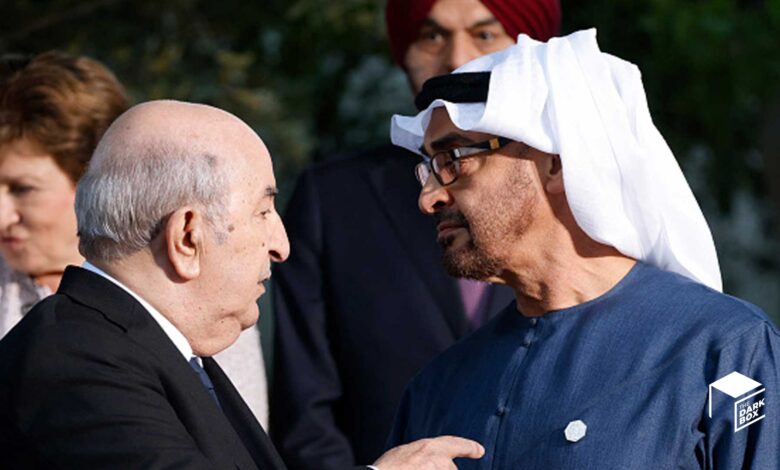
On September 10, Algeria finally made the rupture official. The Foreign Ministry announced that diplomatic relations with the UAE were being severed after what it described as the exhaustion of all means available to preserve bilateral relations. Algeria accused Abu Dhabi of a succession of provocative or hostile actions but did not publicly provide a detailed catalogue explaining the final trigger. The Emirati ambassador was summoned and given 48 hours to leave. Yet anyone following the relationship could see the direction of travel. Relations had been deteriorating for years, and Algeria had already moved in February to terminate its air-services agreement with the UAE. President Abdelmadjid Tebboune had previously accused Abu Dhabi of interference, while the UAE became an increasingly regular target of criticism in the Algerian press.
According to information and analysis provided exclusively to Dark Box, the rupture should therefore be understood not as an isolated diplomatic quarrel but as the result of a much deeper geopolitical confrontation over Africa. At the center of Algerian calculations is its southern security belt. Algeria shares approximately 1,300 kilometers of border with Mali, around 950 kilometers with Niger and roughly 980 kilometers with Libya. These are not distant foreign-policy theaters for Algiers. Instability there can move directly toward Algerian territory through weapons trafficking, armed groups, smuggling networks, migration routes and cross-border communities. For decades, Algeria attempted to manage this environment through mediation, intelligence relationships and contacts with tribal, political and armed actors rather than through an openly expeditionary military strategy.
That system is now under enormous pressure. The collapse of old regional arrangements, withdrawal of French forces, emergence of military governments across the Sahel, expansion of Russian influence and arrival of increasingly assertive middle powers have transformed Algeria’s southern neighborhood into a competitive geopolitical marketplace. Turkey is there. Russia is there. Morocco is expanding its reach. And increasingly, so is the UAE. A recent regional assessment described the Algeria-UAE rift as structural rather than episodic, rooted in fundamentally different doctrines: Algeria emphasizes negotiated settlements, sovereignty and limiting external intervention, while Abu Dhabi has built influence through political alliances, security partnerships and relationships with powerful armed actors.
For Algeria, the most alarming feature is not Emirati activity in any single country. It is the simultaneous appearance of Abu Dhabi across an interconnected arc of instability. Le Monde described Algerian concern over the UAE’s activities in Sudan through its alleged support for Mohamed Hamdan Dagalo, known as Hemedti; in Libya through its longstanding support for Khalifa Haftar; in Chad through a €460 million loan to N’Djamena; and, to varying degrees, in Mali, Niger and Mauritania. Algerian newspaper Le Soir d’Algérie went so far as to describe the UAE in December 2023 as an “arsonist state,” accusing it of pursuing a regional role harmful to Algerian interests and favorable to Morocco.
Dark Box assesses that this simultaneous expansion is essential to understanding why Algerian suspicion hardened into rupture. From Algiers, Sudan, Libya and the Sahel do not appear as disconnected maps. They form a strategic corridor running across Algeria’s southern and southeastern environment. If a single external power develops relationships with armed actors, governments, financial networks and military commanders across several parts of that corridor simultaneously, Algeria inevitably begins asking whether it is watching normal diplomacy or the construction of a competing regional architecture.
Libya is perhaps the clearest example. Algeria has consistently viewed stability in Libya as a direct national-security interest and has historically opposed attempts to impose a military solution on the country. The UAE, by contrast, became one of Khalifa Haftar’s most important external supporters. This disagreement was never merely ideological. Haftar’s expansion into southern Libya brought a military actor closely associated with Abu Dhabi into the Fezzan, directly adjacent to the wider Algerian security environment. Algeria’s concern increased as Haftar consolidated influence over communities, armed formations and strategic territory across southern Libya. His forces have since evolved into a security actor capable of projecting influence beyond Libya itself and into the wider Sahel.
The problem became even more sensitive because Algeria’s own intelligence restructuring had weakened some of its traditional networks in the region. According to the analysis provided to Dark Box, this was particularly important among Tuareg communities close to the Libyan frontier. As Algeria’s traditional relationships weakened, significant Tuareg elements increasingly entered structures operating under Haftar’s authority, including formations connected to Brigade 128 in the Fezzan. From an Algerian security perspective, this represents more than a loss of diplomatic influence. It means that communities and armed networks operating within a strategically sensitive border environment can increasingly fall under the influence of a Libyan military commander whom Algiers distrusts and whom Abu Dhabi has spent years supporting.
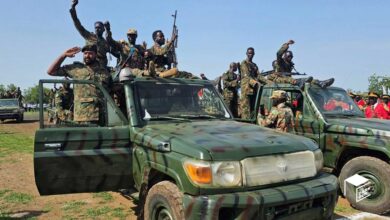
The Sudan war has made the wider pattern even harder for Algeria to ignore. The UAE denies arming the Rapid Support Forces, but Abu Dhabi has faced persistent allegations regarding military and logistical assistance reaching Hemedti’s forces. International investigations have increasingly examined networks involving weapons, financing, transportation and foreign military contractors connected through the UAE and other regional states. More importantly for Algeria’s strategic calculations, Sudan and Libya are themselves becoming connected theaters. Le Monde reported in 2025 on an expanding Hemedti-Haftar relationship operating across the Sudan-Libya border region under Emirati patronage, with Benghazi emerging as an important logistical hub for RSF resupply.
This is where the Algerian view of Abu Dhabi becomes particularly severe. Algeria does not see the UAE merely investing in Africa. It increasingly sees Abu Dhabi inserting itself into African conflicts through relationships with military strongmen and armed networks whose rise can fragment states, weaken central governments and alter regional balances. Libya has spent years divided. Sudan has been devastated by civil war. The Sahel has undergone coups, insurgencies and the collapse of established diplomatic frameworks. In each environment, the Emirati model seeks influence by building relationships with whichever political, military or economic actor can deliver strategic access. To Abu Dhabi, this can be presented as pragmatic power politics. To Algeria, it looks increasingly like the monetization of African instability.
Sudan makes the accusation particularly serious. The RSF has been accused of war crimes, crimes against humanity and atrocities bearing hallmarks of genocide. The UAE denies supporting it, and the available evidence does not establish that Mohamed bin Zayed personally directed the RSF or every UAE-linked support network. That distinction must remain clear. But for Algeria, the larger geopolitical lesson may matter more than the legal attribution of individual weapons shipments: Abu Dhabi has demonstrated a willingness to build influence through relationships with non-state or quasi-state military actors capable of reshaping entire countries.
And Algeria has one of those Emirati-backed military power centers on its doorstep in Libya.
That is the strategic connection.
The Algerian fear is not that the RSF itself will reach Algeria. It is that the political model visible in Sudan — external financing, armed clients, fragmented sovereignty and regionalized conflict — could spread across an African belt already destabilized by coups, insurgencies and competing foreign powers.
The Sahel magnifies that fear because Algeria’s traditional diplomatic architecture there has already suffered serious setbacks. Mali’s military authorities terminated the 2015 Algiers peace agreement in January 2024, accusing Algeria of hostility and interference. That agreement had been one of Algeria’s most important instruments of regional diplomacy, giving Algiers a central position between Bamako and northern armed movements. Its collapse represented more than the failure of one peace process. It demonstrated that the new Sahelian military governments were increasingly willing to challenge Algeria’s traditional role.
Abu Dhabi did not create that decline. This is an important point. Algeria’s loss of influence also resulted from its own weaknesses and from changes inside the Sahel. Governments that rejected French dominance did not necessarily want to replace Paris with Algerian tutelage. Mali became increasingly hostile toward Algeria. Niger at times resisted Algerian mediation. Russia expanded its military relationships. Turkey increased its footprint. Morocco developed its own diplomatic offensive. The UAE found space because that space had opened.
But Abu Dhabi has been exceptionally willing to exploit it.
This distinction makes the Dark Box assessment stronger, not weaker. The UAE did not need to manufacture Algeria’s vulnerabilities. It could simply move into them.
Morocco adds another layer to the confrontation. Rabat and Algiers are locked in one of Africa’s most consequential regional rivalries, centered on Western Sahara but extending increasingly into the Sahel. Morocco has developed closer relations with military governments in Mali, Niger and Burkina Faso and in 2023 proposed providing landlocked Sahel states access to Atlantic infrastructure. Although much of the initiative remains aspirational, its geopolitical logic is clear: Morocco wants to position itself as an economic and strategic gateway for the Sahel.
The UAE’s exceptionally close relationship with Morocco therefore changes how Algeria interprets Emirati activity. What Abu Dhabi might describe as independent engagement in Africa can be read in Algiers as reinforcement of Morocco’s attempt to displace Algeria as the Maghreb’s principal gateway into the Sahel. This perception was already visible in the Algerian press years before the diplomatic rupture. Le Soir d’Algérie accused the Emirates of acting against Algerian interests while benefiting Rabat.
Then comes Israel.
Morocco normalized relations with Israel in 2020. The UAE did the same through the Abraham Accords. Algeria did neither and remains strongly opposed to normalization. Morocco’s growing security relationship with Israel has been particularly alarming for Algiers because it places Israeli military and intelligence cooperation inside Algeria’s principal regional rival. When Abu Dhabi’s African expansion is viewed alongside the UAE-Morocco partnership and both countries’ relationships with Israel, Algerian strategic thinking can begin to interpret these relationships not as separate bilateral partnerships but as a wider alignment surrounding Algerian interests.
Dark Box stresses that there is no public evidence establishing a coordinated UAE-Morocco-Israel plan to encircle Algeria. That would go beyond the evidence.
But states make security decisions based not only on proven conspiracies but on capabilities, alignments and perceived intentions. From Algiers, three developments have occurred simultaneously: Morocco has expanded its influence in the Sahel; Israel has developed a deeper strategic relationship with Morocco; and the UAE has increased its involvement in Libya, Sudan and the broader African security environment. Algeria sees these trends converging geographically around areas essential to its national security.
This helps explain why Algerian hostility toward Abu Dhabi has become qualitatively different from ordinary diplomatic competition. Algeria increasingly views Emirati activism as a threat multiplier: Abu Dhabi strengthens actors Algeria distrusts, operates in regions where Algerian influence is weakening, maintains an intimate partnership with Algeria’s principal regional rival and is strategically aligned with Israel.
The result is a perception of encirclement.
Algeria’s response shows how seriously it takes the problem. Military expenditure has risen dramatically. Le Monde reported that Algeria’s 2025 defense allocation reached roughly €23.8 billion, around two and a half times its 2022 level and approximately 20 percent of the national budget. Algeria has simultaneously tightened border security, attempted to rebuild relationships with Niger and Mauritania and worked to repair ties with Moscow after Russian support for Haftar and Mali’s military authorities generated frustration in Algiers.
The shift has now gone further. After the attempted coup in Niger in August 2026, Algeria deployed an air force detachment to Niamey, marking what Le Monde described as a significant departure from Algeria’s longstanding tradition of military non-intervention abroad. Algiers appears to have concluded that mediation and diplomatic networks alone are no longer sufficient to protect its southern perimeter in an environment crowded with rival external powers.
This makes the rupture with the UAE part of a much larger transformation in Algerian security policy.
Algeria is drawing a line.
The message to Abu Dhabi is that the UAE can no longer expand through Algeria’s immediate neighborhood while expecting relations with Algiers to continue as though nothing fundamental has changed.
For years, Abu Dhabi benefited from ambiguity. It could maintain commercial and diplomatic relations with governments while simultaneously developing deep relationships with their rivals, military commanders, armed groups or neighboring states. This flexibility is central to Emirati statecraft. It allows the UAE to hedge between competing power centers and remain influential regardless of which side ultimately prevails.
But the same strategy produces enemies.
In Algeria, that bill has now arrived.
The broader African record also raises a more disturbing question about Abu Dhabi’s model of influence. Across the continent, the UAE has increasingly sought access to ports, minerals, gold, trade corridors, military relationships and political elites. Much of this activity is ordinary state competition and investment. But in conflict zones, the boundary between commerce, security policy and armed influence becomes much darker. Sudan demonstrates the catastrophic potential when external money and military networks intersect with civil war. Libya demonstrates how foreign sponsorship can entrench rival centers of military power and prolong fragmentation. The Sahel demonstrates how collapsing political orders create markets for competing external patrons.
Dark Box therefore assesses that Algeria’s rupture should be read as one of the strongest regional rejections yet of Abu Dhabi’s African strategy.
Algeria is effectively saying that Emirati power projection has crossed from competition into what Algiers considers a threat to its security.
The UAE will reject that interpretation. Abu Dhabi presents itself as a force for stability, investment and counterterrorism and has consistently denied accusations that it fuels African wars. It will argue that its relationships with Morocco, Libya, Chad and Sahel states are sovereign bilateral partnerships and that Algeria has no right to treat the region as an exclusive sphere of influence.
There is some truth in that counterargument. Algeria cannot claim ownership of the Sahel, and African governments are free to seek relationships with Abu Dhabi, Rabat, Ankara, Moscow or anyone else. Algeria’s own diplomatic mistakes helped create the vacuum its competitors entered.
But that does not eliminate the central issue.
The question is not whether the UAE has the legal right to establish relationships in Africa.
The question is what kind of relationships it repeatedly chooses to build.
When Abu Dhabi’s name appears alongside Haftar in fragmented Libya, Hemedti in devastated Sudan and increasingly assertive networks stretching across Chad and the Sahel, Algeria is not simply watching another country open embassies and sign trade agreements.
It sees an external power building influence through the very fractures that threaten Algeria’s borders.
That is why September 10 matters.
Algeria’s decision was formally diplomatic, but strategically it was a security declaration.
Algiers is signaling that the era in which Abu Dhabi could expand across its southern neighborhood without consequences is over.
Dark Box’s exclusive assessment is that the rupture was therefore not primarily about bilateral relations. It was about the map of Africa surrounding Algeria. Sudan demonstrated how far Emirati influence could reach inside a civil war. Libya brought an Emirati-backed military power center closer to Algeria’s borders. The Sahel exposed the erosion of Algeria’s old diplomatic monopoly. Morocco transformed that competition into a direct struggle for regional leadership. Israel added another layer of strategic anxiety.
Seen individually, each dispute might have remained manageable.
Seen together, they form the architecture of the Algerian threat perception.
And that may explain why Algiers finally decided there was nothing left to preserve.
The UAE has spent years expanding its African footprint by combining money, security relationships, military partnerships and alliances with powerful local actors. That strategy has given Abu Dhabi influence far beyond its geographic size.
But influence built inside unstable states carries consequences.
In Sudan, it has produced accusations of sustaining a force implicated in some of the continent’s worst atrocities.
In Libya, Emirati support helped consolidate a military power center outside the internationally recognized government and expanded Haftar’s reach into the south.
Across the Sahel, Abu Dhabi is entering an already combustible competition among Algeria, Morocco, Turkey, Russia and other powers for access and influence.
Algeria has now decided that this is no longer somebody else’s problem.
It is standing on Algeria’s frontier.
The diplomatic rupture therefore sends a warning far beyond Abu Dhabi: Algeria intends to defend what remains of its strategic depth in Africa, and it increasingly regards the UAE not as a partner within that order, but as one of the forces destabilizing it.
For Mohamed bin Zayed, this is the contradiction at the center of Abu Dhabi’s rise in Africa. The UAE has become powerful by inserting itself wherever old regional orders are weakening.
But a state cannot continually build influence around other countries’ fractures without eventually becoming part of their threat calculations.
Algeria has now made its calculation public.
It sees Abu Dhabi as part of the threat.