Is Abu Dhabi Buying Its Way Into British Politics? Inside the UAE’s Expanding Influence Network Around Reform UK
Dark Box Investigation
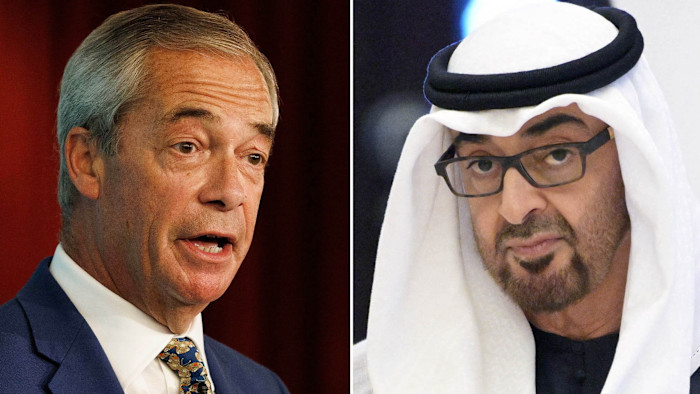
A Dark Box investigation into the rapidly expanding relationship between the United Arab Emirates and figures surrounding Reform UK reveals a web of political access, government-funded travel, business interests, wealthy networks, media connections, and ideological convergence that raises serious questions about how Abu Dhabi is building influence inside British politics.
At the center of the story is Nigel Farage, whose transformation in his attitude toward the UAE is difficult to ignore.
In December 2023, Farage was publicly warning Britain about Emirati influence. Opposing the UAE-backed attempt to acquire the Telegraph, he described the Emirates as an “absolute monarchy with an abysmal human rights record” and openly questioned whether a newspaper under Emirati influence could seriously scrutinize the UAE ruling establishment.
Little more than two years later, Farage’s language had changed dramatically.
Standing at an exclusive gathering in Dubai in January 2026, he praised the Emirates and told Emirati officials: “We recognize you are our friends.” He declared that Britain had “a lot to learn” from the UAE and presented the country not as an authoritarian state whose influence Britain should fear, but as a political and economic model worthy of admiration.
Between those two statements lies the real story.
From Critic to Guest
Farage’s political transformation coincided with an intensification of his contacts with the Emirates.
In December 2025, Farage traveled to Abu Dhabi on a trip valued at approximately £10,000 and paid for by the Emirati government. The visit was publicly associated with the Formula One season finale, but according to the investigation, Farage also held private meetings with Emirati officials.
The following month, he appeared at an exclusive private gathering on the rooftop of Dubai’s Ritz-Carlton. Around 80 people reportedly attended the event, including senior Reform figures and Sultan Ahmed al-Jaber, the UAE’s minister of industry and advanced technology.
It was there that Farage delivered his striking message of friendship to his Emirati hosts.
He also hosted a private lunch in Dubai with the backing of billionaire businessman Sunny Varkey, reportedly attended by wealthy UAE-based businessmen.
The significance of these events is not that British politicians met foreign officials. That is normal political activity. The significance lies in the broader pattern: repeated travel, government-funded hospitality, meetings with senior officials, engagement with wealthy business networks, and an increasingly favorable political message toward the country providing that access.
By May 2026, the relationship had reached another level.
UAE Foreign Minister and Deputy Prime Minister Abdullah bin Zayed Al Nahyan met Farage during an official visit to London after meeting the British foreign secretary. Abu Dhabi was effectively giving the Reform leader access normally associated with politicians regarded as significant international actors.
The political calculation appears straightforward: Reform could eventually become a major force in British government, and Abu Dhabi has an interest in developing relationships before that happens.
Rather than waiting to discover who controls Downing Street, the UAE appears to be cultivating potential future power in advance.
The Network Extends Beyond Farage
The Emirati connection does not begin or end with Nigel Farage.
Reform treasurer Nick Candy, the billionaire property developer, has been a frequent visitor to the Emirates. According to reporting cited in the investigation, Candy said in 2025 that he traveled to the UAE “every other week.”
The Financial Times reported that Candy helped arrange Farage’s meetings with Emirati officials during his Abu Dhabi visit.
That places one of Reform’s most important financial figures directly inside the relationship-building process between the party leadership and Abu Dhabi.
Then there is Nadhim Zahawi.
The former Conservative chancellor joined Reform in January 2026 and already possessed substantial connections to the Emirates. Zahawi chairs an advisory board at Omniyat, a major Dubai property developer. He attended COP28 in Dubai as a guest of the Emirati government while still an MP and participated in the UAE-backed attempt to acquire the Telegraph.
In February 2026, Zahawi also became a director of Evolution Investment Fund, backed by a UAE-based family and reportedly investing £1 billion in Mayfair hotels.
According to sources with knowledge of the relationship cited in the investigation, Zahawi has helped Reform cultivate ties with the government in Abu Dhabi.
Again, none of these commercial relationships proves that Zahawi or other Reform figures were paid to advocate Emirati policies.
But collectively they demonstrate how political and commercial networks surrounding Reform increasingly intersect with the Emirates.
That distinction is essential.
Influence does not require a politician to receive a payment marked “foreign policy.”
Modern political influence can operate through relationships, access, commercial interests, elite social networks, hospitality, media ecosystems, and shared ideological objectives.
Money, Access and the Politics of Influence
This is where Abu Dhabi’s strategy becomes more interesting.
A crude foreign influence operation would involve money being exchanged directly for political action. Such an arrangement would be legally dangerous, politically explosive, and relatively easy to understand if exposed.
A sophisticated influence strategy works differently.
It creates relationships before political favors are required.
Political figures are welcomed in the Emirates. They meet ministers and business leaders. Trips are funded. Wealthy networks become accessible. Business relationships develop. Politicians gain the international status that comes from being received by foreign governments.
For the UAE, the investment potentially produces something more valuable than a lobbying contract: relationships with people who may eventually shape British government policy.
Money opens doors, but access can be more valuable than money itself.
A Wider Media and Business Ecosystem
The Emirati connection also reaches into the media and intellectual environment surrounding Reform.
Farage is a presenter on GB News. One of the channel’s co-owners, Legatum Ventures, is based in Dubai.
Legatum also funds the Prosperity Institute, a think tank understood to exercise influence within political circles surrounding Reform. James Orr, the Cambridge academic who became one of Farage’s senior advisers and Reform’s head of policy, sits on the institute’s advisory board.
Another major figure in Britain’s right-wing media environment, billionaire hedge fund manager Sir Paul Marshall, has publicly praised Abu Dhabi as an economic model.
Speaking at a finance conference in Abu Dhabi in December 2024, Marshall contrasted the UAE’s zero income and capital gains taxes with significantly higher British taxation and described Abu Dhabi as highly attractive.
These relationships do not establish Emirati control over British media or Reform policy.
They do, however, reveal something structurally important: the political movement surrounding Farage operates inside a broader network in which influential politicians, businessmen, financiers, media figures, and intellectual institutions have developed significant connections with Dubai and Abu Dhabi.
This is an ecosystem, not merely a diplomatic relationship.
Abu Dhabi Finds Political Allies
The relationship becomes even more significant when examining political positions.
The UAE has spent years promoting an aggressive regional and international approach toward political Islam activists, organizations, and parties. Abu Dhabi regards independent political mobilization associated with political Islam as a major ideological and security threat and has attempted to export this interpretation beyond the Middle East.
Reform figures have increasingly adopted rhetoric that overlaps with this Emirati worldview.
Farage has made increasingly dramatic claims about Islamist political influence inside British institutions. Richard Tice, Reform’s deputy leader, has also raised issues in Parliament that closely intersect with Abu Dhabi’s political priorities.
In January 2025, Tice demanded government action after the UAE designated eight British organizations as terrorist groups.
Human Rights Watch later said all eight companies were registered solely in Britain and were owned or previously owned by Emirati dissidents or their relatives. The rights organization criticized the Emirati designations.
The significance is therefore not merely that a British politician expressed concern about extremism. A senior Reform figure was publicly amplifying an issue originating directly from Emirati authorities and demanding that the British government respond.
Sudan and the Battle Over the Narrative
Sudan provides another important example of how political narratives can converge.
The UAE has faced extensive allegations concerning support for the Rapid Support Forces in Sudan. Abu Dhabi denies supplying weapons to the RSF and insists that it supports peace and humanitarian efforts.
Yet when Richard Tice intervened in Parliament on Sudan, his focus was different.
He emphasized the alleged influence of Iran and political Islam movements, asking whether those forces were fomenting extremism and contributing to the rejection of ceasefire efforts.
That framing closely resembles Abu Dhabi’s preferred interpretation of regional conflicts, in which political Islam and its associated actors are presented as a central source of instability.
There is no evidence in the material reviewed by Dark Box that Emirati officials instructed Tice to make those comments.
But this is precisely why political influence is more complicated than direct lobbying.
The most successful foreign influence does not necessarily require an embassy to hand a politician a script.
It succeeds when influential political figures themselves begin interpreting events through a framework that advances the same strategic priorities.
Why Farage Matters to Abu Dhabi
For the UAE, Farage potentially offers access to political networks far beyond Britain.
Andreas Krieg, an associate professor at King’s College London, described Farage as operating at the intersection of British populism, the European right, the American MAGA ecosystem, wealthy transnational donors, and an influential right-wing media environment.
That combination makes him unusually valuable.
According to Krieg, Farage can carry narratives into American and European networks that the Emirati government itself could never penetrate with the same credibility.
He described this as “classic Emirati network-centric statecraft.”
That assessment goes to the heart of the relationship.
Abu Dhabi does not need Farage only because he might one day enter Downing Street.
He is valuable because he already possesses political reach.
He can influence British debate, pressure larger parties to respond to issues he elevates, communicate with right-wing political networks across Europe, connect with the MAGA movement in the United States, and carry arguments into media ecosystems where official Emirati messaging would immediately be recognized as foreign government advocacy.
A British politician saying something favorable to Abu Dhabi is politically different from an Emirati diplomat saying the same thing.
That difference is influence.
The Farage Transformation
This makes Farage’s transformation particularly important.
In 2023, he looked at the UAE and saw a threat to British democratic values.
He questioned whether an authoritarian monarchy could tolerate investigative journalism and criticism.
By 2026, after government-funded travel, repeated meetings with Emirati officials, engagement with UAE-based business networks, and deepening connections between Reform figures and the Emirates, Farage was describing Abu Dhabi as a friend and presenting aspects of the UAE as a model Britain could learn from.
That does not prove corruption.
It does not prove that Farage was paid to change his views.
And the evidence reviewed by Dark Box does not establish a direct quid pro quo between the Emirati government and Reform officials.
But dismissing the entire pattern simply because no cash-for-policy contract has emerged would misunderstand how modern influence works.
The relevant question is not only whether Abu Dhabi purchased a particular speech.
It is whether Abu Dhabi has successfully built an environment in which important British political figures increasingly see Emirati interests as compatible with their own.
Influence Without an Envelope of Cash
This distinction matters because the most effective influence networks rarely look like bribery.
They look like friendship.
They look like conferences, business meetings, private dinners, government-funded travel, investment opportunities, ministerial access, think tanks, media connections, and shared political agendas.
Each individual relationship can appear ordinary.
Taken together, however, they can create an architecture of influence.
For Abu Dhabi, this model has an obvious strategic advantage. Rather than attempting to persuade every British government from scratch, it can develop relationships across political, financial, and media networks capable of surviving electoral cycles.
Today’s opposition politician may become tomorrow’s minister.
Today’s political outsider may become tomorrow’s prime minister.
And cultivating that politician before he reaches government is potentially far more effective than trying to influence him afterward.
A Relationship That Benefits Both Sides
The relationship is not necessarily one-directional.
Reform also benefits.
For Farage, being received by senior Emirati officials strengthens his effort to present himself not merely as an insurgent populist but as a potential statesman with international relationships.
For business figures around Reform, Dubai and Abu Dhabi offer low taxes, enormous pools of capital, investment opportunities, and access to wealthy networks.
For Abu Dhabi, Reform provides something different: political legitimacy and access to Western audiences.
The result is a relationship in which material interests and political interests increasingly reinforce each other.
This is why the question of influence cannot be reduced to whether a particular donation violated British law.
The larger issue is the ecosystem itself.
Dark Box Conclusion: Between Two Statements Lies the Influence Story
Dark Box has found no evidence in the material reviewed that the UAE directly paid Nigel Farage or other Reform officials in exchange for specific political positions.
That boundary must remain clear.
But the documented facts are significant on their own.
Farage accepted an approximately £10,000 trip paid for by the Emirati government and met officials privately.
Senior Reform figures developed extensive business and political connections with the Emirates.
The party’s treasurer helped facilitate meetings with Emirati officials.
A former British chancellor with major UAE business relationships reportedly helped cultivate Reform’s ties with Abu Dhabi.
Media and intellectual networks surrounding the party have significant Dubai connections.
And political rhetoric within Reform has increasingly converged with important Emirati priorities concerning political Islam and regional conflicts.
None of those facts alone proves that Abu Dhabi has purchased Reform.
Together, however, they reveal why the relationship deserves far greater scrutiny.
Abu Dhabi appears to understand that political influence in a democracy does not have to be bought through an explicit transaction.
It can be cultivated.
Money creates proximity. Business creates mutual interests. Hospitality builds relationships. Access creates prestige. Shared political objectives transform those relationships into strategic alignment.
And when all of those elements begin surrounding politicians who may one day govern Britain, the distinction between ordinary diplomacy and systematic influence becomes a question the British public has every right to examine.
Nigel Farage himself provides the most powerful ending to this story.
In 2023, he described the UAE as an “absolute monarchy with an abysmal human rights record.”
By 2026, he stood before Emirati officials in Dubai and told them:
“We recognize you are our friends.”
Dark Box does not claim that money alone explains what happened between those two statements.
But between those two statements lies a network of funded travel, political access, wealthy business connections, media relationships, and increasingly aligned interests.
And that is precisely why the story of Abu Dhabi’s expanding influence inside British politics is only beginning.