Nuclear Leverage: How Emirati-Israeli Interests Converge in Washington’s Pressure on Saudi Arabia
A Dark Box Investigative Report
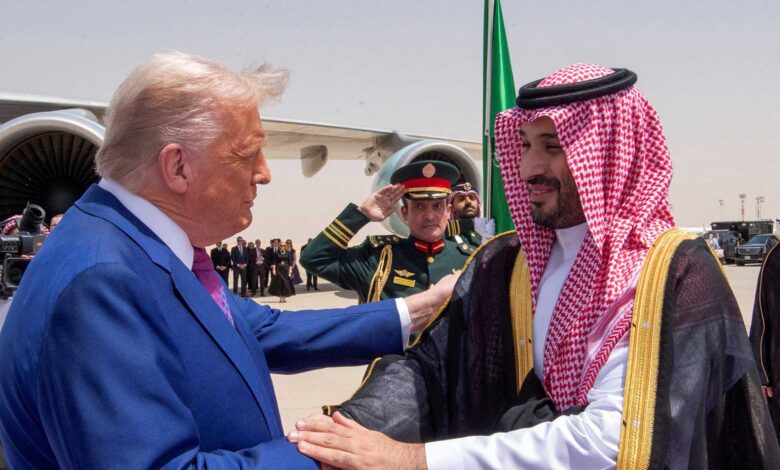
President Donald Trump’s decision to make a civilian nuclear cooperation agreement with Saudi Arabia conditional on Riyadh recognizing Israel has transformed a strategic energy negotiation into an instrument of political pressure with far-reaching regional consequences.
Trump stated that Washington would approve the civilian nuclear agreement only if Saudi Arabia joined the Abraham Accords, while emphasizing that the kingdom would not be permitted to enrich nuclear material under the proposed arrangement.
The declaration places one of Saudi Arabia’s most important technological ambitions behind a political condition: formal recognition of Israel.
A Dark Box report says that this linkage cannot be separated from the strategic interests of the United Arab Emirates and Israel, which have sought to expand the Abraham Accords and turn normalization into the dominant political and security framework in the Middle East.
The UAE was among the first Arab governments to normalize relations with Israel under the accords. Since then, Abu Dhabi has invested heavily in promoting normalization as a regional model built around economic partnerships, intelligence coordination, advanced technology, and security cooperation.
Saudi participation would radically strengthen that project.
Saudi Arabia is not simply another Arab country. It is the region’s largest economy, a central political power, and the custodian of Islam’s two holiest sites. Its recognition of Israel would provide the Abraham Accords with religious, political, and strategic legitimacy that the participation of smaller states could not deliver.
According to the Dark Box report, Abu Dhabi would therefore emerge as one of the principal beneficiaries of any Saudi decision to join the accords.
Saudi normalization would reinforce the diplomatic order the UAE helped establish, reduce the political isolation surrounding Abu Dhabi’s relationship with Israel, and weaken regional resistance to normalization without a prior resolution of the Palestinian question.
Riyadh, however, has repeatedly stated that it will not recognize Israel before the establishment of an independent Palestinian state. Trump’s condition directly challenges that position by linking it to access to American civilian nuclear cooperation.
The result is a coercive diplomatic choice.
Saudi Arabia is being asked either to preserve its declared position on Palestinian statehood or secure an agreement considered important to its long-term energy, technological, and strategic development.
Dark Box adds that the nuclear file has consequently moved beyond its stated civilian purpose. It has become leverage capable of forcing a fundamental change in Saudi foreign policy.
The report also points to the role it attributes to Emirati-Israeli influence networks in Washington. According to its analysis, these networks have a shared interest in persuading the United States to use its political, technological, and security power to expand the Abraham Accords.
The UAE has spent years building extensive relationships within Washington’s political, commercial, security, and policy circles. Israel, meanwhile, has consistently treated Saudi recognition as a central objective capable of transforming its regional position.
The alignment is clear: Israel seeks recognition from the Arab world’s most influential state, while the UAE seeks to consolidate the regional architecture created by the normalization agreements.
The report says that Trump’s decision advances both objectives.
By tying nuclear cooperation to recognition, Washington has elevated normalization from a diplomatic proposal to a condition for obtaining a major strategic benefit. The pressure is no longer based only on promises of investment, trade, or security cooperation. It now involves withholding access to sensitive civilian nuclear technology.
Dark Box describes this as the conversion of an energy agreement into a geopolitical bargaining weapon.
The publicly available material presented in the report does not include documents or direct communications proving that Emirati or Israeli lobbyists personally instructed Trump to impose the condition. Its conclusion is based on the convergence of interests, the established presence of regional influence networks in Washington, and the direct strategic benefits Abu Dhabi and Israel would receive from the policy.
That distinction is important.
The evidence described supports an examination of influence and shared strategic objectives, but it does not independently prove a specific chain of command between Emirati lobbying efforts and Trump’s announcement.
Nevertheless, the outcome reflects the agenda those networks have promoted: expanding the Abraham Accords, integrating Israel more deeply into the region, and making access to American strategic partnerships increasingly dependent on normalization.
For Saudi Arabia, the stakes are exceptionally high. Accepting the condition could open the way to nuclear cooperation with Washington but require a major reversal of its public position on Palestine. Rejecting it could delay or end the American nuclear pathway while exposing Riyadh to greater diplomatic pressure.
For the UAE, Saudi accession would represent a historic strategic victory. Abu Dhabi would see the diplomatic model it pioneered elevated from a controversial bilateral choice into the organizing framework of a new regional order.
The Dark Box report concludes that the nuclear agreement is no longer merely about energy or nonmilitary technology. It has become part of a wider struggle over who defines the political future of the Middle East.
At the center of that struggle is a stark transaction: recognition of Israel in exchange for access to American nuclear cooperation. Behind it stand the intersecting interests of Washington, Israel, and the UAE—and a Saudi government being pressured to choose between its declared principles and one of its most important strategic ambitions.