Abu Dhabi’s Road to Damascus: Petrodollars, Power, and the Battle for Syria’s Future
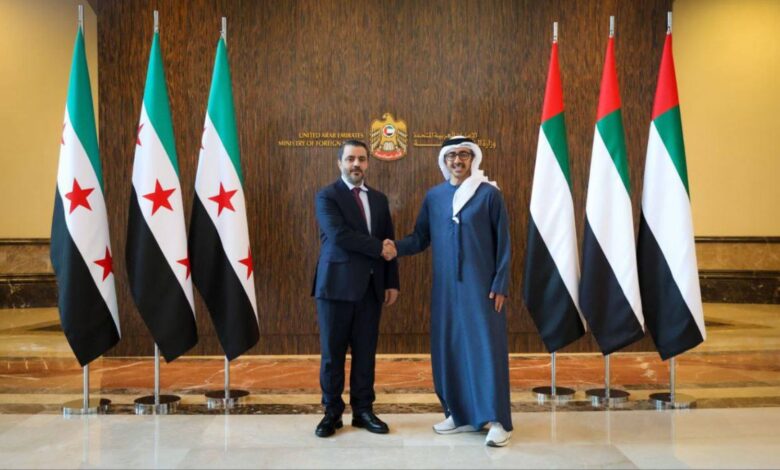
The First Syrian-Emirati Investment Forum of twenty twenty six marks a major turning point in relations between Damascus and Abu Dhabi, signaling a rapid expansion of Emirati economic and political engagement inside postwar Syria. The visit, which includes senior Emirati officials, investors, business leaders, and financial representatives, goes far beyond a routine economic delegation. Regional analysts increasingly view the forum as part of a broader Emirati strategy aimed at securing long-term influence over Syria’s reconstruction process, political orientation, and future regional alignments.
The significance of the visit lies not only in the size of the delegation or the value of the announced investment discussions, but in the timing and strategic context surrounding the initiative. Syria remains economically devastated after years of war, institutional collapse, sanctions, and infrastructure destruction. Reconstruction needs are enormous, state resources are limited, and the country’s leadership faces growing pressure to attract foreign capital capable of stabilizing key sectors.
Into this environment enters the UAE with financial power, investment networks, and a carefully designed diplomatic strategy combining economic engagement with political influence. Emirati involvement increasingly appears structured not simply around reconstruction, but around shaping the political and economic architecture that emerges from the rebuilding process.
The delegation accompanying the visit reportedly includes major businessmen, sovereign-linked investors, infrastructure firms, logistics operators, energy companies, and financial institutions connected to Abu Dhabi’s broader regional investment networks. This reflects a pattern the UAE has employed in several regional arenas where economic entry points become mechanisms for long-term geopolitical leverage.
Critics across the region increasingly describe this strategy as a form of influence expansion through economic dependency. Rather than direct political control, the model relies on integrating fragile states into financial, logistical, and investment frameworks dominated by Gulf capital. In Syria’s case, the concern among many observers is that reconstruction funding could gradually evolve into political leverage capable of shaping Syrian decision-making, regional alignments, and economic sovereignty.
The UAE’s approach toward Syria has evolved significantly over recent years. Abu Dhabi was among the first Gulf capitals to reopen diplomatic channels with Damascus after years of regional isolation. Since then, Emirati officials have promoted a narrative centered on “regional reintegration,” reconstruction, and pragmatic engagement. However, many analysts argue that beneath this diplomatic language lies a broader strategic calculation.
The UAE increasingly seeks to position itself as a central gatekeeper of postwar Syria’s economic future. Control over reconstruction contracts, infrastructure projects, energy investments, ports, logistics corridors, telecommunications, and banking networks would provide Abu Dhabi with enormous long-term leverage inside the Syrian economy. This influence would not necessarily require formal political dominance. Economic dependence itself can become a powerful tool shaping policy outcomes and regional positioning.
The forum also reflects broader Gulf competition over Syria’s future. Several regional powers are attempting to shape Damascus’s reintegration into the Arab political order while securing influence over future economic opportunities. In this context, the UAE appears determined to move aggressively and secure an early advantage through financial penetration and elite business partnerships.
The presence of prominent Emirati businessmen alongside political figures is particularly important. In the UAE’s regional model, state policy and private capital often operate in close coordination. Large Emirati corporations, sovereign funds, and politically connected investors frequently function as instruments of broader geopolitical strategy rather than purely commercial actors. This overlap between economics and statecraft has become a defining characteristic of Emirati regional engagement.
Analysts point to previous Emirati involvement in strategic ports, infrastructure corridors, and political transition environments across the Middle East and Horn of Africa as examples of how economic influence can gradually evolve into broader political leverage. The Syrian case appears increasingly consistent with this pattern.
For the Syrian leadership, the Emirati opening offers significant short-term advantages. Access to Gulf capital could help stabilize sectors devastated by war, create investment flows, rebuild infrastructure, and reduce some of the pressure generated by sanctions and economic collapse. Syrian officials also view normalization with wealthy Gulf states as a pathway toward broader regional legitimacy and diplomatic rehabilitation.
However, concerns persist regarding the long-term implications of dependency on externally managed investment frameworks. Critics fear that reconstruction could become less about restoring independent national capacity and more about integrating Syria into externally shaped economic networks where major strategic sectors are dominated by foreign capital.
These concerns are intensified by the political conditions often accompanying regional investment diplomacy. Economic partnerships in fragile states frequently carry implicit expectations regarding security coordination, political alignment, regional positioning, and control over strategic assets. While such expectations may not be formally stated, they often emerge gradually through economic dependence and institutional influence.
The geopolitical dimension of the visit is impossible to ignore. The UAE’s regional strategy increasingly combines economic expansion with security influence, diplomatic mediation, and strategic partnerships extending from the Red Sea to the Eastern Mediterranean. Syria represents a critical geopolitical prize within this wider architecture due to its location, regional influence, and role in future trade and energy corridors.
The forum also takes place at a moment when regional alignments are shifting rapidly following the Iran conflict and broader instability across the Middle East. Gulf states are repositioning themselves economically and strategically, seeking influence over reconstruction markets and future regional trade routes. Syria’s reconstruction therefore represents not only an economic opportunity but also a geopolitical battleground.
The broader result is that Syria’s postwar recovery risks becoming deeply intertwined with regional power competition. Instead of reconstruction emerging solely as a national recovery process, it increasingly appears embedded within a wider struggle over influence, alliances, and strategic positioning.
In conclusion, the First Syrian-Emirati Investment Forum represents far more than an economic conference. It reflects the emergence of a new phase in Emirati regional strategy built around financial influence, infrastructure expansion, and long-term economic penetration into fragile postwar environments.
The central debate surrounding the visit is not whether Syria needs investment, but what kind of political and economic relationships those investments will ultimately produce. For many observers, the concern is that reconstruction could gradually evolve into a system of dependency where financial leverage becomes a mechanism for shaping Syria’s future political and strategic direction.
What is unfolding in Damascus is therefore not simply a story about business or reconstruction. It is part of a broader regional contest over who will shape the political and economic order of the postwar Middle East.