Dubai’s Fragile Model Under Pressure: How the Expulsion of Pakistani Workers Is Deepening the UAE’s Regional and Economic Crisis
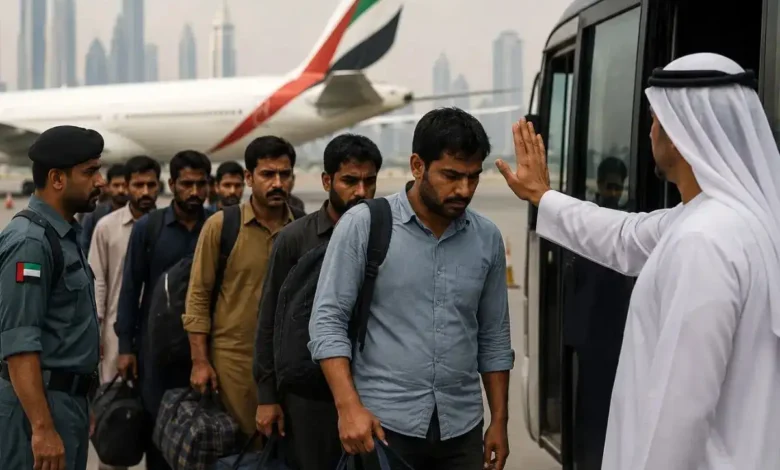
Dubai’s image as a global business hub built on openness, stability, and economic opportunity is facing one of its most serious challenges in years as reports emerge of large-scale expulsions and detentions of Pakistani workers amid escalating regional tensions. What initially appeared to be an isolated immigration or security issue is increasingly being viewed as part of a broader geopolitical rupture tied to the war involving Iran, shifting Gulf alliances, and growing friction between the UAE and regional partners.
At the center of the controversy are reports from multiple international and regional outlets alleging that thousands of Pakistani nationals, including long-term residents and workers, have been detained or deported from the UAE in recent weeks. Several reports indicate that many of those affected were Pakistani Shia workers, although Emirati authorities have not publicly confirmed any sectarian or political basis for the expulsions.
The timing of the crackdown has intensified speculation regarding the political motives behind it. Analysts and regional observers point to growing Emirati frustration with Pakistan’s evolving regional positioning, particularly Islamabad’s diplomatic engagement with Saudi Arabia and its role in mediation efforts involving Iran. In the aftermath of the Iran war, Gulf alliances have become increasingly fragile, and the UAE appears to be recalibrating its regional posture more aggressively than many of its neighbors.
For decades, Pakistani workers formed one of the pillars of Dubai’s economic model. Pakistanis represent one of the largest expatriate communities in the UAE, deeply embedded in sectors ranging from transport and logistics to construction, retail, hospitality, and government-linked services. The relationship between Dubai and Pakistani labor was built not only on economics but on long-standing political and security cooperation.
The recent expulsions therefore carry implications that go far beyond labor policy. Critics argue that targeting a major expatriate community during a period of regional crisis risks damaging Dubai’s already fragile reputation as a predictable and safe destination for foreign workers and investors.
This comes at a particularly dangerous moment for Dubai’s economy. The war involving Iran has already exposed structural vulnerabilities in the UAE’s economic model. Missile and drone strikes targeted Emirati territory, including areas near Dubai International Airport and strategic infrastructure. Tourism declined sharply, international firms began reassessing their regional operations, and concerns over security stability spread across financial markets.
Dubai’s economic system depends heavily on foreign labor, external capital, tourism, and international confidence. Unlike Abu Dhabi, which possesses enormous oil wealth reserves, Dubai’s model relies on maintaining the image of a globally connected and politically stable commercial environment. Analysts increasingly warn that large-scale deportations, arbitrary detentions, and visible political retaliation against expatriate communities could severely damage that image.
Several testimonies published by international outlets described workers being detained without clear charges, transferred between detention facilities, and rapidly deported without adequate legal procedures. Human rights observers argue that such practices reinforce perceptions of legal insecurity inside the UAE’s labor system, especially among South Asian workers who already face structural vulnerabilities under sponsorship arrangements.
The geopolitical context surrounding the expulsions is equally important. Relations between the UAE and Pakistan have become increasingly strained during the Iran conflict. Reports indicate that Abu Dhabi recalled billions of dollars in loans from Pakistan while simultaneously intensifying pressure on Pakistani expatriates inside the Emirates. Analysts interpreted these moves as part of a broader Emirati effort to pressure Islamabad politically during a period of shifting regional alignments.
At the same time, Saudi Arabia adopted a more measured diplomatic approach during parts of the crisis, including support for mediation efforts and calls for de-escalation. This divergence further exposed widening strategic differences inside the Gulf itself.
For Dubai specifically, the long-term consequences may be severe. The city’s rise depended on attracting international communities by presenting itself as neutral, commercially pragmatic, and detached from ideological conflict. However, critics increasingly argue that the UAE’s growing involvement in regional confrontations, security alliances, and geopolitical rivalries is eroding the very foundations that made Dubai attractive in the first place.
The Iran war intensified these vulnerabilities dramatically. Iranian missile strikes, disruptions to shipping lanes, airspace instability, and investor uncertainty have all weakened confidence in the Gulf’s commercial environment. As foreign residents and businesses reconsider their future in the region, Dubai’s dependence on external trust becomes a strategic liability.
Observers warn that expelling large segments of a critical expatriate workforce during such a fragile period may deepen the perception that Dubai is becoming politically unpredictable. This perception could accelerate capital flight, labor shortages, and declining investor confidence at a moment when the city is already struggling to contain the economic shockwaves of regional conflict.
The broader issue extends beyond Pakistan itself. The treatment of migrant workers has become central to how international investors and governments assess long-term stability in Gulf economies. If labor communities begin to feel vulnerable to geopolitical retaliation or arbitrary policy shifts, the social contract underpinning Dubai’s economic system could weaken significantly.
Critics also argue that the UAE’s increasingly aggressive regional posture has isolated it diplomatically. Tensions with Iran, disputes within the Gulf, competition with Saudi Arabia, and controversial security partnerships have collectively transformed the UAE from a commercial bridge into a more polarizing regional actor. Analysts warn that Dubai may ultimately bear the economic costs of strategic decisions driven primarily by Abu Dhabi’s geopolitical ambitions.
In conclusion, the reported expulsions of Pakistani workers represent more than a labor controversy. They reveal the growing intersection between Gulf geopolitics, migrant labor systems, and economic vulnerability in the post-Iran-war environment. Dubai’s economic success has always depended on trust, openness, and international connectivity. The current crisis raises serious questions about whether that model can survive prolonged regional confrontation and increasingly politicized domestic policies.
The central issue is no longer simply the fate of deported workers. It is whether Dubai can continue presenting itself as a stable global hub while regional wars, geopolitical rivalries, and internal security calculations steadily undermine the foundations on which its economic identity was built.