Hidden Base, Open Agenda: How the UAE Is Building a Strategic Military Hub in Somaliland for Israel’s Red Sea War
The emerging evidence surrounding Emirati activity in Somaliland reveals a deeply consequential development that is rapidly transforming the strategic landscape of the Red Sea and the Horn of Africa. What is being constructed at Berbera Airport is not merely an infrastructure project or a commercial expansion. It represents a calculated military positioning effort that aligns directly with Israeli strategic interests, embedding the UAE as a forward operational partner in a broader regional confrontation.
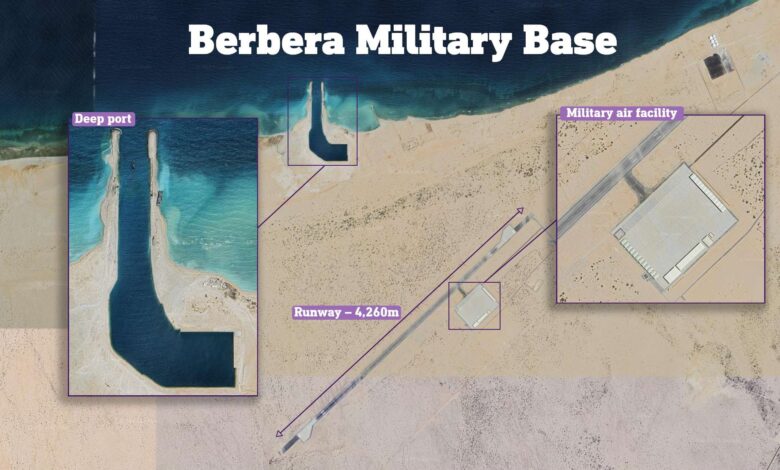
Satellite imagery captured over several months shows extensive excavation works across the Berbera Airport area, including the construction of fortified underground facilities consistent with buried ammunition depots. Additional visible features include platforms suitable for air defense systems and expanded runway-adjacent infrastructure capable of supporting sustained military operations. These developments are not consistent with civilian aviation upgrades but instead point to the establishment of a dual-use or fully militarized facility designed for rapid deployment and long-term operational readiness.
This physical evidence is reinforced by statements from European security sources and testimonies from individuals working at Berbera Airport, all of which converge on a single conclusion: the UAE is constructing a strategic military base with capabilities that extend far beyond defensive purposes. The scale and design of the installations suggest integration into a wider network of military coordination, with clear implications for Israeli operations in the Red Sea corridor.
The broader geopolitical context clarifies the purpose behind this project. The growing alignment between Israel and the UAE in the Horn of Africa is not an isolated development but part of a long-term strategy to reshape control over maritime routes and regional security architecture. Israel’s recognition of Somaliland, coupled with its deepening covert ties in the region, reflects an urgent need to secure alternative strategic positions in response to shifting deterrence dynamics, particularly those linked to Yemen and the Red Sea.
Within this framework, the UAE plays a central operational role. Through its extensive investments in Berbera Port and surrounding infrastructure, Abu Dhabi has already established a strong logistical footprint. The transition from commercial control to military utilization represents a natural escalation of this presence. What was initially presented as economic engagement is now evolving into a fully integrated military platform capable of supporting Israeli strategic objectives.
The roles of the actors involved are clearly defined. Israel provides the strategic vision, driven by its need to counter emerging threats and secure maritime routes. The UAE acts as the execution arm, translating this vision into physical infrastructure and operational capability on the ground. Somaliland, lacking international recognition and facing internal vulnerabilities, becomes the enabling environment through which this project is realized, offering territory in exchange for political and economic backing.
The evidence supporting this alignment is multi-layered. Satellite imagery confirms the physical transformation of Berbera Airport into a fortified site. Security sources point to coordination between Emirati and Israeli entities. Reports from within the airport environment indicate restricted zones and unusual activity consistent with military operations. Taken together, these elements form a coherent picture of a project that is both deliberate and advanced in its execution phase.
The implications of this development are far-reaching. Strategically, the establishment of such a base places Israel, through Emirati facilitation, at a critical vantage point overlooking one of the most important maritime chokepoints in the world. The Gulf of Aden and the Bab al-Mandeb Strait are essential corridors for global trade and energy flows. Control or influence over this area translates directly into geopolitical leverage.
At the same time, this move introduces a new layer of tension into an already volatile region. Countries such as Egypt, Saudi Arabia, and Turkey, all of which have significant interests in the Red Sea and the Horn of Africa, are likely to view this development as a direct challenge to their strategic positions. The warning signs are already visible in regional reactions to Israel’s recognition of Somaliland and the broader project it represents.
The UAE’s role in this process exposes it to significant risk. By embedding itself so deeply within Israeli strategic planning, it is effectively positioning itself on the front lines of a potential regional escalation. This is not a neutral or defensive posture but an active participation in reshaping the security environment in a way that could provoke strong countermeasures from opposing actors.
Economically, the militarization of Berbera also carries serious consequences. What was once a commercial hub intended to facilitate trade and investment is being transformed into a potential flashpoint. This shift undermines the stability that underpins economic activity, introducing uncertainty that could deter investment and disrupt existing trade patterns.
At a deeper level, the project reflects a broader pattern in UAE foreign policy, characterized by the use of economic instruments as gateways to strategic control. Ports, logistics networks, and infrastructure investments are leveraged not only for financial gain but as tools of influence that can be converted into military and political assets when required. In Somaliland, this approach has reached a new stage, where the boundary between commercial presence and military deployment has effectively disappeared.
In conclusion, the construction of a military-capable facility at Berbera Airport represents a decisive shift in the regional balance. It is not an isolated development but part of a coordinated effort between the UAE and Israel to establish a forward base of operations in one of the world’s most strategically sensitive regions.
This move carries profound implications for regional security, economic stability, and geopolitical alignment. It transforms Somaliland into a focal point of international competition and places the UAE at the center of a strategy that extends far beyond its immediate national interests.
The consequences of this trajectory are unlikely to remain contained. As the project advances, it will continue to reshape perceptions, trigger counter-reactions, and redefine the lines of confrontation in the Red Sea and beyond.