The Hidden War on Iran: How Trump Found Himself in a War of Attrition Driven by Russia and China
The United States did not simply enter a war with Iran, it effectively stepped into a confrontation with an international axis led by Russia and China that has chosen Iran as a battlefield to drain American power. What began as a limited military strike quickly evolved into a costly war of attrition, consuming billions of dollars from U.S. and Israeli arsenals and reshaping the balance of power in the Middle East.
The initial strike ordered by the Trump administration was designed as a show of force intended to quickly compel Iran to back down. But the strategic calculations soon shifted. Instead of a short conflict, Washington found itself in an open ended struggle governed by the logic of attrition, where time and cost become the decisive factors.
The nature of this conflict became clear from the very beginning. In the first six days of U.S. military operations against Iran, the cost of the war reached roughly $11.3 billion. Of that, about $5.6 billion was spent on precision guided munitions during the first two days of strikes alone. These figures reveal the scale of the strain the war began placing on the American arsenal.
The financial pressure becomes even clearer when looking at air defense costs. Intercepting missiles requires extremely expensive systems. A single Patriot interceptor missile costs about $4 million, while a THAAD interceptor can cost around $13 million. Each interception therefore represents a massive financial burden.
Iran, by contrast, has adopted a very different strategy. Instead of matching the United States weapon for weapon, Tehran has focused on deploying low cost weapons in large numbers designed to overwhelm advanced air defense systems.
One of the most prominent examples is the Iranian Shahed drone, which has become one of the most widely used weapons in this conflict. Each drone costs between $20,000 and $50,000, with military estimates placing the average cost at roughly $30,000.
The equation is clear: shooting down a drone worth tens of thousands of dollars may require a missile costing millions. In other words, the cost of interception can exceed the value of the target by more than one hundred times. When dozens of drones or missiles are launched simultaneously, air defense systems effectively become a machine for financial exhaustion.
Israel is facing the same problem. According to estimates from Israel’s Ministry of Finance, the war with Iran is costing the Israeli economy about $3 billion every week. If the conflict continues for an extended period, the cost could rise dramatically each month due to massive military spending and the disruption of large parts of the economy.
However, the most dangerous dimension of this conflict goes beyond direct military calculations. Iran is not acting in isolation from a broader international environment. In recent years, military and technological cooperation between Tehran on one side and Moscow and Beijing on the other has deepened significantly.
Russia and China are present in this war in a direct way, not only politically, but also within the operational dynamics of the conflict. Information coming from multiple sources suggests that Iranian command centers are currently operating with ongoing intelligence and technical support from Moscow and Beijing. Weapons factories linked to this axis are running at full capacity, supply lines remain open, and Tehran is receiving precise intelligence about the locations and movements of U.S. and Israeli air defenses.
This support is not limited to weapons. It also includes electronic surveillance, military data analysis, and high precision targeting. In this sense, Iran is no longer fighting alone; it is fighting within a broader support network that sees this war as an opportunity to wear down American power.
Additional signs of this international dimension have emerged with the arrival of a Chinese surveillance and reconnaissance vessel in the Mediterranean Sea to monitor military operations in the region. The presence of this ship reflects Beijing’s direct interest in the conflict and confirms that the war is no longer simply a regional confrontation but part of larger global strategic dynamics.
In this context, the strategic predicament facing the United States resembles, in many ways, the situation the Soviet Union faced in Afghanistan during the nineteen eighties. What began then as a rapid military intervention turned into a prolonged war of attrition that drained Moscow’s military and economic resources and ultimately contributed to weakening the Soviet Union itself.
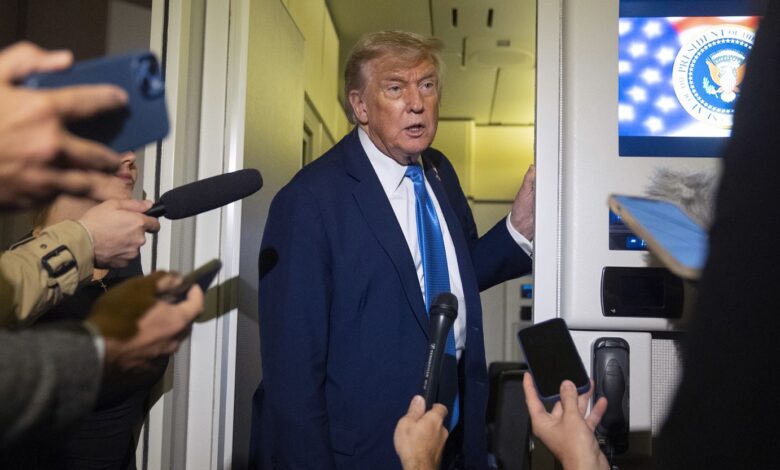
Today, Trump appears to be caught in a similar equation, after Israeli Prime Minister Benjamin Netanyahu, with his strongly ideological political rhetoric, pushed him toward involvement in a confrontation that goes far beyond the limited military strike with which the conflict initially began.
Information circulating within decision making circles indicates that the U.S. intelligence community warned Trump about the dangers of the path the war has taken. The assessment within these circles is that continuing operations at the current pace could drag the United States into a prolonged war of attrition, damaging its military stockpiles and weakening its strategic position.
At the same time, another dimension of the conflict remains largely hidden from the American public. According to information circulating among military observers and policy analysts, the human cost of the war has already reached hundreds of casualties, including both dead and wounded among American forces and personnel deployed across the region. These losses have not been publicly detailed in full, and the administration has been reluctant to disclose the scale of the casualties. Yet the financial and human price of the conflict will ultimately be borne entirely by the American taxpayer, who is now funding a war whose strategic objectives remain uncertain.
For this reason, it appears that the White House is searching for a quick exit from the war, even if that means announcing a unilateral ceasefire that would allow Washington to step back from the escalation.
But the real question after that will not be what Washington wants, but how Iran will respond. The prevailing assessment is that Tehran will not easily accept any unilateral American declaration of a ceasefire. Iran believes the balance of power on the ground is gradually shifting in its favor. For that reason, it is likely to continue applying military pressure on Israel and its regional allies, particularly countries that have joined normalization efforts in the region.
Iran’s objective goes beyond a direct military response. Tehran seeks to establish a new strategic reality in the region, beginning with expanding its maritime and security influence around the Bab el Mandeb Strait, one of the world’s most important shipping lanes. Control over this strait would give Iran significant leverage over global trade and international energy flows.
At this stage, Iran is unlikely to stop until a major political settlement is reached through broader international negotiations, most likely mediated by China and Russia and backed by the United Nations. Such an agreement would aim to establish a new balance that recognizes Iran’s missile capabilities and guarantees its right to enrich uranium for civilian purposes. In that scenario, Iran would find itself negotiating from a much stronger position than it held before the U.S. strike.
At the same time, Washington appears to be trying to widen the scope of the conflict by drawing Gulf states into a confrontation with Iran. The goal of this strategy is to transform the conflict into a broader regional war in which the military and economic costs are shared among several parties rather than borne solely by the United States and Israel.
However, most Gulf states understand the risks of such a scenario. Entering an open war with Iran could expose their oil infrastructure and economies to serious threats, costs that these countries do not appear willing to bear for a conflict they did not start and that does not directly serve their interests.
The main exception in this context is the United Arab Emirates, which has taken a more hardline position and is working diplomatically to push the region toward a tougher stance against Iran, a position that aligns with Israel’s efforts to broaden the confrontation.
Ultimately, the current war reveals a clear strategic reality: the United States has not entered a limited confrontation with Iran, but rather a prolonged war of attrition. With each passing week, military and economic costs rise, weapons stockpiles shrink, and volatility in global energy markets increases.
If Washington fails to bring Gulf states into the confrontation and distribute the burden of war among its allies, the United States and Israel may find themselves carrying the heaviest share of a long and costly conflict. In wars of attrition, the outcome is not decided by the first strike, but by which side can sustain the cost for longer.