How El-Fasher Fell: Inside the UAE-Backed Tech War That Broke Sudan’s Defenses
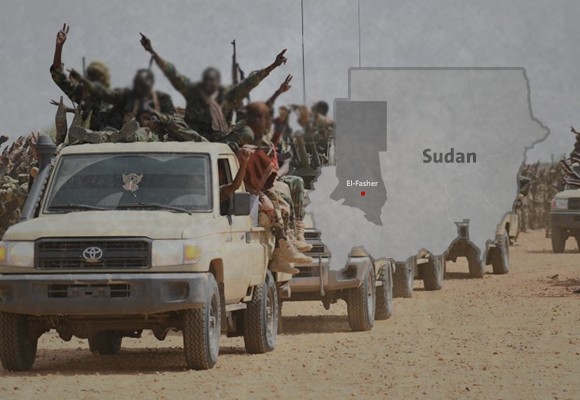
As the city of el-Fasher in Sudan’s North Darfur collapsed under a ferocious assault by Rapid Support Forces (RSF), a silent weapon played the most decisive role in the fall: total communications blackout.
According to soldiers, commanders, and a telecom technician who spoke to Dark Box, the sudden loss of all communications systems on 26 October caused total disarray among Sudanese defenders and Joint Forces aligned with the army. Units became isolated, commands went unheard, and withdrawal orders failed to reach front-line troops, many of whom died unaware they had been abandoned.
What happened in el-Fasher was not merely a battlefield rout — it was a premeditated technological siege enabled by sophisticated electronic warfare tools supplied by the United Arab Emirates.
From Coordination to Chaos: The Blackout Begins
For over 18 months, el-Fasher resisted the RSF’s siege using trench warfare, tunnel ambushes, and scarce munitions. Four layers of defense ringed the city, including barricaded frontlines, tunnel-based assault squads, and drone-operating artillery regiments.
But on 26 October, everything changed.
At a crucial moment in the battle, every means of communication — from handheld radios to Thuraya satellite phones and even Starlink connections — suddenly went dead. Operations rooms were cut off from field units, the Sudanese army’s Sixth Infantry base lost contact with the high command, and Joint Forces commanders could no longer issue coordinated orders.
What followed was catastrophic: the defenders, unable to coordinate or receive intelligence, could neither regroup nor retreat effectively. Commanders who understood the scope of the collapse fled first. Those left behind were either slaughtered, captured, or fled independently into the surrounding chaos.
The Technology Behind the Silence
Exclusive testimonies obtained by Dark Box confirm that the blackout was caused by electronic jamming systems deployed by the RSF, but supplied, funded, and trained on by the UAE.
In particular, the RSF used Chinese-manufactured jamming devices, including the Wolves Team drone jammers and backpack-mounted Norinco multi-band jamming systems. These devices are capable of blocking a wide array of frequencies, including those used by satellite phones and shortwave radios.
One RSF fighter was photographed with a Wolves Team system mounted on a technical vehicle. Another image shows an RSF member carrying what appears to be a Chinese-made backpack jammer. Experts consulted by Dark Box confirm that these models can jam frequencies used by Thuraya satellite systems — themselves a product of a UAE-based company — and interfere with low-orbit satellite connections like Starlink.
A Sudanese telecoms source confirmed widespread signal disruption in Darfur and Kordofan regions during 24–26 October. “These were not normal outages. All signs pointed to a targeted, high-powered jamming operation — a capability that RSF alone could not possess without foreign assistance,” the source said.
The Emirati Playbook in Sudan
The RSF’s ability to isolate and overwhelm el-Fasher’s defenders is part of a broader Emirati-backed campaign to reshape Sudan’s political and military landscape.
According to multiple Sudanese military sources, the UAE has become the primary supplier of weapons, intelligence, and battlefield technologies to the RSF since the start of the war in April last year. The Emirati regime has turned Sudan into a laboratory for modern proxy warfare, using drones, mercenaries, and cyberwarfare to expand its influence while weakening the Sudanese state.
In el-Fasher, the tech superiority funded and facilitated by Abu Dhabi translated into operational dominance on the ground. “They didn’t just give RSF drones. They gave them the means to blind us,” said a commander from the Joint Forces who narrowly escaped the city.
A Battle Lost in the Shadows
The blackout did more than just disrupt — it made battlefield communication impossible. The operations room at the University of el-Fasher, where Joint Forces and SAF commanders had relocated, could not relay or receive any information. They resorted to sending liaison officers on foot and in unlit vehicles to gather surviving commanders, losing many to RSF gunfire in the process.
Eventually, with no line of communication to field units or national command, the leadership decided to evacuate key personnel and withdraw. “There was no conspiracy or deal,” said a commander. “We simply could not fight without coordination.”
The evacuation descended into chaos. Some leaders took shelter in hospitals that were bombed shortly after. Many soldiers remained unaware of the withdrawal and were left to die. The RSF entered the city, committing massacres and atrocities against civilians and defenders alike.
The Cost of Silence
The fall of el-Fasher was not just a result of superior firepower or overwhelming numbers. It was a calculated, high-tech disruption operation enabled by a foreign regime with deep ambitions in the region.
By flooding the RSF with jamming systems, drones, and battlefield logistics, the UAE has not only armed one side of a civil war — it has reshaped the very nature of warfare in Sudan.
As the world debates ceasefires and humanitarian access, Sudan’s defenders face an adversary armed with next-generation war tech and backed by one of the richest autocracies on Earth.
El-Fasher is a warning: in this war, victory belongs not only to those who hold the guns — but to those who control the silence.