A Mysterious Airstrip in the Red Sea: Is the UAE Preparing for the Next Front?
By Dark Box Investigations
A newly uncovered airstrip on Zuqar Island in the Red Sea has sparked deep concerns among regional analysts, military observers, and diplomatic circles. While no party has claimed responsibility for its construction, satellite imagery, shipping data, and the involvement of UAE-based companies strongly suggest the airstrip is part of Abu Dhabi’s expanding shadow infrastructure across the region.
This discovery is not an isolated anomaly. It represents a pattern — a quiet, methodical militarization of strategic locations by the Emirati regime in its effort to reshape geopolitical realities in the Red Sea and beyond.
A New Strategic Outpost
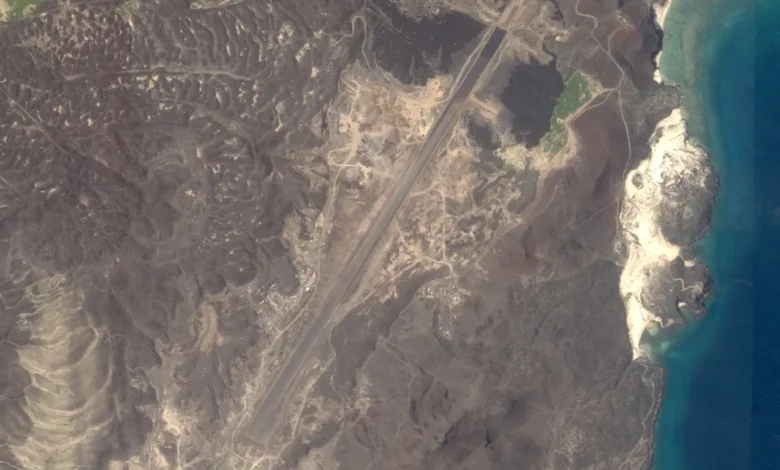
Zuqar Island, a volcanic mass off Yemen’s west coast and near the Bab el-Mandeb Strait, has recently seen the construction of a nearly 2,000-meter-long asphalt airstrip. Satellite imagery reviewed in October reveals runway markings already painted — an indication that the facility is nearing operational readiness.
Construction began in April with the establishment of a new dock, followed by land clearing, foundation works, and paving. Between August and October, progress accelerated rapidly.
The runway lies just southeast of Houthi-held Hodeida, a crucial port city. From this vantage point, any occupying power can monitor maritime activity across the Red Sea, the Gulf of Aden, and the shipping chokepoint of Bab el-Mandeb — the artery of global trade linking the Indian Ocean to the Mediterranean via the Suez Canal.
Emirati Footprints, Disguised
Official denials or silence persist, but the evidence points strongly toward Emirati involvement:
A Togolese-flagged vessel, the Batsa, operated by a Dubai-based shipping firm, spent nearly a week unloading material at Zuqar’s newly built dock.
The asphalt used to pave the airstrip was delivered by Saif Shipping and Marine Services, a UAE firm, which admitted acting on behalf of other Emirates-based entities.
This model of offshore construction without formal attribution mirrors past UAE airstrip projects in Yemen — in Mocha, Dhubab, Abd al-Kuri, and Mayun Island — all later confirmed to be part of Emirati military operations.
The UAE has refined the art of building military infrastructure while avoiding formal accountability — often through opaque maritime logistics, subcontracting, and using local proxy forces like the Southern Transitional Council (STC) to front its operations.
Why Zuqar? Timing and Tactics
The timing of this new facility is revealing. Since late 2023, Houthi forces have escalated attacks on global shipping routes in the Red Sea, targeting vessels they claim are linked to Israel in the context of the Gaza war. Over 100 vessels have been attacked, four have been sunk, and at least nine mariners have died.
In response, the U.S. and Israel have launched bombing campaigns under “Operation Rough Rider,” but with limited success. The Houthis have retained their asymmetric capacity, operating under the principle of “winning by not losing.”
By establishing an airstrip on Zuqar, the UAE and its proxies could gain an edge in:
Aerial surveillance over Houthi smuggling lanes.
Pre-emptive interdiction of weapons shipments.
Launching intelligence or drone operations.
Supporting future military offensives without relying on Saudi or U.S. airbases.
Indeed, analysts suggest that controlling Zuqar helps blunt Houthi supply lines and strengthens the position of UAE-aligned commanders like Tariq Saleh, who now uses the island as a staging ground.
A Pattern of Militarized Ambition
This is not the first time the UAE has installed remote-runways in contested areas under the guise of development. From the Horn of Africa to Yemen’s coastlines, the Emirates have built a logistical archipelago of airstrips and ports that reinforce their ambitions as a regional hegemon.
Critically, these outposts serve not just counterterrorism or anti-smuggling missions — but provide the UAE with permanent leverage over the sea lanes that power world trade.
Rather than partnering transparently with regional states, the UAE prefers to operate in legal grey zones, through clients, mercenaries, and shell corporations — carving out permanent footholds in collapsed or weakened states.
Conclusion: Abu Dhabi’s Quiet Red Sea Takeover
The runway on Zuqar Island marks the latest — and perhaps most consequential — move in a long-running geopolitical chess game in the Red Sea. While headlines remain focused on U.S. airstrikes and Houthi missiles, the UAE is quietly entrenching itself on the frontline of maritime geopolitics.
What remains unclear is how long such shadow infrastructure will go unchallenged, and whether Yemen — fractured and under siege — will ever regain full sovereignty over its coasts.
As Zuqar’s runway nears completion, one thing is certain: the UAE’s warplanes — literal or proxy — will soon have another platform from which to reshape the region.